
Clean drinking water isn’t a luxury—it’s essential. You stand in the water filter aisle or scroll through endless online options. The ceramic filter vs reverse osmosis debate can feel overwhelming. Both promise purer water, but they work in different ways. Choose the wrong system and you could waste money or risk your family’s health.
The real question isn’t which technology sounds more impressive. It’s which one fits your specific situation. Maybe you’re concerned about removing heavy metals. Or perhaps you want to keep beneficial minerals in your water. You might be working with a tight budget. Water waste could be your dealbreaker. This comparison cuts through the marketing hype. It breaks down how these two popular filtration methods stack up across performance, cost, maintenance, and environmental impact. You’ll get the clarity to make a confident decision that you’ll feel good about for years to come.
How Ceramic Filters Work
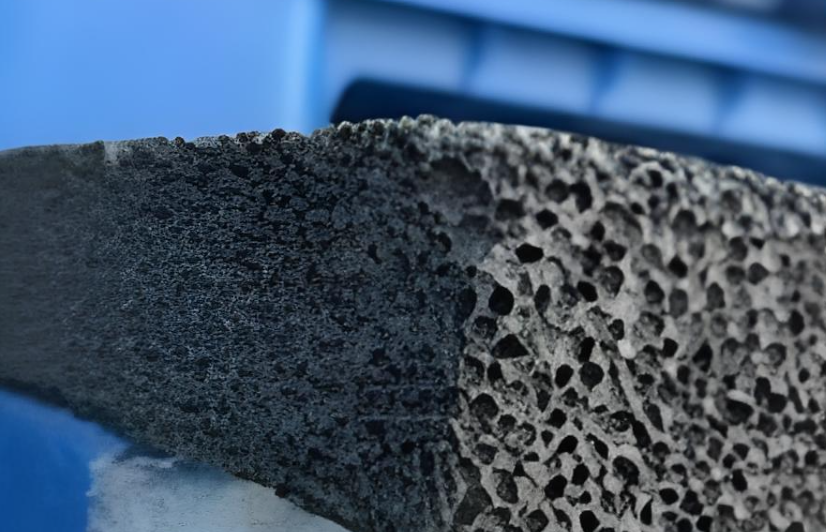
ceramic filters use a simple but effective physical barrier. Water flows through millions of tiny pores in the ceramic material. These pores measure 0.2-0.5 microns. This size traps most bacteria. Water molecules still pass through without trouble.
The filtration happens in stages. Gravity or light pressure pushes water toward the ceramic surface. Particles larger than the pore openings get stuck on the outside layer. This includes bacteria (0.5-5 microns in size), sediment, and visible dirt. Studies show Ceramic filters remove over 99.9% of bacteria. They do this through mechanical blocking.
The system uses cross-flow filtration for better performance. Water moves parallel to the ceramic surface, not straight through. This sideways flow creates movement that sweeps trapped particles away from the pores. Fresh water replaces the filtered portion. Contaminants that build up on the surface get flushed away during cleaning.
No electricity required. Gravity alone provides enough force for most home ceramic systems. The surface gets clogged with particles? Just scrub or backwash the ceramic element. The ceramic material is very durable. It handles repeated cleanings without breaking down. Some industrial ceramic filters use compressed air to blow particles into a collection chamber. This resets the filter so it can keep running.
How Reverse Osmosis Systems Work
Reverse osmosis pushes water through an ultra-fine membrane under pressure. The membrane has pores measuring just 0.0001 microns. That’s far smaller than ceramic filters. Most home systems use thin-film composite polyamide material for this barrier. The tight pore structure blocks 98-99% of unwanted substances. This covers dissolved chemicals, heavy metals, microorganisms, minerals, and salts.
The Pressure-Driven Process
The system needs pressure greater than osmotic pressure to push water molecules through. Ideal feed pressure sits at 60 PSI. You need at least 40 PSI to force water through all stages properly. Below 40 PSI, the system can’t push hard enough. Performance drops. Many homes don’t have enough natural water pressure. A booster pump fixes this by raising pressure to 60 PSI. The flow restrictor keeps membrane pressure steady by limiting how much water exits. This creates the back-pressure you need for proper filtration.
Multi-Stage Filtration Breakdown
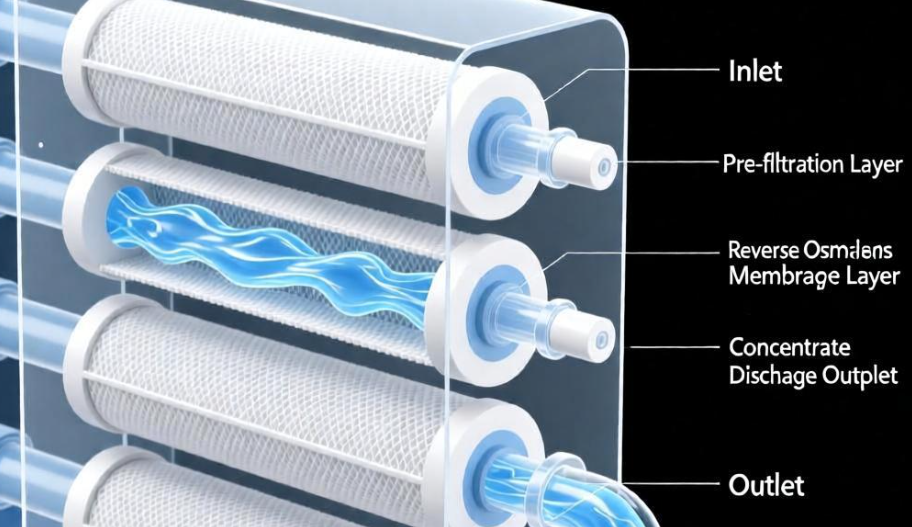
Stage 1 – Sediment Pre-Filter: Water hits a filter with 5-micron pores first. This catches sand, dirt, and rust particles. The pre-filter stops these larger particles from clogging the expensive RO membrane. Replace it every 6 months.
Stage 2 – Carbon Filter: Activated Carbon removes chlorine and organic compounds. Chlorine damages the RO membrane. Carbon also gets rid of bad taste and odor through adsorption. You’ll find either carbon block or granular activated carbon here. This filter lasts 9-12 months.
Stage 3 – RO Membrane: The core filtration happens here. High pressure forces water through the tiny pores. Pure water (permeate) goes to the storage tank. Rejected pollutants flush down the drain as concentrated brine. Modern membranes feature larger active surface areas. Some reach up to 400 square feet per membrane in advanced models like the Toray TMG20D-400. This design boosts flow rates without hurting rejection performance. The membrane usually lasts 2 years.
Stage 4 – Post Carbon Filter: A final carbon polishing filter removes any leftover taste or odor. This gives you clean-tasting water from your faucet.
The system includes a storage tank that holds filtered water. An automatic shut-off valve stops filtration once the tank fills. NSF/ANSI 58 certification confirms the system meets safety and performance standards.
Contaminant Removal Performance Comparison
The numbers tell the real story. Lab tests and field studies show big differences between ceramic filters and reverse osmosis for specific contaminants.
Physical Particle Removal
Reverse osmosis wins at sediment removal. Media filtration systems (which include RO pre-filters) achieve 85% median removal of total suspended solids (TSS). They deliver ~10 mg/L median outflow concentrations—the lowest among all filtration technologies tested.
Ceramic filters operating through gravity match this performance range. They hit 70-85% turbidity reduction depending on design. But here’s the catch: ceramic systems show wider swings. Performance ranges from 19% to 98% based on maintenance frequency and water quality.
RO systems maintain steadier output. Multiple pre-filter stages catch particles before they reach the membrane.
Heavy Metals and Minerals
Iron removal separates good from great. Biosand filters (BSF) remove 73% of iron on average. Ceramic candle filters (CCF) hit 70%. Basic bio-filters (BF) achieve 69%. All three stay above the 65% efficiency threshold.
Maximum efficiency? Ceramic filters reach 99% calcium removal. Biosand hits 93%. Basic filters manage 91%.
Reverse osmosis crushes these numbers—98-99% rejection of dissolved metals including lead, arsenic, chromium-6, and copper. The 0.0001-micron membrane blocks ionic minerals. These minerals slip right through ceramic’s 0.2-0.5 micron pores.
Microorganism Elimination (Log Reduction Values)
Bacteria removal: Both systems score strong here. Slow sand filtration and ultrafiltration achieve 2.6 LRV (log reduction value) for bacteria. That’s 99.7% removal. Granular media filters show 61 data points with similar performance. Reverse osmosis adds 11 bacterial removal data points with high rejection. The 95% confidence interval for bacteria removal across technologies sits at 1.9-3.3 LRV.
Viruses expose ceramic’s weakness. RO systems provide 15 documented data points for virus removal. Ultrafiltration adds 107 data points. Average virus LRV across filtration methods reaches just 2.0—good but not exceptional.
Ceramic filters struggle more because viruses measure 0.02-0.3 microns. Many pass straight through 0.2-micron ceramic pores. RO’s membrane blocks viruses too small for ceramic to catch.
Protozoa removal favors ceramic. These larger parasites (4-15 microns) get trapped by ceramic’s pore size. Granular media shows 146 data points with protozoa LRV of 1.1 (95% CI: 0.5-1.7). That translates to 92% removal at the median. Slow sand filtration adds 65 data points confirming similar performance.
Chemical Pollutants
Organic compounds: Ceramic candle filters remove up to 39% of total organic carbon—better than biosand or basic bio-filters (p≤0.05). But RO systems with activated carbon stages eliminate 95%+ of organic chemicals. This includes pesticides, herbicides, and pharmaceutical residues. The carbon pre-filter absorbs organics. The membrane blocks what carbon misses.
Dissolved salts and fluoride: This is where ceramic fails. Ceramic filters cannot remove dissolved salts, nitrates, or fluoride. These contaminants exist as ions smaller than water molecules.
RO removes up to 99.9% of total dissolved solids. This includes 98% of fluoride and 95-99% of nitrates. For well water with high TDS or municipal water with fluoride, RO delivers full removal.
Water Waste and Environmental Impact
Reverse osmosis systems waste 3-20 gallons of water for every gallon they produce. The membrane rejects dirty water. This rejected brine carries concentrated pollutants straight down your drain. Older RO systems run at 25% efficiency. So 75% of incoming water becomes wastewater. Newer models with permeate pumps reach 50% efficiency. But they still toss half the water.
Ceramic filters waste zero water. Every drop comes out filtered and ready to use. The gravity-fed design skips the drain connection. Nothing gets flushed away.
The math hits your water bill and the planet. A family using 5 gallons of RO water each day wastes 15-25 extra gallons. That’s 5,475 to 9,125 gallons each year. Drought-prone areas face tough choices.
Ceramic filters win on environmental impact. No electricity needed. No wastewater created. The ceramic parts last for years. They wear out slowly. The natural clay breaks down without harm.
RO systems need electricity for booster pumps. Low-pressure homes depend on this. The plastic membrane cartridges pile up in landfills every 2 years. The drain connection puts extra stress on city wastewater treatment.
Your water source shapes this choice. Got heavy contamination with dissolved chemicals? The RO waste might be worth it for cleaner water. Got clean city water with some bacteria? Ceramic’s zero-waste setup makes better sense.
Mineral Retention: Health Implications
Reverse osmosis removes good minerals along with the bad stuff. The membrane can’t tell them apart. Calcium, magnesium, potassium, and trace minerals get filtered out at the same 98-99% rate as lead or arsenic. Your body needs these minerals every day. Losing them from your drinking water makes a real difference.
Calcium helps build strong bones and manage weight. Studies show your body tries to hold onto as much calcium as possible to build bone mass. Not getting enough calcium speeds up weight gain and fat storage. Getting more calcium stops this from happening. Research shows people who consume more calcium have a lower colon cancer risk. Population studies and clinical trials both back this up.
Magnesium runs key body processes. It powers energy production, muscle movement, and cell wall strength. Low magnesium levels link to higher C-reactive protein (CRP) levels—a main sign of body inflammation. Studies prove magnesium supplements bring down CRP levels. Not having enough magnesium raises inflammation signals (IL/TNF) and makes blood cells stick together more. Health experts set the daily amount to stop these issues.
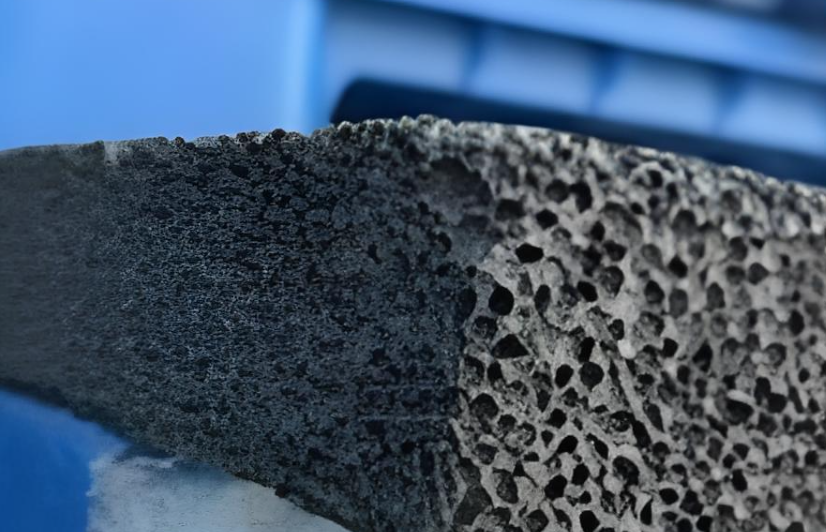
Ceramic filters keep these minerals in your water. The tiny 0.2-0.5 micron holes stop bacteria but let minerals flow through. You get calcium, magnesium, and potassium in every glass. No need to buy extra filters or pills to put back what got taken out.
Some RO users install mineral-adding stages. These filters put minerals back into the cleaned water. They raise your costs, need more upkeep, and give your system one more part that can break down.
Maintenance Requirements and Ease of Use
Ceramic filters need regular cleaning. But you skip the complicated part swaps. Scrub the ceramic element every 2-4 weeks based on your water quality. The process takes 5 minutes. Remove the element. Brush it under running water with a soft pad or cloth. Reinstall it. No tools needed. No technical skills required. The brushing removes trapped dirt and restores flow rate. Got heavy sediment water? Clean it every week. Light contamination? Clean it once a month.
The ceramic element lasts 1-3 years before you replace it. Flow slows down even after cleaning? Time for a new one. Replacement takes 2 minutes—unscrew the old element, screw in the new one. A replacement element costs $30-$60. No plumber required. No special tools. Even kids can handle this basic maintenance.
Reverse osmosis systems need more complex maintenance. You track three different filter types on separate schedules. The sediment pre-filter needs replacement every 6 months. Carbon filters last 9-12 months. The RO membrane gets replaced at 2 years. Miss these deadlines? Performance drops fast. Pre-filters get clogged. This reduces water pressure. Old carbon lets chlorine damage the membrane. Worn membranes let contaminants through.
Each RO filter change means shutting off water valves. You release pressure. You unscrew filter housings. You’ll need a filter wrench and towels for spillage. First-timers take 20-30 minutes per change. Membrane replacement has more steps. The fittings are tighter too. Many homeowners pay $100-$150 for professional help.
Ceramic filters win for day-to-day use. Fill the top chamber. Gravity does the work. No buttons, gauges, or settings to manage. RO systems come with automatic shut-off valves, pressure tanks, and drain connections. These parts can leak. They can break down. The booster pump? That adds electrical problems to fix.
Flow Rate and Water Production Capacity
Reverse osmosis systems make 50-100 gallons per day for typical home units. This fills a 3-4 gallon storage tank in 2-4 hours. The tank keeps filtered water ready at your faucet. Water pressure, temperature, and membrane condition affect production speed. Cold water slows things down—a 77°F drop cuts production by 50%. Household pressure below 40 PSI reduces output too. You’ll need a booster pump to reach the rated capacity.
Ceramic gravity filters give you instant flow without storage tanks. Pour water in the top chamber. Filtered water drips into the bottom chamber at 1-3 liters per hour. This depends on ceramic element condition. A 10-liter system processes a full batch in 3-5 hours. Got a big household drinking 8-10 gallons each day? You’ll refill the ceramic system 3-4 times. This gets tedious fast.
The numbers change with household size. One or two people use about 2-3 gallons each day for drinking and cooking. Ceramic works well for this. Families of four or more need 5-8 gallons each day. RO’s storage tank and continuous production beat ceramic here. You never run out mid-day. The tank refills on its own while you sleep.
Best Use Case Scenarios: Ceramic vs. Reverse Osmosis
Match your water problems to the right filter technology. Contamination type, household size, and budget help you decide between ceramic and reverse osmosis.
Choose Ceramic Filters If You Have:
Municipal water with minimal chemicals. City water meets EPA standards for dissolved solids. You just want to remove chlorine taste, sediment, and bacteria. Ceramic handles this at $250 total over 5 years—far less than RO’s $850-$1,400.
Off-grid living or frequent power outages. The gravity-fed design works anywhere. No electricity needed. No pressure requirements. Camping trips, RVs, and emergency kits benefit most. Fill it and drink within hours.
Small households using 2-3 gallons per day. One or two people don’t need RO’s continuous production. A 10-liter ceramic system covers drinking and cooking without constant refills.
Environmental priorities and water conservation goals. Drought regions like California face restrictions. Ceramic’s zero-waste design saves 5,475-9,125 gallons per year compared to standard RO systems.
Desire to keep beneficial minerals. You want calcium, magnesium, and potassium in your water. Ceramic keeps these while removing physical threats. No remineralization cartridges needed.
Choose Reverse Osmosis If You Face:
Well water with high total dissolved solids (TDS). Got readings above 500 ppm? RO removes 98-99% of dissolved salts, minerals, and metals. Ceramic can’t handle these.
Heavy metal contamination. Lead, arsenic, chromium-6, or mercury in test results? RO is what you need. The 0.0001-micron membrane blocks ionic metals that slip through ceramic’s larger pores. Nevada homes cut arsenic by 79% average with RO treatment.
Fluoride or nitrate reduction needs. Municipal water adds fluoride. Farm runoff brings nitrates. RO eliminates 98% of fluoride and 95-99% of nitrates. Ceramic leaves both alone.
Large families needing 5-8+ gallons per day. The 50-100 gallon per day production capacity plus storage tank handles high demand. You never wait for the next batch. The system refills on its own overnight.
Virus removal in questionable water sources. Viruses measure 0.02-0.3 microns. That’s small enough to pass through ceramic. RO’s membrane catches what ceramic misses. This matters for compromised private wells or travel situations.
Pharmaceutical and chemical pollutant concerns. Prescription drugs, pesticides, and herbicides dissolve in water. RO’s Activated carbon stages plus membrane achieve 95%+ removal of organic chemicals. Ceramic’s 39% total organic carbon reduction doesn’t compare.
Hybrid Solutions: Combining Both Technologies
Some homes use both systems together. A ceramic pre-filter catches dirt and bacteria before water reaches the RO membrane. Your membrane lasts 6-12 months longer than normal. The ceramic part stops particles that would clog the RO system fast. This means less maintenance. Plus, you save $50-$80 on early membrane swaps.
You can also add a mineral cartridge after the RO stage. The RO membrane takes out everything first—dirt and minerals together. The mineral filter then puts back calcium and magnesium. You get 99% clean water with healthy minerals. The mineral cartridge costs $100-$150 more at the start. You’ll spend $30-$50 each year to replace it.
The downside? More moving parts. You’re managing two different filter systems instead of one. More parts can break. Setup gets harder. Price goes up too—plan for $250-$400 more than basic RO systems.
This works well in certain cases. Got well water with lots of dirt plus arsenic? The ceramic filter grabs the visible stuff. RO handles the chemical nasties. Want RO’s deep clean but need minerals? The mineral stage fixes both. If not, just pick one system that fits your main water problem.
Decision-Making Checklist: Factors to Consider Before Buying
Go through these practical checks before you commit to ceramic or reverse osmosis. Your answers show which system fits your real needs—not just marketing claims.
Test Your Water First
Order a $20-$40 home water test kit or pay $100-$200 for lab analysis. Get hard numbers on TDS levels, heavy metals, bacteria counts, and chemical contaminants. TDS below 300 ppm with no arsenic or fluoride? Ceramic handles it. TDS above 500 ppm or heavy metal detection? RO is necessary, not optional.
Check Your Home’s Water Pressure
RO systems need 40-60 PSI minimum. Test your pressure with a $10 gauge at any outdoor faucet. Below 40 PSI? Budget an extra $150-$300 for a booster pump. Add $20-$40 per year in electricity too. Ceramic runs on gravity. Zero pressure requirements.
Evaluate Environmental Priorities
RO wastes 5,475-9,125 gallons per year in most homes. Living in California, Arizona, or Nevada where droughts hit hard? That waste conflicts with water restrictions. It goes against conservation goals too. Ceramic creates zero waste. This design fits environmental values and local regulations.
Review Health and Mineral Preferences
Want to keep calcium, magnesium, and potassium in your water? Ceramic keeps these minerals. Studies link enough calcium to lower colon cancer risk and healthy weight. Magnesium brings down C-reactive protein inflammation markers. RO strips all minerals. You’ll need a $100-$150 remineralization cartridge. Then budget $30-$50 per year for replacements to add them back.
Conclusion
You don’t need to pick just one between ceramic filters and reverse osmosis. Your best Water Purification choice depends on your specific needs. Consider your budget, what contaminants you face, household size, and environmental values.
The “better” system matches your actual contamination issues, budget, and values. ceramic filtration, reverse osmosis, or a hybrid setup – any can work. Take action now for cleaner, safer water. Your next step is simple: test your water, then choose what fits.