Search how many types of aluminium casting there are and you’ll get a different answer every time. One source says four. Another says seven. A foundry textbook counts twelve.
That gap isn’t random. Casting methods get classified, combined, and named differently across industries. So the numbers shift depending on who you ask.
The real question isn’t which number is “correct.” It’s understanding what separates each method — where it works best, and where it breaks down.
Each process makes a different set of trade-offs. High-pressure die casting is fast and high-volume. Lost-wax casting delivers tight, jeweller-level precision. Neither is universally better.
Know those trade-offs, and picking the right method becomes a clear decision — not a guess.

The Direct Answer: How Many Types Exist (And Why Sources Disagree)
Three. Seven. Twelve. Foundry guides, engineering handbooks, and manufacturing blogs don’t agree — and that gap isn’t random. It’s built into how each source defines the subject.
Here’s why the numbers differ:
Classification scope drives everything. A metallurgy textbook counts core process families. A manufacturing consultant counts every commercial variant. A procurement guide counts whatever shows up on a purchase order.
Same industry. Three different answers.
Most sources fall into one of two camps:
-
Narrow classification — 3 to 4 fundamental methods (die casting, sand casting, investment casting, permanent mould)
-
Broad classification — 8 to 15 types, once gravity variants, low-pressure methods, and hybrid processes each get their own entry
Neither camp is wrong. They’re just answering different questions.
The narrow view asks: how does the metal fill the mould? The broad view asks: what does the process look like on a real production floor?
Knowing that difference clears up the confusion. It also makes every comparison you run after this one far easier to follow.
High-Pressure Die Casting (HPDC) — The Industry Workhorse
About half the aluminium parts you’ve touched today were made this way.
HPDC leads volume manufacturing for one simple reason: it turns molten metal into a finished, near-net-shape part in under a minute. Two hardened steel die halves — a cover die and an ejector die — clamp together under forces up to 4,000 tons. Molten aluminium gets forced into the cavity at 10,000–20,000 psi. The metal fills every corner of the die in a fraction of a second. It solidifies. Ejector pins push the part out. The cycle resets.
That’s it. Thousands of times over. With almost no human involvement.
What the Numbers Mean
Speed and pressure aren’t just selling points — they change the material itself. Fast solidification tightens the grain structure. That makes the final part both stronger and harder. Parts come out with tight dimensional tolerances and surfaces smooth enough that most need no machining at all.
The cost structure makes sense once you see the volume. Tooling costs a lot upfront. But once the die exists, per-part cost drops fast — and keeps dropping as volume goes up.
|
Method |
Pressure |
Cycle Time |
Consistency |
|---|---|---|---|
|
HPDC |
10,000–20,000 psi |
Seconds |
High — tight tolerances |
|
Low-Pressure Die Casting |
<100 psi |
1–3 minutes |
Moderate to High |
Where It Works — And Where It Doesn’t
The automotive industry runs on HPDC. Engine blocks, transmission cases, structural housings — all common outputs. Tesla pushed the process further than most thought possible. Giant HPDC machines cast entire front and rear body sections of the Model Y as single components. That replaced up to 70–100 individual parts in one shot.
Aerospace, electronics, and consumer equipment follow the same pattern. You need precision geometry, thin walls, and consistent output at scale. HPDC delivers all three.
But HPDC has hard limits.
-
Thick-walled sections trap gas during solidification. This creates porosity — a real structural risk in load-bearing parts.
-
Low-volume runs don’t justify the tooling investment.
-
Prototypes almost never make financial sense here.
The process has also split into variants worth knowing:
Vacuum HPDC held 55.67% of 2025 revenue. It pulls trapped gases out before injection, cutting porosity below 2%. That makes it a solid choice for heat-treatable alloys and battery enclosures.
Squeeze HPDC targets fatigue-critical parts like suspension knuckles. It carries a forecasted growth rate of 7.74% CAGR.
Conventional HPDC covers everything else.
HPDC isn’t the right answer for every project. But for high-volume production where consistency, surface quality, and per-part cost all matter — nothing else comes close.
Low-Pressure Die Casting (LPDC) — Controlled Fill for Complex Parts
Flip HPDC upside down — and you start to understand LPDC.
LPDC doesn’t inject metal downward at extreme pressure. Instead, it sits a pressurized furnace beneath the die. Compressed gas — 0.3 to 1.5 bar — pushes molten aluminium up through a riser tube and into the cavity above. Slow. Steady. Controlled.
That’s the whole game here: control.
Why Slow Fill Changes Everything
Turbulence is the enemy of structural integrity. HPDC’s high-velocity injection traps air, creates oxide films, and leaves porosity behind. That porosity weakens the finished part. LPDC cuts that problem at the source.
Metal rises from the bottom. No slag inclusions. No splashing. No chaotic flow chasing itself through the cavity. The pressure holds steady during solidification. It keeps feeding the part as it shrinks. The result is a dense, uniform grain structure with far fewer internal defects.
That grain structure matters a great deal for what comes next. LPDC works with heat-treatable alloys like A356 and AlSi7Mg. Those alloys respond well to T6 treatment. After treatment, the mechanical properties push into a range that competes with forged components.
The numbers back this up:
|
Metric |
LPDC |
HPDC |
|---|---|---|
|
Porosity |
Low (pressure-fed) |
Higher (turbulent fill) |
|
Mechanical Strength |
Superior — T6-treatable |
Good, but defect-prone |
|
Cycle Speed |
Slower |
Faster |
|
Complex Thin Walls |
Handles well |
Limited by turbulence |
Where LPDC Runs in Practice
Automotive wheels. Suspension arms. Steering knuckles. Subframes. These aren’t decorative parts. They’re load-bearing, fatigue-critical components. A hidden void in any of them means a failure in the field. LPDC’s low-porosity output and high repeatability make it the go-to choice — structural integrity isn’t optional here.
AlSi7Mg0.3 steering knuckles are a clear example. They serve as a real replacement for steel. Low shrinkage porosity. Dense walls throughout.
Outside of automotive, you’ll find LPDC in wind turbine housings, motor enclosures, industrial pumps, and compressor bodies. These applications need strong, lightweight parts. They can also tolerate a slower cycle time.
The Trade-Off You Have to Accept
LPDC doesn’t match HPDC’s throughput. Cycle times run longer. Volume ceilings sit lower. Producing millions of non-structural brackets? HPDC wins on cost every time.
Your part carries a load. It needs T6 treatment. It can’t have internal defects. In that case, LPDC earns its place on the production floor — no argument needed.
Permanent Mold (Gravity Die) Casting — The Balance Point
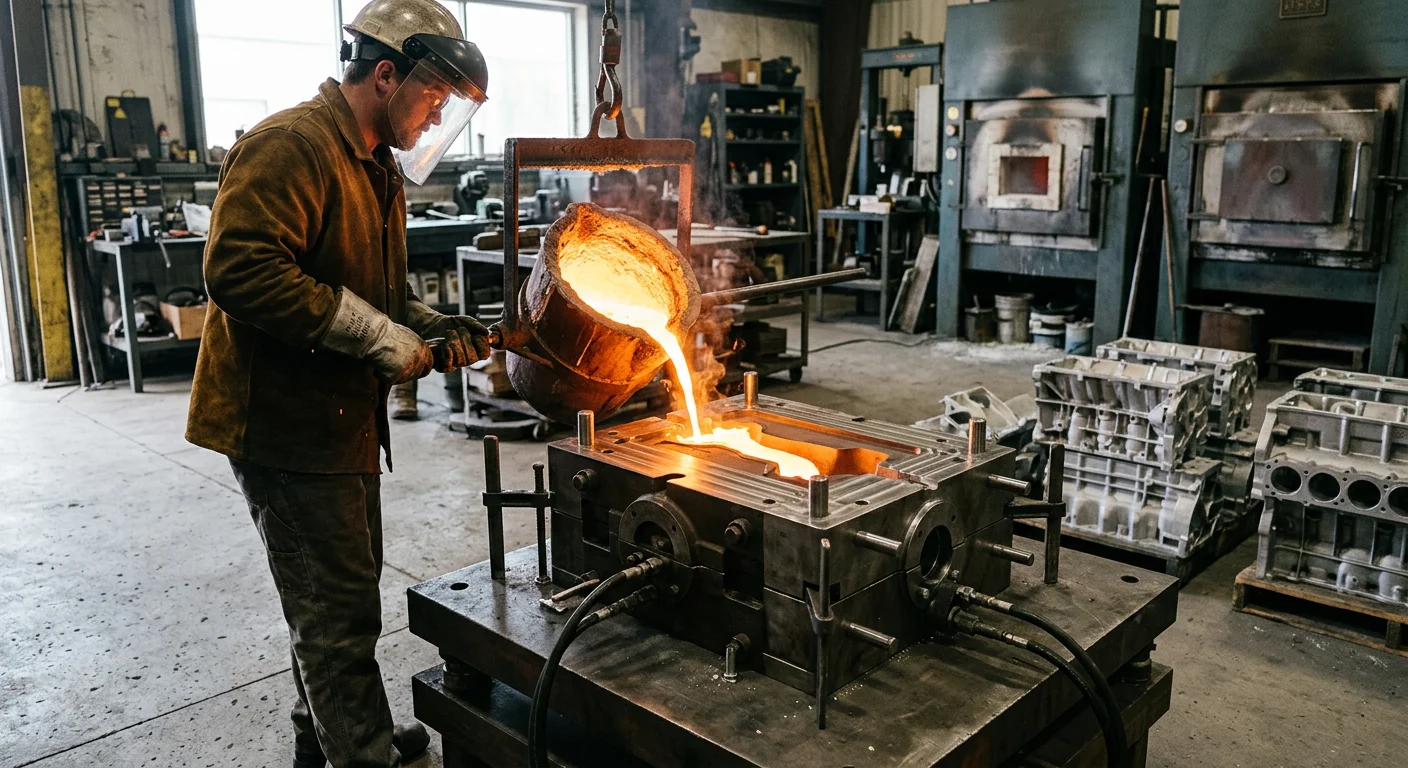
Gravity does the work here. No pressure injection. No compressed gas pushing metal upward through a riser tube. Molten aluminium pours into a precision-machined steel or cast iron mold. It fills by its own weight. Nothing more.
That simplicity is the point.
Where It Sits in the Process Family
Permanent mold casting sits between sand casting and HPDC. That middle position is what makes it useful.
|
Aspect |
vs. Sand Casting |
vs. HPDC |
|---|---|---|
|
Cost |
Higher tooling, lower per-unit at medium volume |
Far lower initial investment |
|
Quality |
Finer grain, lower porosity, tighter tolerances |
Less precise, but better directional solidification |
|
Speed |
Faster cycle, cleaner output |
Slower throughput |
Porosity holds at ≤1%. Tolerances reach ±0.1mm. The mold preheats to 200–300°C. Workers coat it with a graphite or ceramic release agent. It runs 100,000+ cycles before thermal fatigue becomes a concern.
Where It Makes Sense
Medium-volume runs. Parts under 40 kg. Jobs that need a clean surface finish without HPDC’s tooling cost.
Think automotive wheels, engine components, aerospace fittings, and heat sinks. A356 and LM25 are the go-to alloys. Both handle the rapid cooling that permanent mold delivers. Fast solidification tightens the dendritic microstructure. That tightening raises tensile and fatigue strength.
Minimum wall thickness is 3mm. Non-ferrous alloys are the limit — nothing with a melting point above aluminium’s 660°C.
It won’t beat HPDC on volume. It won’t beat sand casting on upfront cost. But for medium runs where part quality is a real priority, it holds its ground well.
Sand Casting — Maximum Flexibility, Minimum Tooling Cost
The tooling bill tells the whole story. A sand casting pattern runs $500 to $5,000. A die casting tool costs $15,000 to $50,000. That gap is the entire business case for sand casting.
Under 1,000 to 5,000 units, sand casting wins on cost. Every time. The mold material — wood, resin, or aluminium alloy — costs a fraction of heat-treated steel. Pattern creation takes fewer labor hours. No high-pressure injection requirement means a low-cost mold still delivers solid per-unit economy across hundreds or thousands of parts.
Flexibility That Moves Projects Forward
Engineering changes happen. Sand casting absorbs them without scrapping expensive tooling. Adjust the sand core design. Modify the geometry. Fix porosity-prone areas before they cause field failures. No expensive die goes to waste. No six-week wait on a new tool.
That flexibility carries over to geometry too. Internal cavities, undercuts, complex structures stretching more than a meter across the floor — sand casting handles all of it. You can also combine separate components into a single casting. That cuts downstream assembly costs in one move. One real-world consolidation delivered a 40% weight reduction and a 25% drop in production cost. Lead time dropped from several weeks to just 10 working days.
The Trade-Offs Worth Knowing
Sand casting is not precision work. Surface finish runs Ra 250–500. That’s rougher than investment casting’s Ra 63–125, and rougher still than die casting. Dimensional tolerance sits at around ±0.030 inch. Typical machining allowances range from 0.100 to 0.500 inches.
Most sand castings go through secondary CNC machining. That’s expected — not a problem. The smart move: machine the critical features, leave everything else as-cast. It’s faster than starting from billet. Cheaper too.
Minimum order quantity starts at 20 to 50 pieces — or lower, depending on the foundry. Maximum part size is limited by the foundry floor, not the process itself. For prototypes, low-volume complex parts, or anything too large to justify a steel die, sand casting isn’t the fallback option. It’s the right call.
Investment Casting (Lost-Wax) — Precision for Complex Geometry
Wax goes in. A perfect metal part comes out. That gap in between is why aerospace engineers and surgeons trust this process with parts that cannot fail.
The steps are straightforward. Inject wax into a pattern. Dip it in ceramic slurry. Let it harden. Burn the wax out. Pour molten aluminium into the cavity left behind. Break the shell. What you get is geometry no other casting method can produce with this level of control.
What “Precision” Means Here
The numbers are specific: ±0.010″ on the first inch, ±0.005″ on every additional inch. Surface finish lands at 125 μin — half the roughness of sand casting’s 250 μin. Dimensional accuracy runs five times better than sand.
That precision is not just cosmetic. You get 90° walls with no draft angles. Thin walls down to 0.015 inches. Undercuts, blind holes, internal passages — features other methods cannot form, or need expensive assemblies to copy.
Micro-venting (0.2 mm diameter channels in blind holes) cuts defect rates by over 90%. A small detail with a big impact.
Where It Earns Its Premium
Investment casting dominates three areas: aerospace turbine components, medical implants, and defense hardware. The common thread is not the industry — it is consequence. These are parts where a single internal defect causes a real failure.
The upfront cost is higher than sand casting. But complex internal passages remove extra assembly steps downstream. Near-net-shape output cuts machining time by a solid margin. For complex geometry at low-to-medium volume, the premium pays for itself fast.
Lost Foam Casting — Near-Net-Shape Without Tooling Complexity
No die to machine. No ceramic shell to build up layer by layer. Just a block of expanded polystyrene foam, a CNC machine, and a mold that vanishes the moment metal touches it.
That’s lost foam casting at its core — and the cost benefits flow straight from that simplicity.
CNC machines cut EPS foam patterns (density 1.0–1.5 lbs/cu.ft.) from stock blocks. The patterns match final part geometry — gating systems included. For complex assemblies, multiple pieces bond together with adhesive. You get interior channels, blind holes, as-cast threads, and zero-draft geometries — all in one foam structure. Features like these would need expensive cores or multi-part setups in sand casting. Here, they go straight into the foam.
Pour molten aluminium in. The foam vaporizes. Metal fills the void. What comes out is near-net-shape — no flash, no parting lines, no draft angles shifting the geometry away from what the designer intended.
What the Economics Look Like
The savings are specific and worth a close look:
|
Metric |
Reduction vs. Traditional Methods |
|---|---|
|
Production Cost |
20–25% lower |
|
Energy |
25–30% reduction |
|
Labor |
46% productivity gain |
|
Material Waste |
7% less used |
Design changes move fast. No tooling gets scrapped when geometry shifts. The dry sand is recyclable. Setup times stay short. So across the full production cycle, costs stay lean in multiple places at once.
Where It Breaks Down
Lost foam has its limits. Foam patterns are fragile — handling damage is a real risk. Porosity runs higher than investment casting. Ultra-thin walls aren’t a good fit here.
This process works best on:
– Complex, thicker automotive components
– Pump housings
– Aerospace brackets
It’s not the right choice for precision miniature work. The strengths are real, but so are the boundaries. Knowing both helps you decide if lost foam casting fits your application.
Shell Mold Casting — Sand Casting’s Faster, Cleaner Cousin
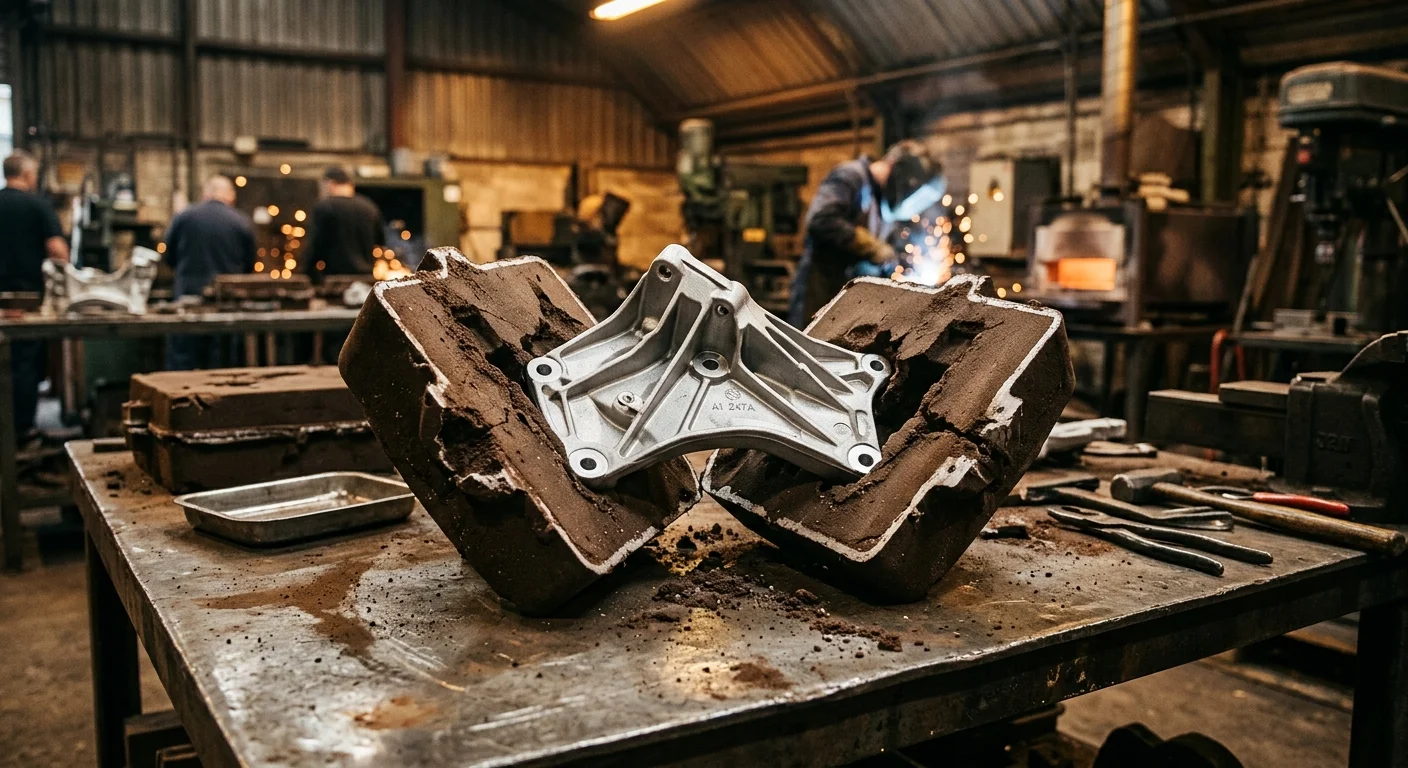
Thin shell. Better part. That’s the whole idea.
Shell mold casting coats fine silica sand — fineness 100+, compared to green sand’s 60–80 — with phenolic resin. That coated sand presses against a heated metal pattern. It cures into a rigid, lightweight shell. Pour aluminium in. The shell cools fast. Small parts solidify in 1–5 minutes. Break the brittle shell with vibration or mechanical shock. The part drops out.
What You Gain Over Green Sand
The numbers say it clearly:
|
Aspect |
Shell Mold |
Green Sand |
|---|---|---|
|
Surface Finish |
Ra 1.6–6.3 µm |
Ra 6.3–25 µm |
|
Tolerances |
±0.25–0.5 mm (CT7–CT9) |
±0.8–3.0 mm (CT10–CT13) |
|
Draft Angles |
1° — or zero on short walls |
2°–3° |
|
Porosity |
Low (100–200 perm units) |
Higher, variable |
Tighter tolerances mean less machining after casting. Less machining means lower finishing costs. Metal patterns run 100,000+ cycles before wearing out. So per-part costs fall at medium-to-high volumes — the more you run, the more you save.
Where It Fits
Shell mold casting works best in a clear range:
-
Precision parts under 50 lbs
-
Thin walls down to 2–3 mm
-
Complex geometry with undercuts
Automotive suspension components, aerospace brackets, heat-treated aluminium alloys — these are its home ground. It handles tight specs that green sand simply can’t match.
It won’t replace sand casting for large, heavy sections like engine blocks. Flat parts can swell. Very large runs still favor green sand on upfront tooling cost.
For medium-to-high volume work where surface quality and dimensional consistency matter, shell mold casting earns its place — and its premium.
Squeeze Casting & Semi-Solid Casting — High-Integrity Emerging Methods
Near-zero porosity. Wrought-like tensile strength. Heat-treatable microstructure. These aren’t marketing claims — they’re what pressure does during solidification, not just at injection.
That’s what sets squeeze casting and semi-solid casting (SSM) apart from every other aluminium casting method.
Squeeze casting pours liquid metal into a die, then holds 50–150 MPa of pressure through the full solidification window. That pressure keeps feeding the part as it shrinks. It wipes out the microporosity that standard HPDC leaves behind. The result: secondary dendrite arm spacings far smaller — by an order of magnitude — than you get from sand or permanent mould castings.
Semi-solid casting takes a different approach. The metal enters the die at 50% solid — a thick, paste-like slurry that flows without turbulence. Rheocasting, thixocasting, and thixomolding each handle that slurry in their own way. The outcome stays consistent across all three: near-zero porosity, faster cycles than squeeze casting, and die life that outlasts conventional HPDC.
|
Method |
Porosity |
Heat-Treatable |
Cycle Speed |
|---|---|---|---|
|
Squeeze Casting |
Low |
Yes |
Slow |
|
Rheocasting |
Near zero |
Yes |
Moderate |
|
HPDC |
High |
Limited |
Fast |
The mechanical properties sit closer to forgings than castings. You get better elongation and higher fatigue resistance. Structural automotive and aerospace parts — components that would normally need forging or heavy machining — become practical cast outputs instead.
Adoption is still limited. Equipment costs match or exceed HPDC. Real-time injection control adds process complexity. But for high-value structural parts where defects have real consequences, these methods aren’t just interesting experiments — they’re the logical next step.
Centrifugal Casting — Rotation-Driven Density and Purity
Spin molten metal fast enough, and physics does the purifying for you.
The mold rotates during the pour. Centrifugal force builds up to 100 times gravity. That force sorts everything by density. Heavier metal pushes outward to the mold wall. Oxides, gas pockets, and non-metallic inclusions move inward toward the bore. Solidification locks that separation in place. Impurities end up concentrated at the inner diameter. One machining pass clears them out.
What’s left is dense, uniform, and clean — something gravity-fed methods can’t match.
What the Process Produces
Centrifugal casting is built for cylindrical and tubular geometry — pipes, rings, sleeves, bushings. You can achieve thin walls down to 2.5 mm with a low defect risk. Solidification runs outward to inward — outer diameter first, bore last. This gives you a fine, uniform grain structure with no cavities, no shrinkage porosity, and no trapped gas.
Yields reach up to 100%. No gates. No runners. No wasted metal sitting in the feed system.
The limits are real, though. Complex internal geometry and small internal diameters don’t work here. Vertical casting produces parabolic inner walls that need machining back to a true cylinder. For anything outside a rotational form, a different casting method is the right call.
How to Choose the Right Aluminium Casting Method
Four variables decide everything: production volume, part complexity, surface finish, and budget. Write those four numbers down before you talk to a single foundry.
Here’s how they map to real decisions:
-
Under 1,000 units, moderate finish, tight budget → Sand casting. Tooling runs $1,000–$10,000. Geometry is flexible. No trade-offs to argue about.
-
1,000–10,000 units, higher complexity, better accuracy needed → Permanent mold or investment casting. Tooling is reusable. Tolerances are tighter than sand can deliver.
-
Above 10,000 units, thin walls, ±0.1mm tolerances → HPDC. Tooling costs are steep ($50,000–$500,000+), but per-unit cost drops to $1–5 at scale.
Where Most Buyers Go Wrong
The mistakes follow a pattern. Someone runs HPDC at 3,000 units and wonders why the numbers stopped making sense. Someone else picks sand casting for a part that needs ±0.5mm — then burns the savings on machining corrections.
Die casting doesn’t pay for itself below 50,000 units. Investment casting gets expensive fast at volume. These aren’t rare edge cases. They’re the most common selection errors in aluminium procurement. Buyers hit them over and over because the math gets skipped.
A Simple Decision Sequence
-
Lock your specs first — volume, wall thickness, tolerance, surface finish (Ra 3.2μm?)
-
Run the crossover math — tooling plus (volume × per-unit cost). Sand-to-die crossover lands around 5,000–10,000 units for most parts
-
Check your timeline — need a prototype inside four weeks? Sand casting is your realistic option. Nothing else moves that fast at low cost
-
Match the alloy — alloy 383 handles standard die casting well at low cost
-
Consider a hybrid path — sand prototype first, die production after. That’s not a compromise. It’s smart sequencing that saves money early and scales cleanly later
The right method isn’t the most impressive one on the spec sheet. It’s the one that hits your cost target, meets your tolerance, and ships on time.
Conclusion
Nine methods. One material. Very different outcomes.
That’s the honest answer to how many types of aluminium casting there are. But here’s the more useful answer: the number doesn’t matter as much as knowing which one fits your part, your volume, and your budget.
High-pressure die casting dominates mass production. Sand casting keeps prototypes affordable. Investment casting handles the geometry that other methods won’t touch. Each process exists for a reason. No single method wins every situation — and manufacturers who understand that make better parts at lower cost than those who don’t.
So don’t walk away with just a list. Walk away with a decision framework.
Scoping a new component? Map your requirements against the nine methods covered here before you call a supplier. That one step separates informed buyers from costly mistakes.
The right casting method isn’t the most popular one. It’s the one built for your problem.