Quality filtration separates precision castings from expensive defects. It protects workers from breathing hazards. It keeps you compliant with environmental rules instead of facing shutdowns.
Hundreds of filtration providers claim they know metal casting. But foundry managers need suppliers who get it—the heat, the molten metal, the particle-heavy air. That’s the real challenge.
I’ve analyzed the top 10 filtration companies in the foundry industry. My criteria: tech innovation, proven track record, and how they perform in real iron, steel, and aluminum operations.
You might be upgrading old dust collection systems. Or sourcing ceramic foam filters for cleaner pours. Maybe you need complete air quality solutions. This breakdown gives you the facts to make smart decisions. Your profit margins and operations depend on it.
Introduction to Filtration in the Foundry Industry
The global industrial filtration market shows clear numbers: USD 39.86 billion in 2024, set to reach USD 59.23 billion by 2033. That’s a 4.5% CAGR. Foundries now take contamination control far more serious than before.
Here’s the shocking part: less than 8% of the world’s 11 million tonnes of annual steel casting production gets filtered right. Over 10 million tonnes of molten metal flows into molds without good particle removal. That’s a huge quality gap.
The business case is clear. One foundry tracked their numbers. They had a 2.1% reject rate on 63,000 castings using standard 10ppi zirconia foam Filters. They switched to better 15ppi filters. Reject rate dropped to 0.5%. Just 400 rejected parts instead of thousands.
North America leads the glass fiber foundry filter market with 40% global share. The region has strict air pollution rules. Foundries must invest in good filtration systems. You either comply or close.
Three core materials drive the market. Aluminum filtering fiberglass mesh leads in market share. It traps impurities before they ruin your castings. High silica fiberglass mesh for iron grows fastest. Extreme heat resistance matters at 1,500°C. zirconia foam Filters deliver that big reject-rate drop I mentioned.
The automotive and aerospace sectors push hard for filtration upgrades. They need zero-defect castings. No compromises.
Criteria for Selecting Top Filtration Companies
Not all filtration suppliers know foundry operations. I’ve watched purchasing managers burn budget on systems that quit within months. Why? The vendor never dealt with 1,500°C molten metal or silica-heavy dust clouds.
Technical specs come first. Micron rating tells you what your filter catches. Beach sand particles range from 0.3 to 60 microns. Dust mites hit 100-300 microns. Ground coffee sits around 400 microns. Foundry dust? You get everything from sub-micron silica to 200-micron sand particles. A 25-micron filter catches more than a 50-micron one. But it clogs faster. Production halts while you swap filters. Pick wrong and you damage your whole system.
Flow rate needs to match your output. High-capacity shops need gear that handles peak loads. No bottlenecks. Here’s the problem: higher flow rates cut retention efficiency. Your metal pours come out less clean. Check the medium’s max flow rate. Ask suppliers how their system scales as you grow.
Filter lifespan hits your profit. Filters that last longer mean fewer maintenance stops. Less downtime. Lower labor costs for swaps.
Material compatibility splits the pros from beginners. Foundries need rust-resistant materials like stainless steel. Your filters take extreme heat, rough particles, and chemical exposure. A vendor pushing standard materials? They don’t get your business.
Top 10 Filtration Companies Specializing in the Foundry Industry
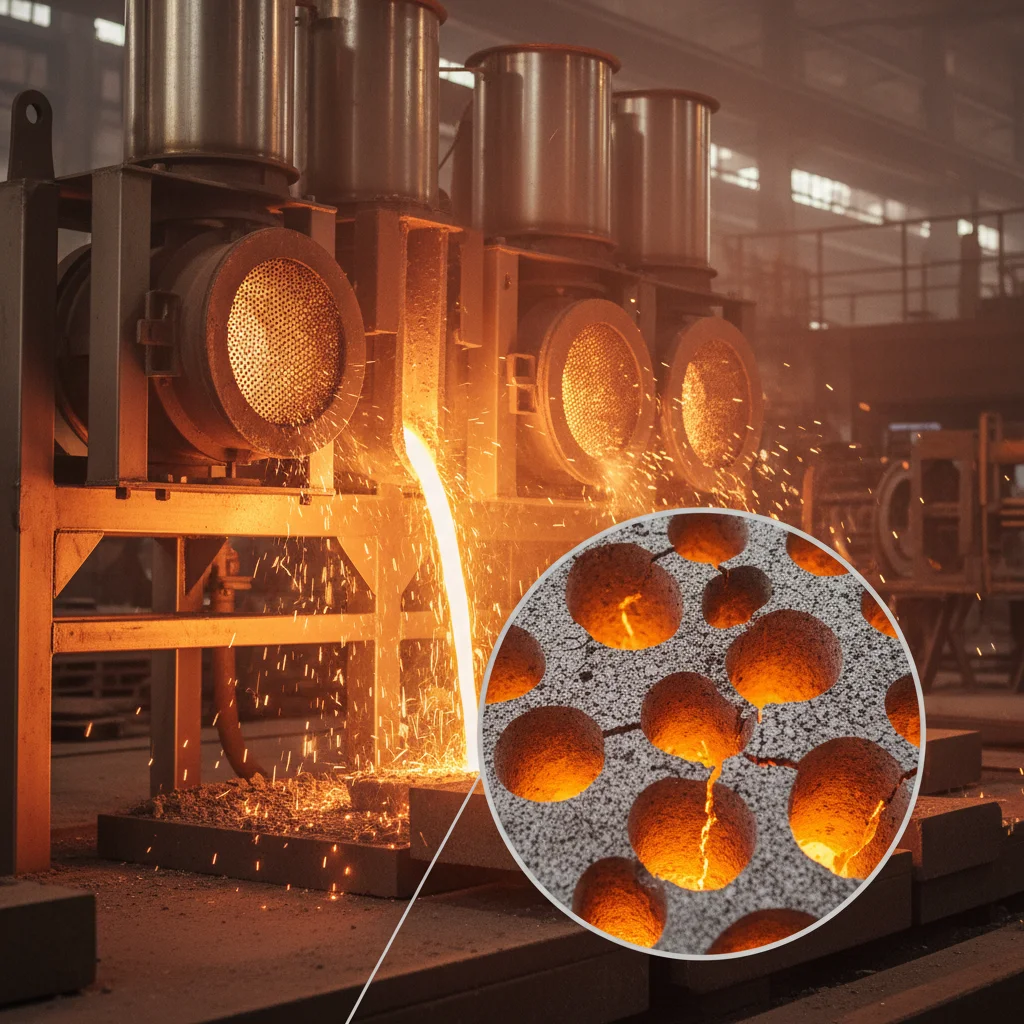
These ten suppliers earned their spots through proven foundry performance. Not marketing claims.
FOSECO (Vesuvius)
FOSECO dominates ferrous Metal Filtration worldwide. Their SEDEX series—SEDEX, SUPER SEDEX, and SEDEX ULTRA—targets grey and Ductile Iron operations.
The numbers tell the story. Their flow analysis shows 4.5 kg/s flow rates with 24-second fill times. Standard vertical filter prints handle 0.75 kg/s entry velocity. Switch to reduced inlet designs. You get 0.94 kg/s—a 25% jump. Those reduced inlets manage 23 kg versus 18 kg in other sections.
Add their slag trap feature. You gain 0.23 kg casting weight. Plus cleaner flow profiles.
DISAMATIC high-pressure molding lines run their 10-30 PPI filters. STELEX PrO carbon-Aluminum oxide filters handle large Ductile Iron castings. STELEX ZR ULTRA uses zirconia-based technology. Friability drops 70-80% compared to standard filters.
Field testing proves it works. One operation tested 400 castings. Reject rates fell from 2.1% to 0.5%. The baseline from 63,000 castings using standard 10 PPI filters sat at 2.8-3.1%.
FOSECO integrates with ESI ProCAST software for simulation. Their product range covers carbon-bonded alumina, SiC, zirconia, and graphite filters. They use additive manufacturing for custom pore shapes.
Here’s the market reality: less than 8% of global steel casting tonnage uses filtration. That’s 10 million tonnes flowing unfiltered.
Donaldson Company
Donaldson hit $3.7 billion in sales for fiscal year 2025. Record numbers. This Minneapolis filtration company runs 140 locations across 44 countries. They’ve spent 110 years perfecting air and Liquid filtration for industry.
Their Industrial Filtration Solutions segment grew 10.5% in Q4 2025. Foundries drive that growth. Metal casting shops need dust collectors that handle extreme particles. Donaldson builds systems for silica-heavy air and hot zones.
Operating margin reached 16.4%—a company record. They held this while dealing with tariff pressure and inventory costs. Gross margin sat at 34.8%, down 140 basis points from tariffs. But here’s what matters: they still beat analyst forecasts. Q4 sales hit $981 million against a $951.57 million estimate.
Strong finances show up in shareholder returns. Donaldson bought back $465 million in shares (4% of outstanding stock). They raised dividends 11% for the 30th consecutive year. Cash conversion rate: 123%. You don’t see those numbers from companies that just talk innovation.
Their R&D budget funds real solutions. Not marketing fluff. Foundry managers get dust collection systems built for metal particle loads that destroy standard gear. Cartridge filters swap out fast during high-volume runs. Air handling systems meet strict EPA standards.
Parker Hannifin
Parker Hannifin closed fiscal 2025 with $19.9 billion in sales. That’s Fortune 250 territory. This Cleveland company makes motion and control tech. They run filtration operations from aerospace to heavy manufacturing. Foundries get industrial systems built to last.
Net income jumped 24% to $3.5 billion in fiscal 2025. Adjusted earnings per share hit a record $27.33—up 7% year-over-year. These aren’t marketing numbers. Cash flow from operations reached $3.8 billion, a 12% increase. That’s 19% of total sales. Strong cash conversion lets them invest in R&D. No burning money on debt service.
Q1 fiscal 2026 shows faster momentum. Sales hit a record $5.1 billion. Adjusted EPS growth: 16% year-over-year. Operating margin expanded to 27.4% adjusted—a 170 basis point jump. All business segments delivered positive organic growth for the first time in two years. Orders climbed 8% versus prior year.
Their filtration systems handle hydraulic equipment and tough industrial setups. Foundries run high-pressure molding lines. They need gear that won’t quit under heat stress. Parker’s segment operating margin of 26.1% adjusted (120 basis point improvement) proves they run tight operations. A supplier maintains those margins while growing? You get reliability plus innovation.
Parker projects $21.26 billion revenue for 2026. Full-year EPS guidance sits at $30—a 10% bump from earlier forecasts. Their balance sheet stays clean. Net debt to adjusted EBITDA sits at 1.8x. That’s below their 2.0x target.
FoundryMax
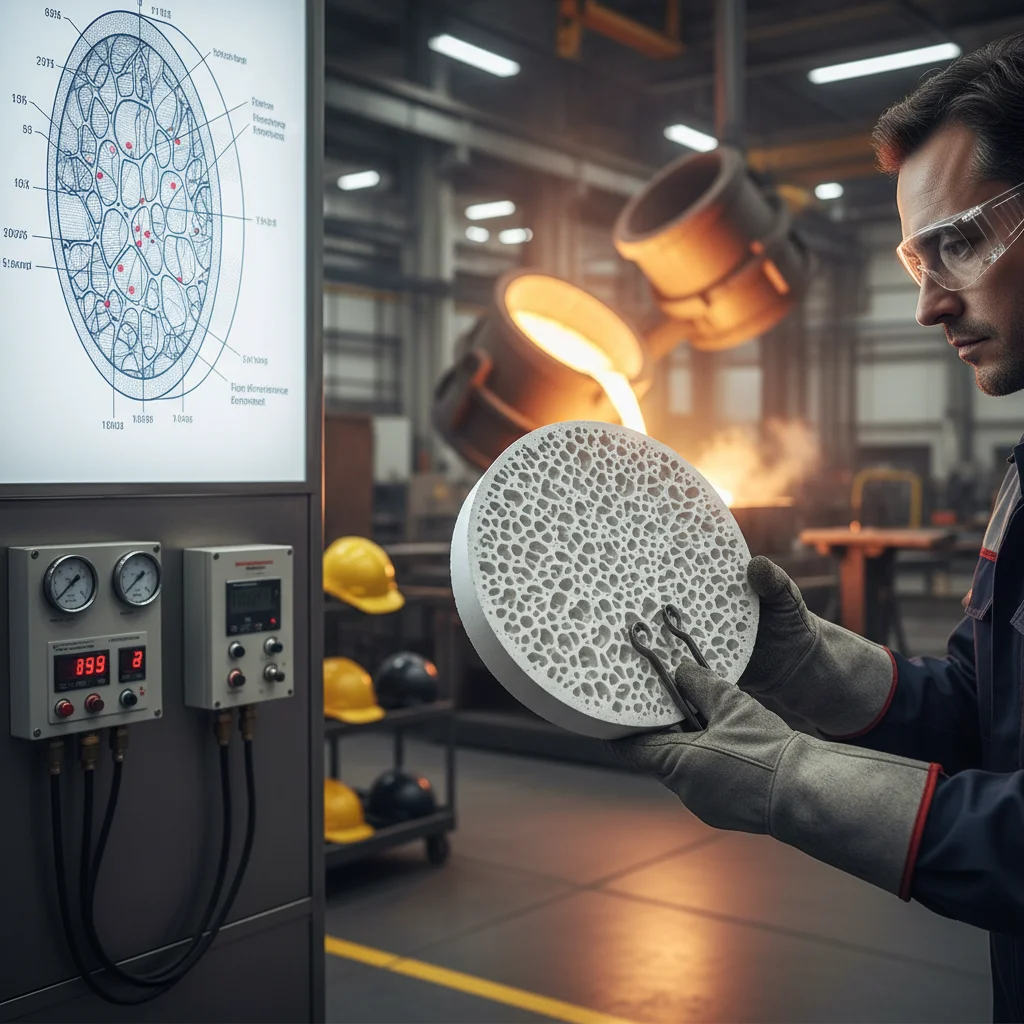
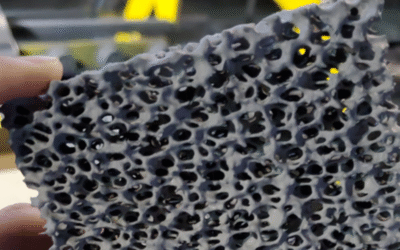
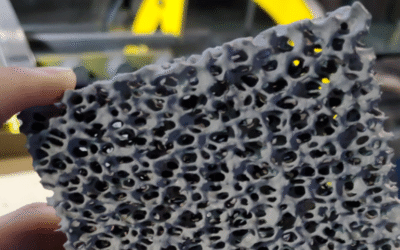
FoundryMax makes Ceramic foam filters. They solve one clear problem: removing inclusions from molten metal before they ruin your castings. Their filtration lines hit 95% inclusion removal efficiency across different filter types. That’s what counts for reject rates.
Particle capture starts at 10-50μm. The ultra-fine specs catch tiny inclusions that standard filters miss. Sand particles range from 0.3 to 60 microns. Coffee grounds sit around 400 microns. FoundryMax targets the sub-50 micron range. That’s where casting defects hide.
Their Ceramic honeycomb structures connect to Industry 4.0 platforms. You get energy tracking through built-in systems. Here’s the smart part: adaptive airflow adjustment based on actual pollution levels. Most dust collectors run full power all the time. That wastes energy even when your shop floor doesn’t need it. FoundryMax adjusts flow to match real-time conditions.
This helps operations running tight margins. Full-power dust collection costs money every hour. Adaptive systems cut energy waste. You still get clean air. Workers stay safe. Plus, your utility bill drops.
The Ceramic foam tech handles iron casting operations. Temperature and particle loads destroy weaker materials in these conditions. High silica content and extreme heat need filtration gear built for foundry work.
Mann+Hummel
This German family business is 84 years old. They run 80+ locations across six continents. They don’t just talk filtration—they engineer it from scratch. MANN+HUMMEL builds their own Filter Media in-house. They control the materials that touch your molten metal systems.
€4.5 billion in 2024 sales proves their scale. Currency shifts dropped the numbers from €4.7 billion in 2023. Adjust for exchange rates? Sales grew 1.2%. EBIT margin sits at 5.1% with €230.1 million operating profit. These aren’t huge margins. This is manufacturing reality. But look at their spending: €128.3 million went straight to R&D.
That R&D budget pays off. They filed 70+ new patents in 2024 alone. They created cellulose-based test filters. These cut CO₂ output by over 50%. A dedicated R&D unit now focuses just on filter media. For foundries, this is critical. Better materials create filters that handle extreme heat cycles. They don’t break down mid-pour.
Their SPEED operating model runs six-month cycles. Strategy, Performance, Execution, Excellence Drive—now in year three. Digital tools speed up product creation. Custom industrial filtration solutions reach market faster. Foundries get modular systems built for tough conditions. These work in places where standard equipment quits.
Pall Corporation
Pall Corporation brings in $2.9 billion in annual revenue. They run filtration operations for foundries, semiconductors, and aerospace. Founded in 1946, this Port Washington company works under Danaher Corporation now. They have between 5,000-10,000 people working globally. Revenue per employee? $559,000—that’s strong output.
Q3 sales hit $681.1 million. Flat year-over-year in reported currency. Adjust for exchange rates? 11% growth in local currency. Take out acquisitions and organic growth still climbs 9%. Their 2014 EBITDA was $583.19 million on $2.79 billion revenue. Those aren’t startup margins. This is mature, profitable manufacturing.
They opened a $150 million facility in Singapore (June 2024). The plant creates up to 300 jobs. It focuses on semiconductor filtration demand. Foundries benefit too. The same particle-removal tech that cleans microelectronics works for molten metal systems.
Midstream oil and gas filtration shows their range. That market grows from $2.80 billion (2025) to $3.73 billion by 2030—a 5.9% CAGR. Pall builds high-efficiency coalescers and particulate filters. They remove contaminants in tough industrial conditions. Their vertical integration? They control quality from raw materials to final product.
Foundries need aerospace-grade precision? Pall delivers systems proven in extreme environments.
Cummins Filtration
Cummins Filtration grabbed 4.2% of the industrial air filtration market in 2024. That put them ahead of the pack. The market itself hit $6.7 billion in 2024 and climbed to $7 billion in 2025. Projections show $10.6 billion by 2034—a solid 4.7% CAGR through that period.
Here’s the leadership picture: Cummins Filtration, Mann+Hummel, Camfil, Parker Hannifin, and Filtration Group together controlled 12% market share in 2024. Cummins held the biggest piece.
Asia Pacific drove the biggest regional demand at $2.3 billion in 2024. Growth there runs 5.3% CAGR to 2034. Europe followed with $1.7 billion (4.2% CAGR). The US made up 77% of North America’s market at $1.6 billion. Middle East and Africa came in at $274.3 million with slower 3.4% growth.
Chemical and petrochemical sectors made up 27% of the total market. That segment grows 5.2% each year through 2034. Indirect sales channels show even faster growth at 5.7% CAGR for the same period.
Then came the big shift. Cummins Inc. sold its Filtration business on March 18, 2024. The unit became Atmus Filtration Technologies. Cummins lost that division but still pulled $34.1 billion in 2024 revenue. Flat year-over-year, but strong given the sale.
The parent company posted record numbers. GAAP net income hit $3.9 billion (11.6% of sales). EBITDA reached $6.3 billion (18.6% margin). Earnings per share landed at $28.37. Adjusted EBITDA came in at $5.4 billion (15.7% of sales), up from $5.2 billion and 15.3% in 2023.
Foundries used Cummins systems before the split. They got industrial air filters tested in chemical plants and heavy factories. After the sale? Atmus carries that tech forward. They’re now a standalone filter company.
SEFU CERAMIC

SEFU makes vacuum-formed ceramic fiber products for foundry heat management. They shape these into sampling spoons, tap-out cones, and riser tubes. Send them your drawings. They’ll build what you need.
You get three temperature grades for different casting jobs. Standard grade works at 1150°C. High Aluminium grade goes to 1260°C. Zirconium grade maxes out at 1450°C. Each grade shrinks ≤ -3% during long heat exposure. This means they stay stable under heat stress.
Bulk density sits at 300-450 kg/m³ across their vacuum-formed line. At 400°C, heat conductivity runs 0.110-0.120 W/m·K for standard material. High Aluminium version? Similar: 0.105-0.125 W/m·K. Less conductivity equals better insulation. Heat stays put.
Their zirconia ceramic foam filters work for carbon steel, alloy steel, and stainless steel casting. 10 PPI density traps impurities during pours. FOB pricing starts at $1.659 per piece (500-9,999 units). Buy 300,000+ pieces? Price drops to $1.571.
Ceramic pouring cups use high alumina silicate. They handle 1650°C operating temps. Flexural strength tops 10 MPa. Thermal expansion runs 8-9 × 10⁻⁶ /°C. This controlled expansion stops cracks during fast temperature swings.
Freudenberg Filtration Technologies
Freudenberg Filtration Technologies is part of the larger Freudenberg Group. The group brought in €11.9 billion in sales for 2023. That’s a 1.3% jump from the year before. The filtration unit runs two main brands: Viledon and micronAir. You’ll find these brands in foundries, cleanrooms, and process plants around the globe.
They make HVAC filters, gas turbine intake systems, and car cabin air filters. Foundries care most about the pre-filtration systems. Metal casting shops face heavy particle loads. They need strong air quality systems. Freudenberg supplies pharma companies, chip makers, and chemical plants. These fields need precise filtration. The same gear works for foundry dust control.
The industrial filtration market reached $36.03 billion in 2024. Forecasts point to $53.81 billion by 2033—a 4.6% growth rate over that span. Freudenberg goes head-to-head with Donaldson (13.4% market share), 3M, Mann+Hummel, and Parker Hannifin. Where do they stand? They’re a solid mid-tier player. German engineering gives them weight.
They own units in Germany (Weinheim) and Australia (Braeside). Both are 100% owned. The 2021 WACC was 7.3%, shared with Freudenberg Sealing Technologies. Indoor air quality and gear protection fuel their main business. Process safety counts in foundries. Workers breathe metal dust through entire shifts.
Eaton Corporation
Eaton closed 2025 with $27.4 billion in sales—a company record. That’s 10% growth over 2024. Break it down: 8% came from organic growth, 2% from acquisitions. They handle power management for data centers, utilities, and heavy manufacturing. Foundries with big hydraulic systems or electrical setups rely on their gear.
Segment margins hit 24.5% for the full year. That’s up 50 basis points from 2024. Another record. Adjusted earnings per share reached $12.07, a 12% jump year-over-year. These aren’t empty promises. Operating cash flow in Q4 alone hit $2.0 billion—up 23% from Q4 2024. Free cash flow landed at $1.6 billion, a 17% increase.
Their Electrical Americas segment pulled $3.5 billion in Q4 sales, growing 21% with 15% organic growth. Operating profit reached $1.0 billion at 29.8% margins. The Electrical Global unit brought in $1.7 billion (up 10%) with operating profit of $340 million. Margins there expanded 200 basis points to 19.7%.
Foundries rely on Eaton’s hydraulic filtration systems. These systems clean dirty fluids in high-pressure molding lines and casting gear. Their power distribution equipment keeps things running. Electrical systems can’t go down. Book-to-bill ratio sits at 1.1 with backlog up 16% versus December 2024. Strong demand ahead.
Conclusion
Picking the right filtration partner goes beyond checking boxes on a spec sheet. You need quality and efficiency to keep your foundry ahead of competitors. The top 10 filtration companies in foundry industry we’ve covered here each offer unique strengths. Asian Foundry filters brings specialized ceramic solutions. Donaldson provides global engineering support. Parker Hannifin delivers innovative filtration tech.
Here’s what counts most: Match your casting needs with a company’s technical know-how. Check their track record in your metal type. Technical support matters—especially at 2 AM before a major pour.
Your next move? Shortlist 2-3 companies from this list that fit your production needs. Request sample filters or case studies from similar jobs. Run a pilot test before you commit to a long-term deal. The right filtration system does more than remove impurities. It becomes your silent partner in delivering perfect castings, batch after batch. Your foundry’s reputation depends on it.