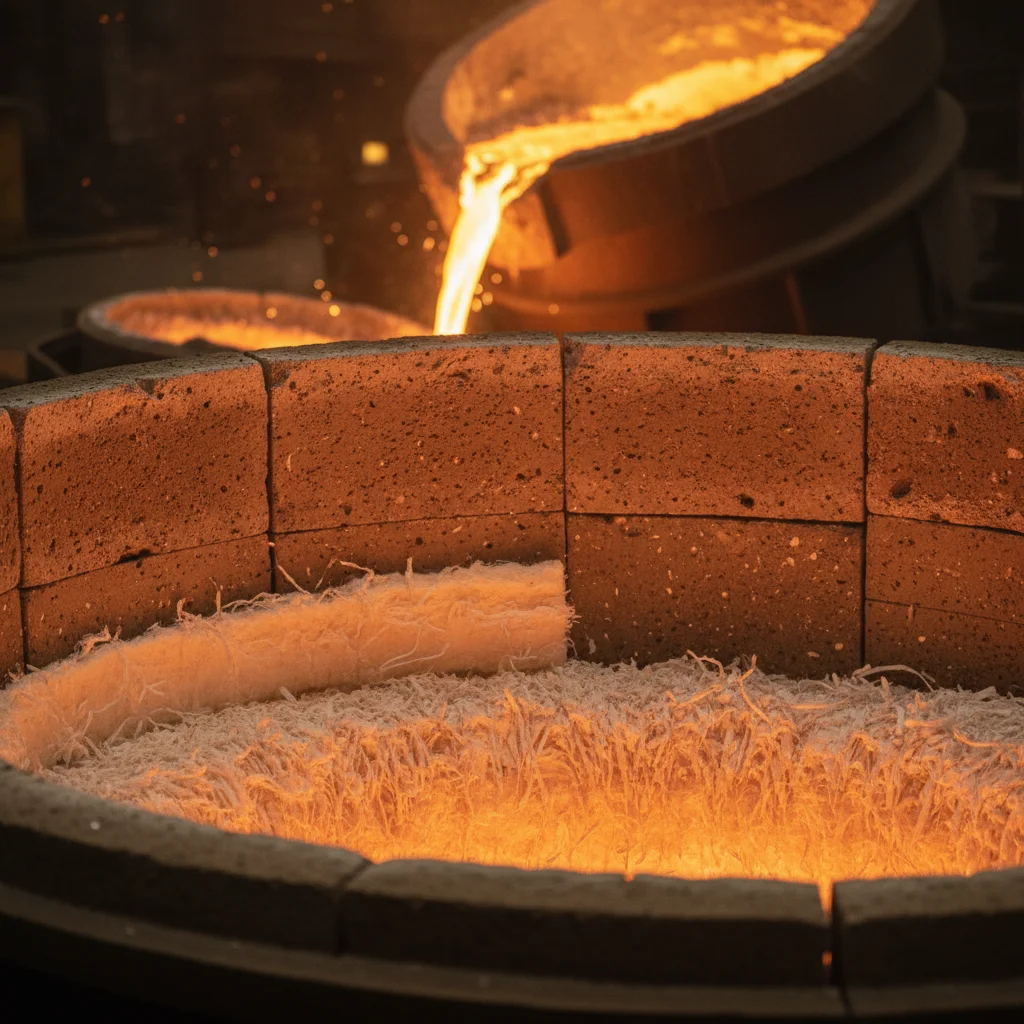
Every furnace fights a constant battle between extreme heat and the materials containing it. Choose the wrong refractory? Physics wins. Your furnace turns into very expensive scrap metal.
You might run an industrial kiln at 1,800°C. Or maybe you operate a steel-making giant that handles temperatures hot enough to vaporize most materials. Either way, knowing what Refractory materials work in furnaces matters. This knowledge separates smooth operations from catastrophic failure.
Fireclay bricks have done their job since ancient Mesopotamia. Zirconia refractories cost more per kilogram than a good lunch. The right choice depends on several factors: temperature, chemical environment, thermal shock resistance, and your budget.
This guide breaks down the major options. You’ll learn about shaped bricks, ceramic fibers, monolithic castables, and specialized high-performance materials. Match the perfect refractory to your specific furnace application. No PhD in materials science required (though it helps).
Fireclay Bricks (Shaped Refractories)
Fireclay bricks are the Honda Civic of refractories—not flashy, but reliable every single day. These shaped blocks contain 18–50% alumina (Al₂O₃) mixed with 50–80% silica (SiO₂), plus a tiny dash of iron oxide around 2–3%. That ratio makes a big difference.
Low-duty fireclay sits at 18–30% alumina. Standard grades (SK-32 to SK-34) climb to 30–42%. High-duty fireclay (SK-36) hits 50% alumina. This gives you better performance. It also costs more.
Temperature capabilities separate the grades. All fireclay bricks share a minimum PCE (pyrometric cone equivalent) of 19. This means they resist warping up to 1649–1665°C. Super-duty versions reach PCE ≥33. Maximum operating temperature? 1690–1730°C. Softening happens between 1300–1400°C.
Physics gets interesting here. Under load (0.2 MPa), different grades act in different ways:
-
SK-32: Holds until 1250–1300°C
-
SK-34: Maintains integrity to 1330–1350°C
-
SK-36: Performs at 1450°C
Bulk density ranges 1.9–2.4 g/cm³. It climbs as alumina content increases. Porosity sits at 19–26%. Lower porosity means denser, stronger bricks. Cold crushing strength varies a lot: SK-32 manages 20–25 MPa, while SK-36 reaches 45 MPa.
Manufacturing starts with pulverizing flint clay, kaolin, and calcined clays in dry pan mills. Then you press the mixture with hydraulic force. Vacuum-forming creates better bricks. You get improved slag resistance and lower gas penetration.
High Alumina Bricks
Alumina content matters most. Get your refractory brick past 50% Al₂O₃, and you’re in high alumina territory. The physics shift.
Grades run from 55% to 85% alumina. Each percentage jump gives you better temperature resistance and stronger structure. A 55% brick handles 1750°C. An 85% brick reaches 1830°C. That 80-degree gap means your furnace keeps running instead of melting down.
Here’s what the numbers show:
-
60% grade: Holds up under load at 1420°C, works up to 1500°C
-
70% grade: Load resistance hits 1460°C
-
75% grade: Takes loads up to 1520°C
-
85% grade: Goes to 1550°C under 0.2 MPa pressure
Bulk density goes up with alumina percentage—from 2.3 g/cm³ at 60% to 2.8 g/cm³ at 85%. Cold crushing strength follows the same path. A 60% brick crushes at 50-80 MPa. An 85% brick holds over 70 MPa minimum.
Manufacturing uses high-grade bauxite clinker. We fire it in rotary kilns. Iron oxide stays under 2.6%. Less is better. Anti-spalling types use zirconium materials for thermal shock resistance.
Standard size matches fireclay bricks: 9″ × 4.5″ × 3″ rectangles are most common. Side tapers, knife shapes, wedges, and arch feet work for special uses.
Chemical stability tops fireclay across the board. Potassium, sodium, sulfur, chlorine, and alkaline salts don’t affect these bricks much. Clinker erosion? Alkali damage? High alumina resists them both.
Different grades fit different uses. 60% alumina works in cement kilns and ladles. 70% fits tunnel kilns where you need corrosion resistance. 75-85% grades go in blast furnaces and glass tanks above 1500°C.
Magnesite and Magnesite-Chrome Refractories
Magnesia melts at 2,800°C. That’s hotter than the surface of most planets you’d want to visit. This material doesn’t mess around.
Magnesite refractories pack over 90% magnesium oxide (MgO). Natural dead-burned versions hit 90%. High-purity synthetic grades climb to 96%. The main crystal structure? Periclase. Larger periclase crystals resist slag better. Electro-melting makes them bigger.
Service temperature reaches 2,000°C or higher. Glass furnaces run them at 1,750°C every day. Under load (0.2 MPa), standard grades hold until 1540–1550°C. High-performance versions work up to 1620–1700°C.
Physical properties show strength. Cold crushing strength hits 49–58.8 MPa. Porosity stays below 18–20%. Heat moves through fast—great for rapid heat transfer. Linear change after reheating (1650°C for 2 hours) stays under 0.6%.
The chemistry gets interesting. Magnesia absorbs huge amounts of iron oxide. Refractoriness stays intact. Works in oxidizing atmospheres. Works in reducing atmospheres. Basic slags? It handles them. Lime, iron-rich environments, alkali attack? Magnesia takes them all.
Steel production uses these the most:
– Basic open-hearth furnace bottoms and walls
– Electric arc furnace sub-hearth bricks
– Oxygen converter linings
– Ladle linings
– Continuous casting slide gates and nozzles
Also works in cement rotary kilns, glass tank checkers, and non-ferrous metal smelting furnaces.
Chrome-Magnesite Combinations
Blend magnesia with chrome. You get neutral refractories with combined benefits. Refractoriness under load: 1580–1600°C. Cold crushing strength drops to 25–35 MPa. That’s lower than pure magnesia. But thermal shock resistance improves a lot.
Magnesia-alumina spinel refractories (78–90% Al₂O₃ + MgO) serve ladle linings. Bulk density: 2.65–2.95 g/cm³. Crushing strength at 110°C? Just 25–30 MPa. Fire them to 1600°C for 3 hours. Strength doubles to 50 MPa.
Refractory Ceramic Fibers
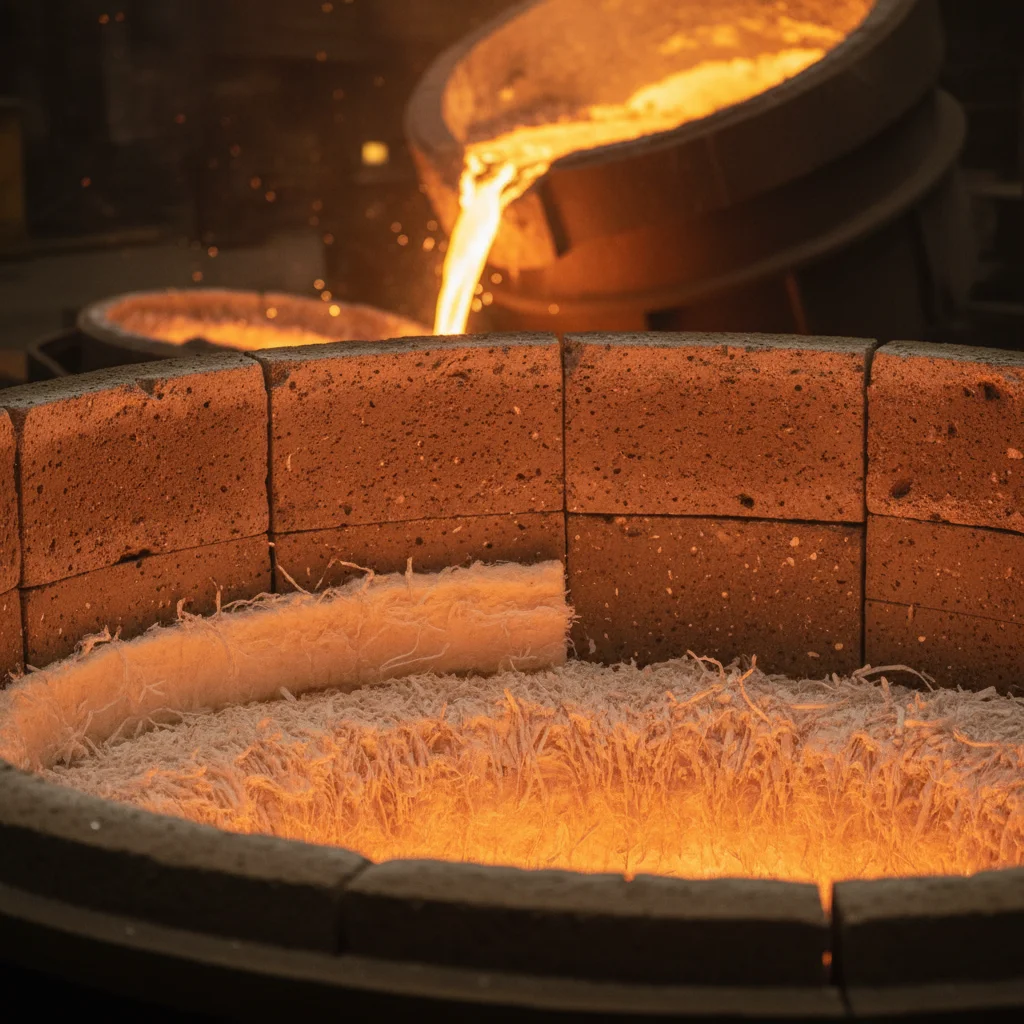
Ceramic fibers weigh almost nothing. They handle temperatures that would turn steel into pudding. A blanket of this material gives you the same insulation as a brick wall 20% heavier.
Temperature ratings work like a ladder. Type 1260 works up to 1260°C. Type 1400 pushes to 1400°C. Spun fiber blankets reach 1450°C. The top grades? 3000°F versions hit 1650°C. That’s hot enough to melt most of what’s in your pocket right now.
Thermal conductivity stays super low. Energy flows through ceramic fiber like molasses through a snow bank. Your furnace holds heat inside. It doesn’t broadcast heat to the air around it.
Each form fits a specific job:
-
Blankets (1050–1450°C): No binders. Pure spun fiber. Wrap them around pipes. Stuff them in ducts. Layer them for backup insulation.
-
Boards: Rigid panels with 20% higher compressive strength than standard boards at the same density. Hot face linings need this backbone.
-
Ropes: Round, square, twisted. We reinforce them with glass filament or stainless steel wire. Perfect for gaskets and seals.
-
Modules: Needled blankets shaped into furnace-ready chunks.
-
Tape, paper, cloth: Seals, wraps, and casting washers built for 2300°F work.
Processing and heat treatment facilities use 40% of all ceramic fiber production. Steel takes another 25%. Quick repairs? Pump coatings into cracks. Stiffening compounds stop fiber from wearing away in hot gas streams.
Installation takes less time. Energy loss drops. Maintenance lasts longer.
Monolithic Refractories (Castables and Mortars)
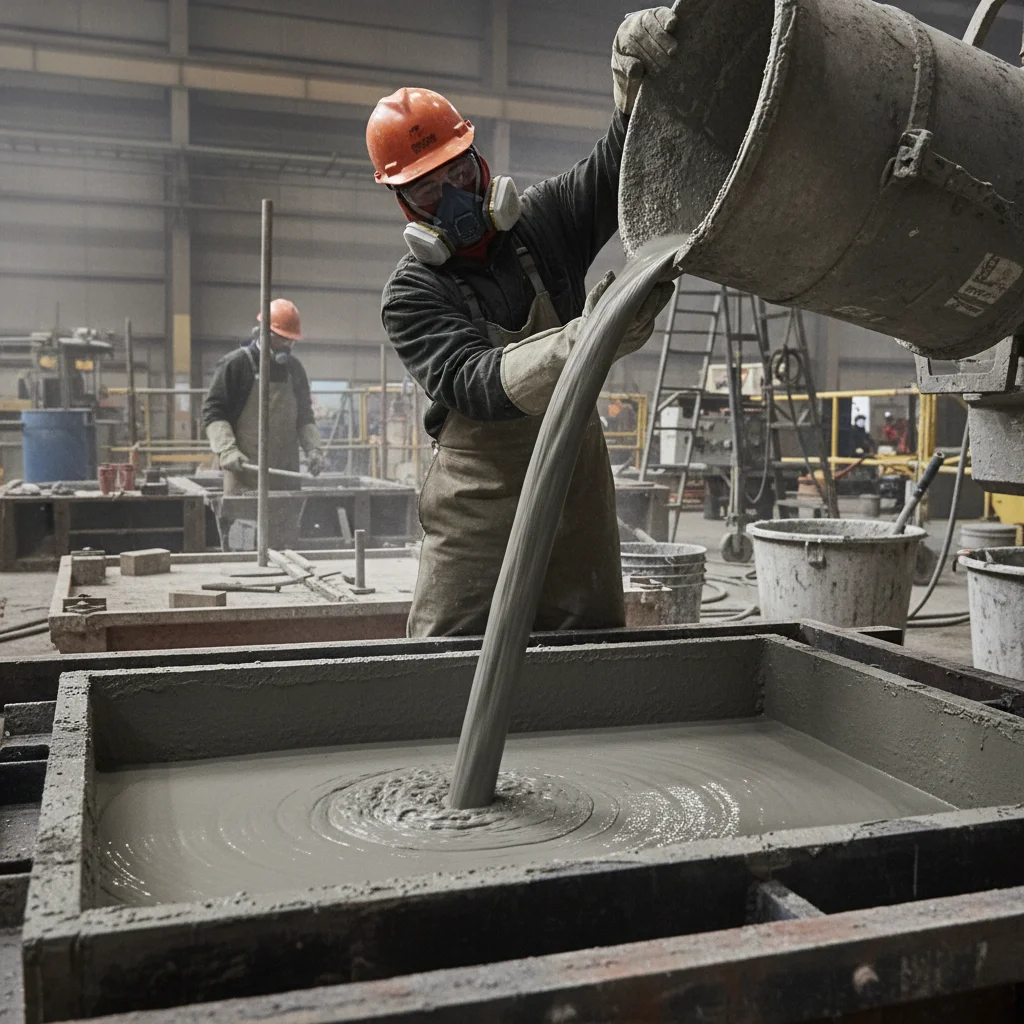
Pour liquid rock into your furnace. Wait for it to harden. Now you have a lining with zero weak joints.
Castables skip the whole “stacking bricks” thing. You mix powdered heat-resistant materials with binders and water. Then you pour, pump, or gun the mixture where you need it. The result? One solid piece of heat-resistant material. No mortar joints. No gaps where slag sneaks through.
Cement content sets the type. Standard castables pack 15–30% cement binder. Low cement (LCC) versions drop to 3–10%. Ultra-low cement (ULCC) goes under 3%. Medium castables (MCC) sit at 5–15%. MCC gives you better strength at low temps. Plus, it’s easier to work with than LCC. Free-flow castables need less water. They also skip vibration.
The recipe matters. Aggregates make up the bulk: alumina, silica, magnesia. High alumina castables reach 90% Al₂O₃. Binders hold it together. Think high alumina cement, aluminas that absorb water, and silica in liquid form. Additives tune the performance. Microsilica boosts density. Stainless steel fibers handle heat shock. Flow agents make the mix run smoother.
A typical 55% alumina castable shows what these materials can do. Bulk density hits 2,300 kg/m³ minimum. Cold crushing strength after drying (110°C for 24 hours)? 35 MPa minimum. Fire it to 1,000°C for three hours. Strength climbs to 40 MPa. Heat shock resistance survives 30 cycles. That means water quenching from 900°C. Top service temp reaches 1,710°C.
Kaocrete HPM 85 pushes even harder. It’s 82% alumina. Rated to 3,100°F (1,700°C). It resists wear from hot furnace materials scraping past.
Installation goes step by step. Weigh raw materials. Mix them in the right amounts. Add water. Pour or pump the mixture. Vibrate in 300 mm layers. Space vibrator insertions 250 mm apart. Keep casting without stops. Need to stop? Make joints at anchor centerlines. But do this if you go past the initial set time.
Curing depends on binder type. Cement-bonded castables need plastic sheeting or straw cover. This stops fast water loss. Chemical-bonded versions need no cover. Final dryout pulls out moisture. It also makes the bond stronger.
The benefits pile up fast. No joints means no weak spots. Slag resistance goes up. Heat stays in better. Install speed beats brick work by miles. You pour, trowel, gun, or vibrate. No need to lay each brick with care. Labor costs drop. Got complex shapes? Pour what you need.
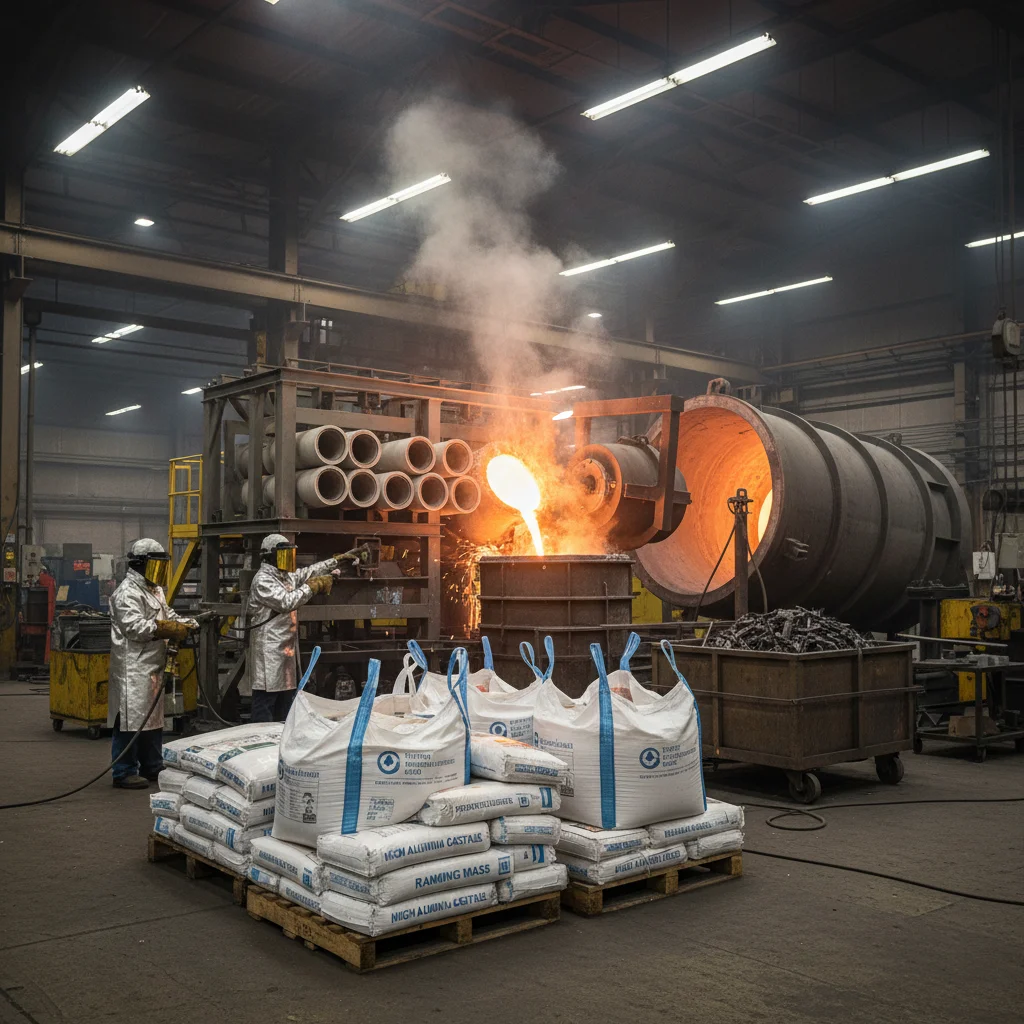
Projects run big. One recent job used 400 metric tons of high alumina materials. That covered castable, ramming mass, mortar, and low-cement types. All met ASTM C-401 Class B standards. These standards cover materials that don’t dissolve in water and handle high heat.
Ceramic Filters
Molten metal carries junk. Slag bits. Oxide chunks. Ceramic pieces from old furnace linings. All this trash flows toward your final product unless something stops it.
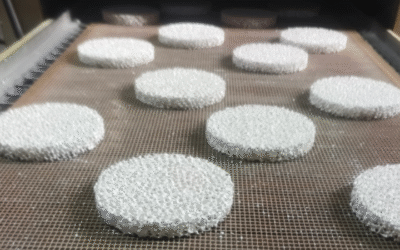
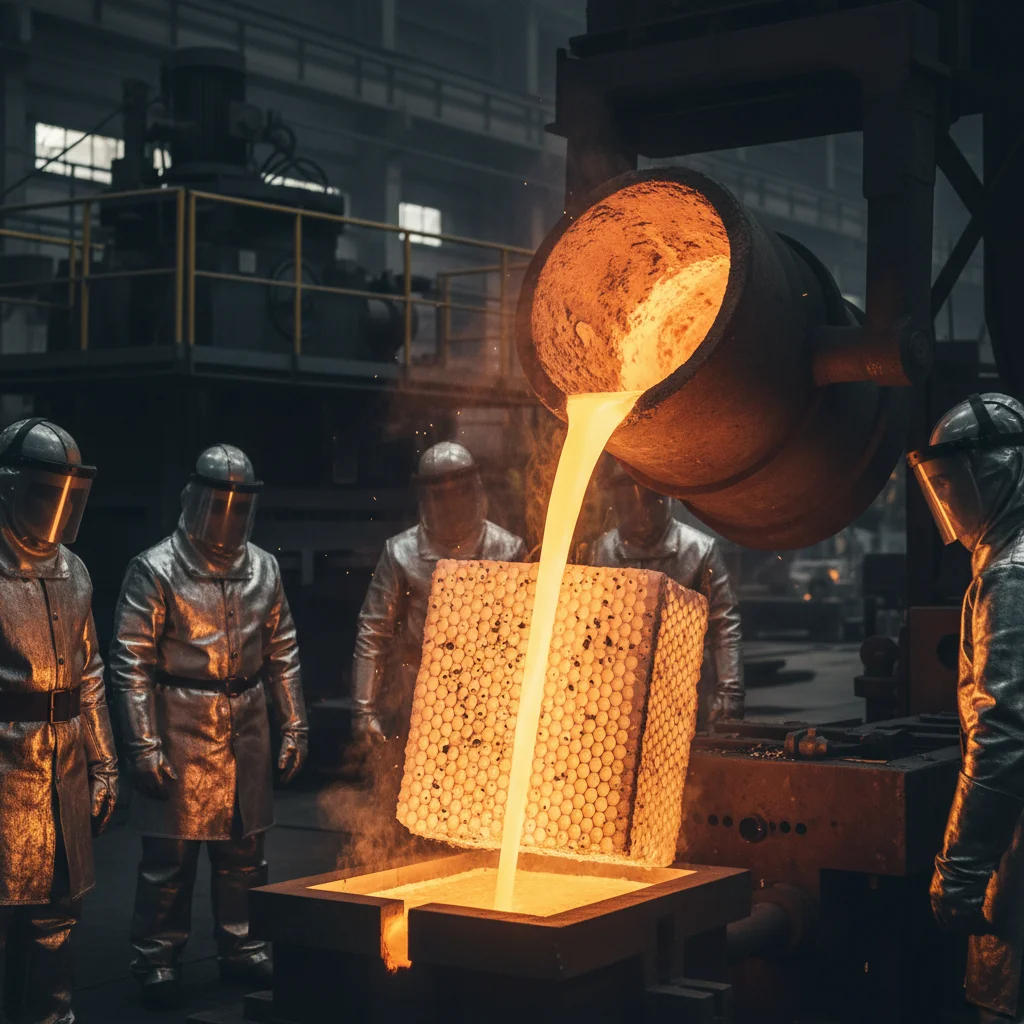
ceramic foam filters sit in the gating system. They catch unwanted particles before metal reaches the mold. Think of them as bouncers at a nightclub. Aluminum gets filtered through alumina filters. Steel uses zirconia or magnesia filters. Each metal needs its own chemistry match.
Pore size matters. 10 PPI (pores per inch) catches big chunks. 20 PPI grabs medium particles. 30-50 PPI pulls out fine bits. Finer pores give cleaner metal. But flow resistance goes up. Your pour rate drops.
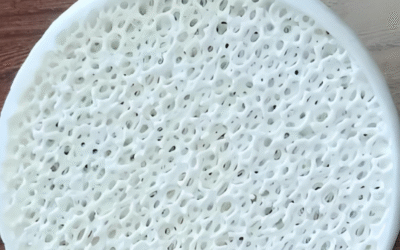
The structure looks like a frozen sponge. open-cell foam creates winding paths. Metal flows through. Particles stick to ceramic walls. Surface area stays huge—way bigger than simple screens.
Installation goes right in the runner or sprue. Pre-heat the filter to 500-900°C. Cold filters cause heat shock. They crack. Then you’re filtering metal through broken ceramic. That ruins the whole point.
Foundries running aluminum castings see rejection rates drop 40-60% after adding foam filters. Tiny holes decrease. Surface finish gets better. Machining tools last longer. Fewer hard bits means cutting edges stay sharp.
Silicon Carbide (SiC) Refractories
silicon carbide handles temperatures that would melt your car’s engine block. Other refractories start to fail. SiC stays solid.
Thermal conductivity hits 125.6 W/mK at room temperature. That’s about four times better than typical Alumina refractories at 30 W/mK. Heat moves through SiC fast. At 200°C, conductivity drops to 102.6 W/mK. By 400°C, it’s down to 77.5 W/mK. Still outperforms most competitors.
The mechanical numbers are impressive. Flexural strength reaches 380 MPa in 4-point testing. 3-point tests push it to 550 MPa. Here’s the kicker—this strength stays strong at high temperatures. Cold crushing strength sits at 15,600 psi at 2500°F (1371°C). Compressive strength ranges from 1,725 to 3,900 MPa. Grade and processing determine the exact number.
Hardness? Knoop 2800 kg/mm². Mohs scale puts it at 9-10. That’s 50% harder than tungsten carbide. Ten times harder than stainless steel. Abrasion does almost nothing to this material. At 1500°F, abrasion loss measures just 3.5 cc. At 2500°F, it climbs to 4.0 cc.
Thermal shock resistance comes from two factors. First, high thermal conductivity spreads heat quickly. Second, coefficient of thermal expansion stays low at 4.02 × 10⁻⁶ /K. Quick temperature changes? SiC handles ΔT swings of 350-500°C without cracking.
Maximum service temperature in air reaches 1900°C. Pure breakdown doesn’t start until around 2500°C. It resists oxidation past 1900°C. Acids don’t touch it. Alkalis can’t hurt it. Molten salts up to 800°C? SiC just sits there.
Dense SiC works in kiln furniture and radiant tubes. Castable versions (RENO CAST SF 60 SiC) line boilers and incinerators. Aluminum reduction cells use SiC bricks. Blast furnaces need SiC runners and monolithics. Zinc furnaces, desulfurization nozzles, waste-to-energy plants—they all pick SiC. This material handles abrasion, thermal shock, and extreme heat at the same time. Few materials can do that.
Yes, it costs more than alumina. But SiC won’t fail under tough conditions. You get performance that lasts.
Specialized High-Performance Refractories (Zirconia, Spinel, Chromite)
Zirconia melts at 2,720°C. Steel would vaporize at that heat. Aluminum turns to gas. Most furnace materials can’t handle it.
Zircon and Zirconia refractories need high purity. You need over 97% zirconia particles. Smart operators aim for 99%. Particle size matters. Mean diameter sits at 13 μm. Keep everything under 27 μm. Bulk density climbs to 3.80 g/cc minimum. Top versions hit 4.25 g/cc. Apparent porosity? Under 18%. High-end grades drop below 11%.
Strength numbers set zirconia apart from common materials. Starting flexural strength (MOR) exceeds 55 MPa. Top grades reach 135 MPa. Typical production? 154 MPa. Clay-bonded zircon only hits 22 MPa. Zirconia delivers seven times the strength. Porosity gets cut in half—10% versus 21%. Thermal shock resistance (R_st) hits 3.6 M^{1/2} K^{-1}.
Spinel mixes magnesia and alumina (MgO-Al₂O₃). MAE-32 fused alumina-magnesia spinel uses large crystals for chemical stability. Plastic spinel refractories show bulk density over 2.8 g/cm³. Crushing strength reaches 80 MPa after drying at 110°C. Fire it to 1100°C for five hours? Strength jumps to 90 MPa. Heat resistance tops 1730°C. Thermal shock resistance survives 25 cycles at 900°C water quenching.
Chromite refractories mix chrome with magnesia. Chrome-magnesite packs 15-35% Cr₂O₃ and 42-50% MgO. Flip the ratio for magnesite-chromite: over 60% MgO with 8-18% Cr₂O₃. Fused chrome-alumina (CRA) pushes chromia content past 90%. You get strong corrosion resistance for fiberglass furnaces and coal gasification units.
These materials resist basic slag attack. Thermal expansion stays around 1%. They work in ferro-alloy furnaces, copper smelters, and platinum refineries. Cost runs high—dissociated zircon batch hits $A2.70/kg. But performance justifies the price where standard refractories fail.
Refractory Material Selection Guide for Different Furnace Types
Your furnace runs at a specific temperature. It contains specific chemicals. These two facts determine which refractory keeps your equipment intact. Pick wrong, and you get expensive dust.
Temperature-Based Selection
Below 1000°C, fireclay does the job. You get 25–45% alumina mixed with 50–80% silica. Standard refractory bricks work in the 1000–1300°C range. Most heat treatment operations fit here. Basic drying kilns run fireclay without problems. So do low-temperature annealing furnaces and pottery kilns.
The 1000–1500°C zone needs alumina refractories. High-alumina versions pack 45–95% alumina. They handle temperatures up to 3350°F (1843°C). Mullite brick sits in this range—72% alumina, 28% silica. Volume stays stable. Strength holds at high temps. Blast furnace stoves use mullite. Glass tank superstructures use it too. So do electric furnace roofs.
Above 1500°C, you need the serious stuff. Magnesia melts at 5070°F (2788°C). Your furnace temperature doesn’t faze it. Chrome-magnesite combinations bring 15–35% chromia with 42–50% magnesia. Flip it for magnesite-chromite: over 60% magnesia plus 8–18% chromia. Carbon graphite works at extreme temps. It’s the most stable option available. Nothing reacts with it.
Chemical Environment Matching
Oxidizing atmospheres love alumina refractories. Heat processing industries pump oxygen-rich gases through furnaces. Alumina handles this without breaking down. High oxygen levels don’t affect it.
Reducing environments need different chemistry. Alumina still works—it resists reducing atmospheres just like oxidizing ones. But magnesia-carbon bricks work better for rapid thermal cycling. Carbon stops cracking during fast temperature jumps. Electric arc furnaces prove this every day.
Slag chemistry determines refractory survival. Acidic slags need acid refractories. Use silica-based materials. Basic slags destroy acid refractories in hours. Match them with basic refractories instead: magnesia, dolomite, chromite. Magnesia resists slags rich in lime and iron oxide. Dolomite (CaO·MgO) fits cement kilns best. Its coating stays more stable than competitors. Purity hits 97% minimum for calcium oxide plus magnesium oxide combined.
Furnace-Specific Applications
Electric arc furnaces run magnesia-carbon bricks. Temperature changes happen nonstop. Slag tries to penetrate everything. These bricks combine magnesia’s chemical stability with carbon’s thermal shock resistance. Nothing else survives the conditions.
Blast furnaces use mullite and high-alumina materials in the hearth and shaft. Temperatures push past 1500°C. Volume stability matters here. The structure can’t shift or crack.
Glass tank furnaces demand mullite or high-alumina refractories. Chemical resistance stops molten glass from eating the lining. This extends how long you can run. Temperatures exceed 1500°C for months without shutdown.
Cement kilns need dolomite. Alkali attack destroys most materials. Thermal shock resistance handles rapid temperature changes during startups. Operating range sits at 1200–1500°C. Dolomite works better with clinker than anything else.
Reheating furnaces use chemical bond castables like CCT-A617. Ceramic fiber products work too. Low bulk density cuts energy use. These materials handle constant heating cycles. Temperature range: 1260–1430°C.
Melting furnaces require high-alumina or corundum refractories. Corundum packs 99% alumina. Chemical stability stays rock-solid. It handles over 1500°C without issue. Metal doesn’t contaminate. Slag doesn’t dissolve the lining.
Pick the wrong material? Your furnace fails. Pick the right one based on temperature and chemistry? Operations run smooth for years.
Conclusion
Picking the right refractory materials for your furnace takes some know-how. We’ve looked at different materials, from fireclay bricks to zirconia compounds. Each one tackles specific heat problems. Think of them as protective layers: high alumina handles the chemical stress of melting aluminum, silicon carbide gives you strength plus heat flow, and ceramic fibers provide light insulation that lasts.
Here’s what matters: the refractory materials used in furnace jobs depend on what your furnace does. Match your heat level, chemical exposure, and heating cycles to what each material does best. You’ll get a system that performs. Get it wrong, and you’re burning cash.
Want to upgrade or redesign your furnace lining? First, measure your real operating conditions. Check what your thermocouples read, not just what the manual claims. Compare those readings to the material specs we covered. Your furnace will run better. Your maintenance costs will drop too.
Need help picking refractories for your setup? Our technical team can create a custom furnace lining solution for you.