Shopping for Foam filters? You’ll see two terms pop up: reticulated and non-Reticulated foam. This applies to aquarium equipment, HVAC systems, and industrial machinery.
These two types might look the same at a quick glance. But their internal structures are completely different. This affects filtration power, airflow patterns, and how they perform in real use.
So what’s the difference between reticulated and non-Reticulated foam filters? It’s not just about specs on paper. The right choice prevents clogging and boosts efficiency. Plus, it saves you money over time.
What Is Reticulated Foam Filter (Definition & Manufacturing Process)
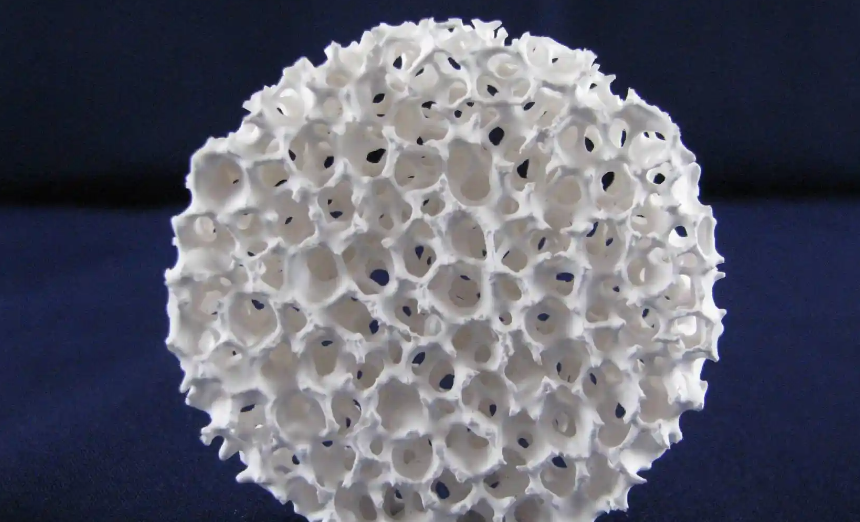
Reticulated foam filters use open-cell polyurethane foam as their base. The manufacturing process removes thin cell windows inside the foam. You’re left with skeletal struts arranged in a 3D net-like structure.
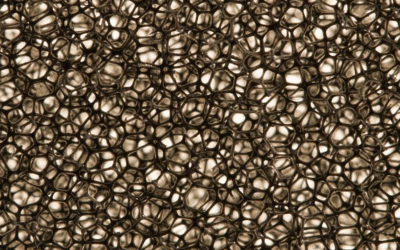
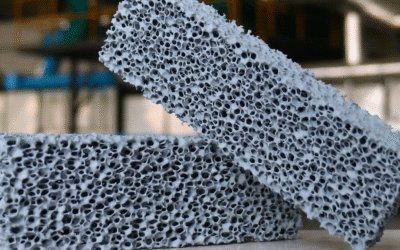
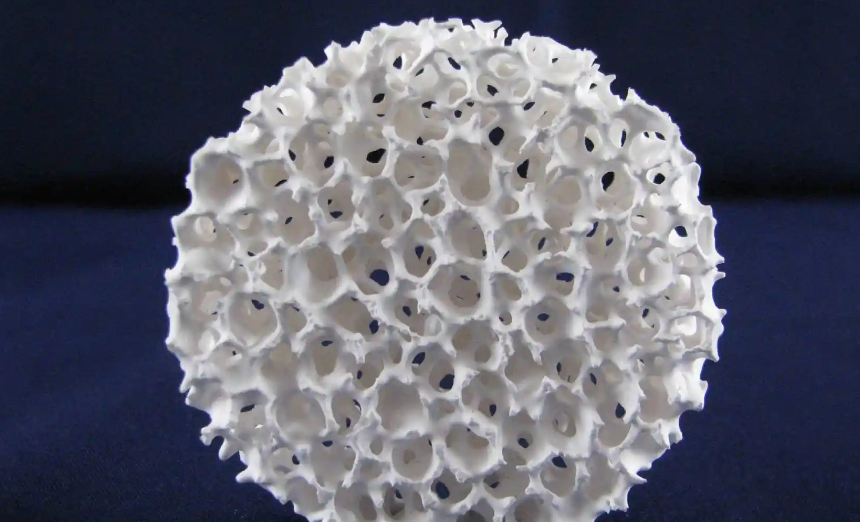
Picture a honeycomb with the cell walls stripped away. Just the frame edges remain. That’s how Reticulated foam looks. The void space inside reaches 97–98% of the total volume. This open design lets air and fluids pass through with little resistance.
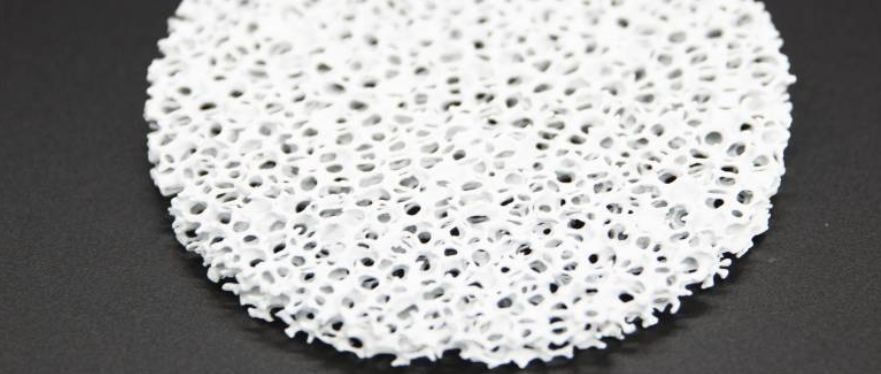
Two base materials dominate production: polyether and Polyester polyurethane foams. The cells look like dodecahedron shapes—think of a 12-sided soccer ball pattern. These connected struts create winding flow paths. Particles and dirt get trapped on the large internal surface as fluid moves through.
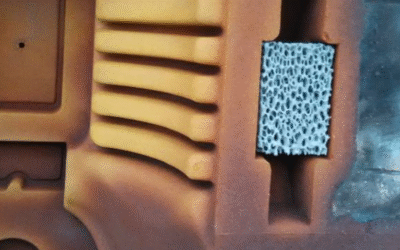
Pores per inch (PPI) measures cell density. ceramic filter templates often use 10 PPI polyurethane sponge cut to 50 × 50 × 25 mm³ blocks. Higher PPI means finer filtration. But flow rates get slower.
The Manufacturing Process
Step 1 starts with regular Polyurethane foam. Manufacturers make open-cell or partly open-cell foam to a target PPI spec. Closed-cell foam goes through roller compression first. The rollers break cell walls. This creates connected pores.
Step 2 is the reticulation stage. This removes cell membranes while keeping struts intact. Two methods handle this:
Chemical reticulation works best for polyester PU. The foam soaks in 10% sodium hydroxide (NaOH) solution heated to 50°C for 10 minutes. The alkali solution eats away the thin membranes. After that, wash the foam in water. Neutralize it in acetic acid. Wash again, then dry. This process roughens the strut surfaces. Those tiny rough spots catch particles better during filtration.
Thermal reticulation fits both polyether and polyester types. The foam goes into a sealed reactor chamber. Technicians remove the air down to 13.3 Pa (about 0.1 Torr vacuum). Then they pump in an oxygen and natural gas mix at a 2:1 ratio by volume. A spark plug lights the mixture. The controlled blast sends a flame front through the foam below sonic speed. The quick fire burns away cell membranes. But struts remain standing. The result? Flame-polished struts with smoother surfaces than chemical methods give you.
What Is Non-Reticulated Foam Filter (Definition & Structure)
Non-reticulated foam filters keep their original cell structure intact. The manufacturer skips the reticulation treatment. Cell membranes stay in place across most pore openings. This creates a semi-closed to open cell structure.
The foam still has open pores. But thin walls span across many cell windows. Think of it as a honeycomb where some cells still have their wax caps on. Air and liquid can pass through. The path gets more blocked compared to reticulated versions.
Polyurethane is the base material for most non-reticulated filters. Two types dominate:
-
PUR polyester foam: Very regular cells with high oil and grease resistance. Available in 10 to 90 PPI grades. The tight structure handles chemical exposure better.
-
PUR polyether foam: Controlled pores ranging 10 to 55 PPI. Works well in water treatment and wastewater applications.
Polyolefin foams offer another option. Some non-reticulated polyolefin types (like PTPK grade) show semi-closed cells. These compress into closed-cell barriers. You get controlled permeability with extra softness.
The cell shape matches reticulated foam. But here’s the key difference: membranes span the cell faces. Those thin films block flow paths. For the same PPI rating, non-reticulated foam gives you lower airflow, higher pressure drop, and better structural strength.
A 10 PPI non-reticulated filter has about 2.5 mm pore diameter. The intact cell walls cut airflow resistance below what 10 PPI reticulated foam delivers. But particle capture stays under 50% at this coarse grade. Higher PPI ratings shrink pore size. This boosts pressure drop and traps finer particles better.
Key Structural Differences (Cell Architecture Comparison)
Reticulated and non-reticulated foam filters differ in what happens inside each cell. Both start as polyurethane foam with similar dodecahedron-shaped cells. The difference shows up at the membrane level.
Cell Membrane Presence
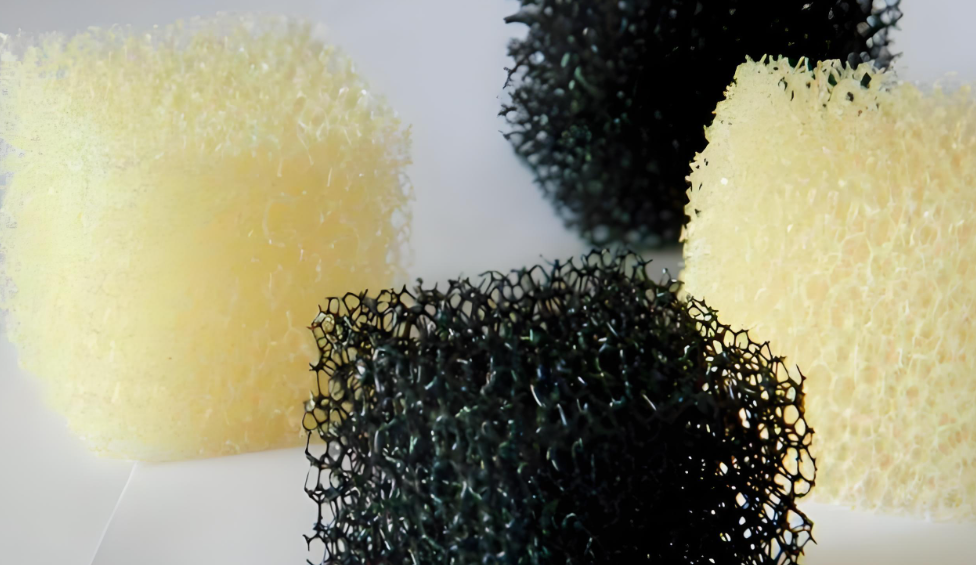
Reticulated foam removes all cell membranes during manufacturing. You get just skeletal struts—about 2-3% solid material by volume. The remaining 97-98% is open void space. Picture a 3D net where every pathway connects to the next.
Non-reticulated foam keeps most cell membranes intact. Thin polymer films span across pore openings like tiny walls. These membranes don’t seal cells fully. Holes and partial tears create twisted flow paths. The void space drops to 85-92% based on foam density.
Strut Surface Characteristics
The reticulation process changes strut surfaces a lot. Chemical reticulation with sodium hydroxide leaves tiny roughness on each strut. These small ridges measure 5-15 micrometers in height. Particles hit this rough surface and stick.
Thermal reticulation makes flame-polished struts. The controlled burn smooths surfaces to under 3 micrometers roughness. Smoother struts mean less particle sticking but better structural evenness.
Non-reticulated foam struts stay as-molded. Surface texture varies by base foam quality. Most show 10-25 micrometer bumps from the original foaming process. The intact membranes add filtration area. But they also create flow bottlenecks.
Pore Connectivity
A 10 PPI reticulated filter gives you close to 100% pore interconnection. Air or liquid flows through with little redirection. Pressure drop stays low—usually 0.1-0.3 inches of water at standard airflow rates.
The same 10 PPI non-reticulated filter forces flow through membrane holes. Pore connectivity drops to 60-75%. Fluids zigzag around intact membranes. Pressure drop jumps to 0.4-0.8 inches of water under the same conditions. Higher PPI grades make this gap even bigger.
Filtration Performance Differences
Cell structure decides how well each foam type catches particles and moves air. Membranes—or the lack of them—create performance gaps you’ll see in real use.
Particle Capture Efficiency
Reticulated foam uses strut surfaces to trap particles. The skeleton creates long, twisting paths for air to travel. Particles hit struts through impact and blocking. A 10 PPI reticulated filter captures 40-55% of particles in the 3-10 micron range at standard face speed. Higher PPI ratings make pores smaller. They also add more struts per cubic inch. A 30 PPI reticulated filter jumps to 75-85% efficiency for the same particle size.
Non-reticulated foam adds membrane walls. Particles must move around intact cell walls. This creates more contact points with the foam material. The same 10 PPI non-reticulated filter reaches 60-70% capture efficiency for 3-10 micron particles. At 30 PPI, efficiency climbs to 88-94%. The membrane surfaces give extra filtering area that reticulated versions don’t have.
Fiber diameter rules work here too. Research on fibrous filters shows collection efficiency goes up as fiber diameter goes down. Non-reticulated foam copies this effect. Membrane thickness acts like fine fibers. Thinner membranes in better-grade foams catch more particles. One study found filters with smaller parts achieved collection efficiency >88% across tested particle ranges, even with higher pressure drop.
Airflow Resistance Trade-offs
Reticulated foam gives low pressure drop. The open paths let air pass with little blocking. A 20 PPI reticulated filter at 100 feet per minute face speed creates 0.15-0.25 inches water column pressure drop when clean.
Non-reticulated foam pushes that number higher. Membranes create tight spots that slow airflow. The same 20 PPI non-reticulated filter under the same conditions shows 0.50-0.75 inches water column. You’re looking at 2-3 times more resistance for similar pore density.
The quality factor balances efficiency against pressure drop. Non-reticulated foam often wins this measure, even with higher resistance. Better particle capture makes up for airflow blocking when clean air matters more than energy cost.
Airflow & Porosity Characteristics
Porosity decides how much air moves through foam. It also controls the pressure cost. Open space affects both flow capacity and resistance.
Porosity Range Effects
Hollow fiber membranes show clear performance patterns at different porosity levels. Research tested ranges from 0.35 to 0.90 porosity. The data shows distinct zones.
Porosity 0.35 to 0.80 creates major performance gains. Outlet air temperature drops about 2 K at constant airflow rates. This means better heat transfer. Moisture content jumps 1.5 g/kg dry air in the same conditions. You see big improvements in humidification across this range.
Porosity 0.80 to 0.90 hits a plateau. Temperature change shrinks to just 0.2 K. Moisture content shows little movement. Some tests from 0.80 to 0.85 showed no increase at all. Benefits stop past this point.
The sweet spot for polypropylene hollow fiber membranes sits at 0.65 to 0.80 porosity. This range balances humidification power and structural strength. One study found that increasing porosity by 35.3% boosted pure water flux by 286.9%. Mass transfer improves fast with added pore space.
Airflow Rate Interactions
Porosity and airflow rate work together. Hold porosity constant. Increase air velocity. Outlet temperature goes up because contact time drops. Less time for heat transfer means warmer exit air. Moisture content falls for the same reason. Humidification efficiency drops as flow speeds up.
Flip it around. Hold airflow constant. Raise porosity. Moisture content climbs up to ε ≈ 0.80. Beyond that point, gains weaken. The porosity plateau effect appears again.
Distribution and Uniformity Trade-offs
Higher porosity creates flow distribution problems in fibrous systems. Larger porosity or thicker fibers drop internal pressure. But air velocity distribution gets worse along the filter length.
Total permeability goes up with more pore space. The catch? Airflow becomes less uniform. Some sections get more flow than others. This creates preferred flow paths. Filter effectiveness drops overall.
Porous media that’s partly saturated shows similar behavior. Air-filled porosity drops as water saturation rises. Airflow conductivity falls fast. Capillary barriers and material variations force air into uneven channels. The flow takes the easiest path instead of spreading out.
Pressure Drop Relationships
Pressure drop across fibrous filters follows a near-linear pattern with filtration velocity. The relationship Δp ∝ v holds across most operating ranges. A structural coefficient captures how porosity, fiber diameter, and thickness affect resistance.
Filtration velocities depend on efficiency targets:
-
High-efficiency filters: v < 0.2 m/s
-
Sub-HEPA grades: v < 0.5 m/s
-
Medium-efficiency: v < 0.8 m/s
-
Coarse filters: v < 1.2 m/s
HEPA filters maintain near-linear pressure drop at velocities of 3 m/s or below. Push face velocity higher. The relationship turns nonlinear. Pressure drop climbs faster than airflow increases.
Non-reticulated foam filters with intact membranes follow steeper pressure curves than reticulated types. The membrane barriers act like finer fibers. They add resistance. They also boost particle capture. Reticulated foam gives lower pressure drop for the same PPI rating. The open skeletal structure lets air pass with less friction.
Application Scenarios (Where Each Type Excels)
Each foam type works best in different industrial and commercial settings. Your choice between reticulated and non-reticulated foam filters depends on what you need for airflow, filtration precision, and operating conditions.
Where Reticulated Foam Filters Excel
High-volume air handling systems work best with reticulated foam’s open structure. HVAC units in commercial buildings and data centers need low pressure drop to stay energy efficient. A reticulated filter allows 2,000-3,000 CFM airflow per square foot at pressure drops under 0.3 inches water column. Fan energy consumption drops by 15-25% compared to denser filter types.
Dust pre-filtration stages in multi-stage systems pair well with reticulated foam. The open skeleton catches large particles—50 microns and above—without getting clogged fast. Paint booth pre-filters use 10-20 PPI reticulated foam to stop overspray particles before finer HEPA stages. Downstream filter life extends by 40-60% in typical spray operations.
Aquarium and pond filtration uses reticulated foam for biological and mechanical stages. The 97-98% void space gives you massive surface area for beneficial bacteria colonies. A 30 PPI reticulated block measuring 10×10×4 inches offers over 200 square feet of bacterial colonization area. Water flows through with minimal restriction. Pump energy stays low. Fish waste breaks down fast.
Sound dampening applications use the open cell network. Reticulated polyurethane foam in 20-30 PPI grades absorbs sound waves across 500-4,000 Hz frequencies. Automotive cabin insulation, studio acoustic panels, and industrial noise barriers use this foam. The skeletal structure converts sound energy to heat through air friction in the struts.
Where Non-Reticulated Foam Filters Excel
Fine particle capture in sensitive environments needs non-reticulated foam. Cleanroom air handlers use 45-60 PPI non-reticulated filters to trap 5-10 micron particles at 85-92% efficiency. The intact cell membranes create winding flow paths. Particles hit membrane surfaces multiple times. Electronics manufacturing and pharmaceutical production depend on this filtering power.
liquid filtration with controlled flow rates works better with non-reticulated structures. Fuel filters in automotive and industrial engines use 30-40 PPI non-reticulated foam. The membranes slow fuel flow to 0.5-1.5 liters per minute through a 2-inch diameter filter. This prevents fuel surge. It also traps particles down to 10 microns that damage injectors and pumps.
Chemical and oil mist separation uses the semi-closed cell design. Machine tool coolant mist collectors use 20-30 PPI non-reticulated polyester foam. Oil droplets 1-20 microns in size stick to membrane surfaces. Collection efficiency reaches 80-90% at face velocities of 50-100 feet per minute. The foam resists mineral oils, cutting fluids, and synthetic coolants better than reticulated versions.
Cushioning with controlled compression gives you filtration and mechanical protection. Non-reticulated foam in 10-20 PPI grades provides impact absorption in packaging and protective gear. The cell membranes add 25-35% more compression resistance than reticulated foam at the same density. Air escapes during compression to create controlled cushioning response.
Water treatment pre-filtration uses non-reticulated foam to remove sediment and organic matter. Pool and spa filters use 15-25 PPI non-reticulated blocks measuring 8×8×12 inches. They capture particles 20-50 microns at flow rates of 30-50 gallons per minute. The foam handles chlorine exposure and pH swings from 6.5 to 8.5 without breaking down for 12-18 months of continuous use.
Cost & Availability Analysis
foam filter pricing breaks into two groups based on cell structure. Reticulated foam filters cost 15-40% more than non-reticulated types at the same PPI rating. A standard 12×12×1 inch non-reticulated filter in 20 PPI sells for $3-5 in bulk orders of 500+ units. The same size reticulated filter runs $4.50-7 per piece. That extra dollar or two adds up fast in high-volume operations.
The price gap comes from how they’re made. Reticulated foam needs special equipment, controlled conditions, and quality testing to remove all membranes. Non-reticulated foam skips these steps. You cut the block from parent foam, wash it, and package it. Production costs drop 20-30% right there.
How To Choose Between Reticulated vs Non-Reticulated
Your application drives the decision. Match foam structure to what flows through it and what you need blocked.
Start With Fluid Flow Requirements
Pick reticulated foam for fast fluid passage. HVAC pre-filters, aquarium bio-media, and dust collectors need high permeability. The open skeleton delivers airflow rates of 2,000-3,000 CFM per square foot. Pressure drops stay under 0.3 inches water column. Reticulated foam works at densities ≥25 kg/m³. This density floor limits cushioning uses. But it keeps flow channels wide open.
Choose non-reticulated foam for controlled flow or barriers. Fuel filters, oil mist separators, and water pre-filters benefit from the semi-closed structure. Intact membranes slow flow to 0.5-1.5 liters per minute through a 2-inch filter. This rate traps particles down to 10 microns. It also prevents surge. Non-reticulated foam spans 20-150 kg/m³ density range. That flexibility covers soft gaskets to firm structural padding.
Match Density to Mechanical Needs
Density below 25 kg/m³? You must use non-reticulated foam. Reticulated versions don’t exist in this range. The open cell removal process needs minimum material thickness. This keeps strut strength intact.
Between 25-150 kg/m³, compare mechanical feel. Reticulated foam compresses easier at the same density. A 30 kg/m³ reticulated block feels softer. It rebounds faster than a 30 kg/m³ non-reticulated block. The membrane walls in non-reticulated foam add 25-35% more compression resistance. Industrial seals and vibration dampeners use this extra firmness. Sound panels and Filter Media prefer the softer reticulated compression.
Check Filtration vs. Insulation Goals
Filtration, airflow, or acoustic absorption—all point to reticulated foam. The 97-98% void space gives massive surface area. This works for particle contact or sound wave friction. A 30 PPI reticulated filter captures 75-85% of 3-10 micron particles. It also absorbs sound across 500-4,000 Hz frequencies.
Insulation, buoyancy, or water resistance—these need non-reticulated foam. Closed membranes trap air pockets. These slow heat transfer. Flotation devices need the semi-closed cells. This prevents water saturation. Thermal conductivity drops 40-55% compared to reticulated foam at equal density. Membrane barriers keep fluids out. Use these for a moisture shield instead of a fluid pathway.
Follow The Four-Step Selection Process
Step 1: Define your primary function. Continuous fluid passage? Go reticulated. Fluid exclusion or thermal barrier? Choose non-reticulated.
Step 2: Set target density. Need under 25 kg/m³? Non-reticulated is your choice. Above that threshold, let permeability needs decide.
Step 3: Test fluid contact requirements. Will liquids or gases flow through? Reticulated foam handles this. Need to block or slow fluid movement? Non-reticulated membranes do that job.
Step 4: Check mechanical response. Want softer compression and faster rebound? Reticulated foam delivers. Need firmer support and structural stability? Non-reticulated foam provides it.
A 20 PPI grade shows the trade-off. Reticulated at this density shows 0.15-0.25 inches water column pressure drop. It captures 40-55% of particles. Non-reticulated hits 0.50-0.75 inches pressure drop. But it jumps to 60-70% capture efficiency. Your system decides which balance wins—low resistance or high filtration.
Conclusion
What is the difference between reticulated and non-reticulated foam filter? Know this, and you’ll make better filtration choices for your needs. Here’s what matters: Reticulated foam has an open-cell design. This gives you better airflow and holds more dirt. It works great for air filters, HVAC systems, and factories. Non-reticulated foam uses a closed-cell design. It’s best for cushioning, packaging, and keeping moisture out. Filtration takes a back seat here.
What should you pick? Think about your goals first. Need maximum airflow and good particle capture? Go with reticulated foam. Need structure and basic filtering? Non-reticulated foam works fine. Don’t choose based on price alone. The wrong foam can cost you more later. You’ll pay through maintenance, higher energy bills, and poor system performance.