Choosing the wrong ceramic foam filter for a steel pour isn’t a small mistake — it leads to scrapped castings, expensive rework, and a supplier you’ll want to drop fast.
Foundry buyers face the same confusing question again and again: comparing SiC filters vs. Zirconia ceramic filters for steel foundry applications from different suppliers is tough. Spec sheets and marketing claims pile up fast. How do you make a decision that holds up at 1600°C?
This guide breaks down the material science, the real-world performance trade-offs, and the supplier variables that product brochures tend to skip. You walk away with a clear framework — not just more data to sort through.
What Are SiC and Zirconia Ceramic Foam Filters in Steel Casting?
Two materials dominate Ceramic foam filtration in metal casting. They are not interchangeable.
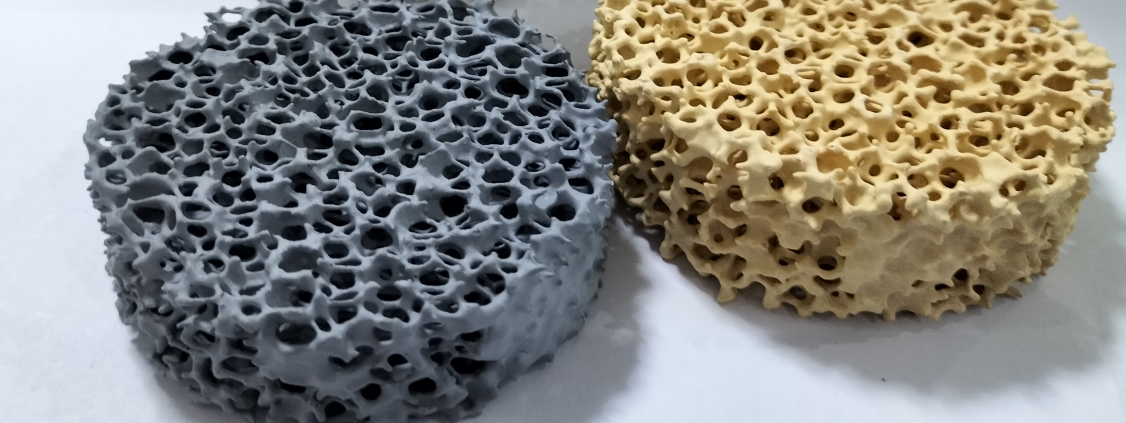
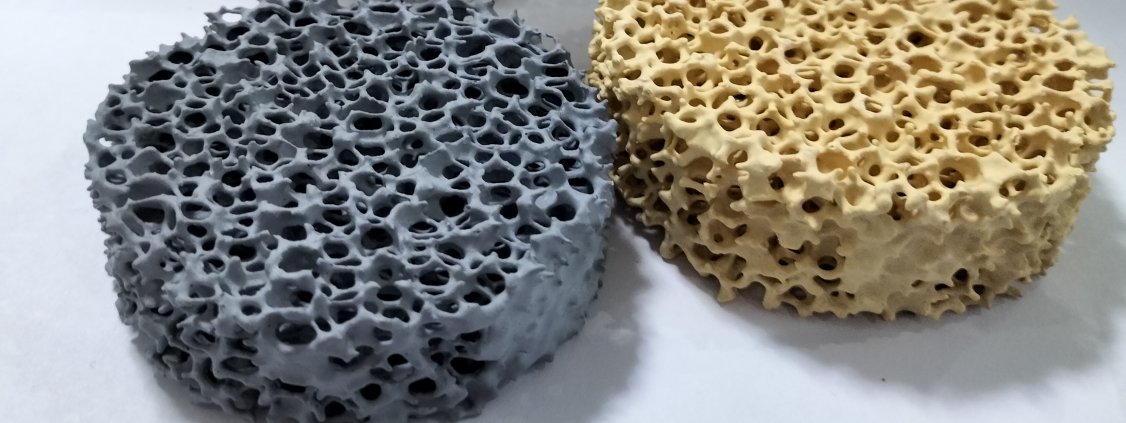
Silicon carbide (SiC) Ceramic foam Filters are open-cell structures built for ductile iron, gray iron, Malleable Iron, and copper alloys. They handle temperatures up to 1500–1530°C, depending on the manufacturer. SiC delivers strong thermal shock resistance, chemical corrosion resistance, and mechanical strength. These qualities make it the go-to filter for iron and non-ferrous foundries. The technology dates back to the 1970s. Decades of real-world use have sharpened both the material and how it’s applied.
zirconia ceramic foam filters (ZrO₂) take on a harder job. Steel runs hotter, behaves in its own way, and exposes weak filter choices fast. Zirconia is rated for steel and steel alloys up to 1700°C — a clear step above SiC’s working range. For high-quality steel grades, inclusion control at extreme heat is not optional. Zirconia is the standard material specification for that job. It’s not an upgrade — it’s the baseline.
Both filter types use the same core filtration approach: a 3D open-cell structure that handles mechanical screening, adsorption filtration, and flow rectification. This drives laminar flow through the gating system. You get less turbulence and lower scrap rates as a result.
The Material Decision Comes Down to One Number: Your Pouring Temperature
|
Application |
Filter Material |
Working Temperature |
|---|---|---|
|
Ductile / gray / malleable iron |
SiC |
~1500–1530°C |
|
Copper alloys |
SiC |
~1500–1530°C |
|
Steel / steel alloys |
Zirconia (ZrO₂) |
up to 1700°C |
Don’t treat SiC as a default steel filter. Every credible source in the market puts zirconia as the steel-grade solution. SiC belongs in cast iron and copper-alloy applications. Running SiC on a steel pour is not just a performance compromise — it’s the wrong material for the job, plain and simple.
SiC Ceramic Foam Filters: Strengths, Limitations, and Where They Belong
Silicon Carbide ceramic Foam Filters built their reputation through decades of real work — Ductile Iron pours, automotive cylinder blocks, brake rotors, and hydraulic bodies across high-volume foundries worldwide. The material works. The question is whether it works for your application.
What SiC Delivers
The physical profile tells part of the story. SiC foam runs 80–90% open porosity, with pore densities from 8 to 60 ppi. Bulk density lands at 0.35–0.5 g/cm³. Compressive strength reaches ≥0.9–2.0 MPa at room temperature. That’s not bulletproof, but it holds up fine with the filter seated and supported correctly.
Thermal shock resistance is a genuine strength. SiC foam survives ≥6 rapid heat/cool cycles at 1100°C without structural failure. That counts in jobbing foundries where conditions are far from textbook-perfect.
Three filtration mechanisms work together to drive real yield gains: mechanical sieving, adsorption, and flow rectification. Foundries that switch from wire mesh or ceramic screens to SiC foam see 30–60% fewer inclusion-related defects and 5–15% lower machining costs from cleaner metal reaching the machine shop.
SiC fits best when all four of these line up: – Alloy is ductile iron, Gray Iron, malleable iron, or copper-base – Pouring temperature stays in the 1300–1500°C range – Quality targets demand tight inclusion control – Gating design holds the filter in proper cups or recessed pockets
Where SiC Falls Short
Compressive strength of ~1–2 MPa leaves no room for rough handling. Drop or mishandle the filter, and it cracks. Debris enters the mold. The casting fails before the pour even begins. Heavy iron gating systems need dedicated filter cups — not bare foam sitting under a tall metal head.
Push past ~1500–1550°C, and SiC starts to oxidize in aggressive atmospheres. The structure weakens. For high-basicity CaO-rich slag environments — steel casting territory — zirconia is not a premium upgrade. It’s the one credible choice.
Go straight to zirconia instead of SiC:
– You’re casting carbon or low-alloy steel at 1500–1650°C
– Slag chemistry is aggressive
– Metal head pressure is high enough to crush foam
SiC filters cost 1.2–2× Alumina foam per comparable piece — and less than zirconia. That price point makes sense only with the right alloy and temperature range behind it. Push SiC outside that range and you don’t save money. You generate scrap.
Zirconia Ceramic Foam Filters: Why They Are the Industry Standard for Steel Castings
Steel is unforgiving at 1600°C. It exposes every weak link in your process — and a filter made from the wrong material is one of the first things to fail.
Zirconia ceramic foam filters (ZrO₂) hold a continuous working temperature of up to 1700–1750°C. That’s not a marketing ceiling. It’s a real operating range, tested across carbon steel, stainless steel, and nickel- and cobalt-based superalloys. Compare that to alumina, which tops out at 1450–1500°C. SiC holds up to 1500–1600°C. The gap is clear. Very few ceramic materials survive repeated contact with 1550–1650°C molten steel under rapid thermal cycling. Magnesium-stabilized zirconia is one of the few scalable options that does it at production scale, pour after pour.
Physical Specs That Matter on the Pour Floor
Standard zirconia foam filters for steel run 10–15 PPI for high-flow gating and heavy sections. General steel castings use 20–30 PPI — a balance between cleanliness and flow rate. Aerospace-grade and investment cast parts push to 30–40 PPI, where inclusion size limits get tight.
Open porosity sits at ≥80%. That keeps permeability high. It also keeps internal surface area large enough to trap non-metallic inclusions. For 20–30 PPI filters, effective inclusion capture runs 20–50 microns. That covers oxides, slag particles, and refractory debris — the defects that lead to fatigue failures and machining problems later on.
Compression strength hits ≥1.5 MPa at room temperature. Add strong hot-strength and creep resistance, and you get a filter that holds its shape under metallostatic pressure. No warping. No collapsing mid-pour.
One practical detail worth noting: Zirconia filters are yellow. That sets them apart from black SiC and white alumina at a glance. On a busy foundry floor, that color difference matters. A wrong filter in the wrong pour box is an expensive error.
The Quality and Cost Argument
zirconia filters cost 2–4× more per piece than SiC or alumina equivalents. Foundry buyers who stop the analysis there make the wrong call.
Look at the full picture:
-
Scrap reduction for filtered versus unfiltered steel castings runs 20–50%
-
Machining stock shrinks by 1–3 mm in investment and sand-cast applications
-
Grinding time drops
-
Weld repair frequency falls
Those are real cost savings. They add up fast on high-value steel grades.
Aerospace structural steels, turbine components, high-pressure valve bodies — these are the parts where zirconia has become non-negotiable. The price premium disappears the moment you scrap one casting at that level.
Head-to-Head Comparison: SiC vs Zirconia for Steel Foundry Applications
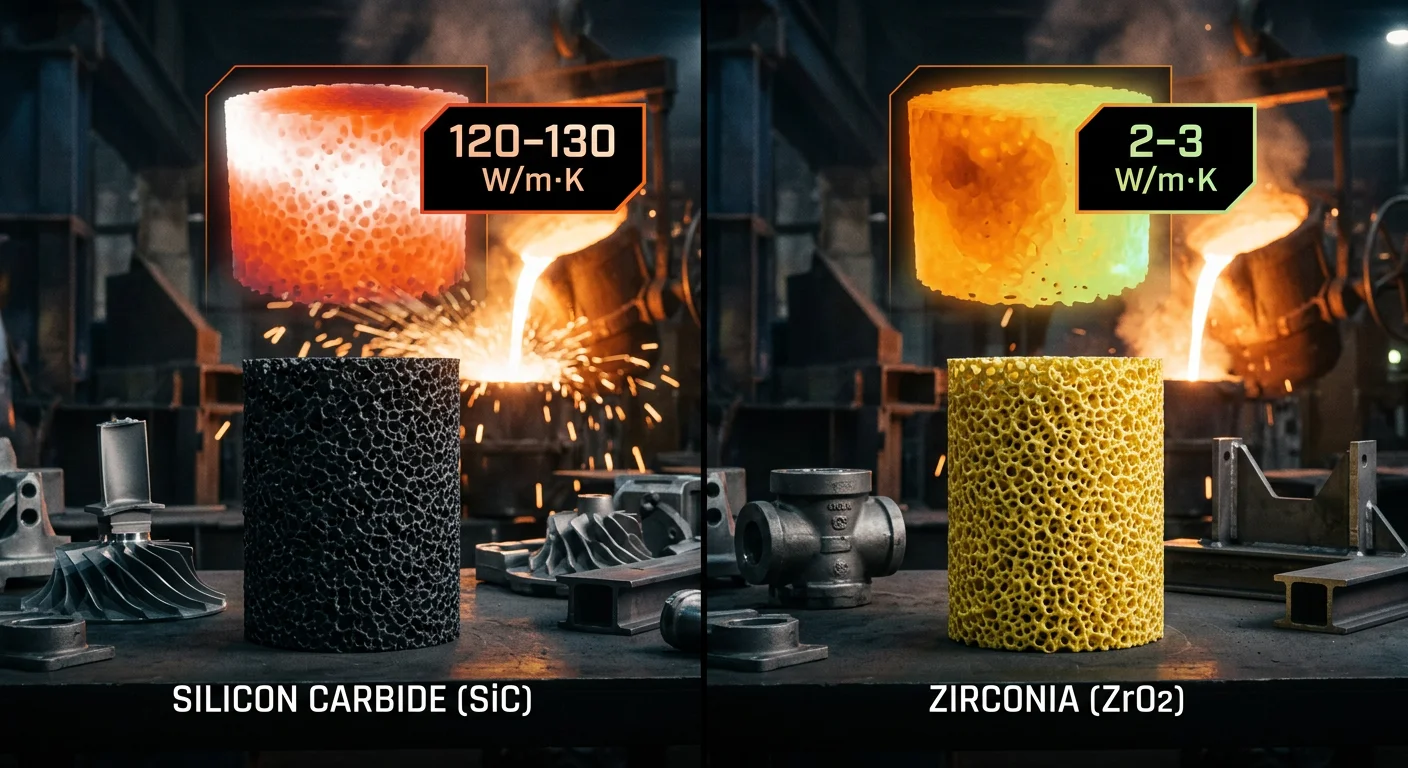
The numbers settle most arguments. Thermal conductivity: SiC runs 120–130 W/m·K. Zirconia runs 2–3 W/m·K. That’s not a small difference — SiC transfers heat 40 to 65 times faster than zirconia. Steel foundries run on extreme thermal loads. That gap decides which material goes where.
But conductivity is one part of this comparison. Pick the right filter — or the right refractory component — from the right supplier. You need the full picture to do that.
Where Each Material Wins
SiC leads in thermal performance and corrosion resistance:
-
High-temperature integrity: SiC holds its mechanical structure up to ~1600°C. Zirconia starts phase transformations around 1000°C. Those changes damage structural stability well before the part shows any visible signs of failure.
-
Corrosion resistance: Saint-Gobain data shows SiC material loss rates at 10–15× lower than alumina in molten metal and aggressive chemical environments. Slag chemistry in a steel foundry is harsh. That number matters every single shift.
-
Service life: In abrasive foundry conditions, SiC components outlast zirconia by 1.5 to 2×. They outlast alumina by 2 to 3×. Longer life means fewer changeouts and less downtime. Run the numbers on cost-per-pour — SiC comes out ahead.
Zirconia wins one category — toughness:
-
Fracture toughness of 9–17 MPa·m¹/² puts zirconia ahead of SiC, silicon nitride, and alumina. That advantage matters most under mechanical shock or impact loading.
-
Vibration, sudden force, or physical impact is the main threat? Not heat, not corrosion? That’s where zirconia earns its place.
Matching Material to Foundry Role
|
Foundry Role |
Better Material |
Why |
|---|---|---|
|
Furnace linings / hot-face components |
SiC |
Thermal stability, corrosion resistance |
|
Molten metal contact parts |
SiC |
Low material loss, high conductivity |
|
Heat exchangers / thermal management |
SiC |
40–65× heat transfer advantage |
|
High-wear components |
SiC |
1.5–3× longer service life |
|
Impact-prone fixtures / vibration zones |
Zirconia |
Superior fracture toughness |
The Cost Calculation Suppliers Won’t Lead With
SiC costs more to manufacture. Sintering temperatures reach 2000–2200°C. Zirconia only needs 1500–1600°C. That higher processing demand pushes up the unit price.
But higher cost up front shows up in real performance gains too:
-
Industrial furnace data shows 15–20% energy savings after SiC components replace traditional ceramic alternatives.
-
Cost parity with alumina lands at 2–3 years. With zirconia, you reach that point at 3–4 years — under demanding, high-wear service conditions.
The rule is simple. Direct heat, thermal cycling, molten metal contact, corrosive slag — SiC is the clear technical choice. Mechanical shock is the main concern and temperatures stay well within both materials’ safe range? Zirconia is worth specifying. For most steel foundry thermal and refractory roles, SiC wins this comparison. Zirconia is a focused tool built for a narrower set of conditions — not a general-purpose upgrade.
Supplier Comparison: How Different Manufacturers Differ on Zirconia Filter Specs
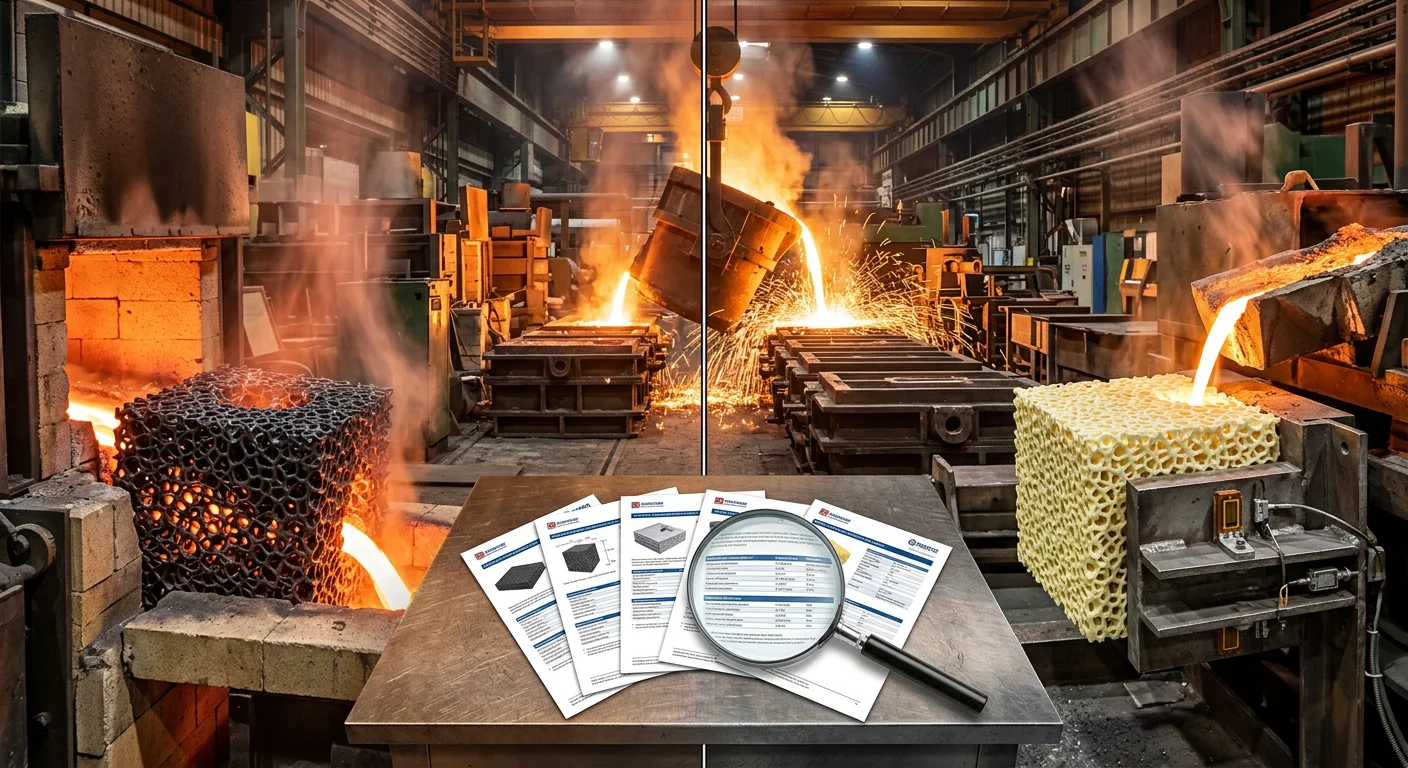
Six suppliers. One filter category. Specs that look nearly identical on the surface — until you dig into the numbers that decide whether your casting comes out clean or gets scrapped.
Zirconia ceramic foam filters for steel foundry applications sound standardized. They’re not. Look at suppliers like Hebei Cangchen, Xinda Casting Technology, MW Alloys, Nexgen Materials, Baoding Ningxin, and IndiaMART-aggregated brands — real differences show up in temperature headroom, PPI range, porosity, mechanical data, and composition transparency. Here’s where those differences land.
Temperature Rating: 1700°C vs. 1750°C — It’s Not a Rounding Difference
Most suppliers in this segment advertise a 1700°C working limit. Cangchen, MW Alloys, IndiaMART listings, and Xinda’s primary spec sheet all sit there. That covers most carbon and stainless steel pours running 1550–1650°C.
Two suppliers push higher. Nexgen Materials rates their zirconia filters to 1750°C. Xinda lists 1700°C on their main table but notes “typical tolerance up to 1750°C” elsewhere — treat that as a short-term upper boundary, not a continuous rating.
The practical call: Running high-superheat pours, nickel- or cobalt-based superalloys, or extended holds above 1650°C? Nexgen or Xinda’s upper tolerance gives you real margin. For standard steel foundry work, 1700°C is wide enough — and your selection criteria shifts to PPI range and porosity instead.
PPI Range: Where the Supplier Field Splits Most
This is where supplier positioning separates most visibly.
-
Xinda Casting Technology: 10–40 PPI — the widest zirconia range in this comparison
-
MW Alloys: 10–30 PPI — covers standard steel casting needs, stops short of fine-grade filtration
-
Nexgen Materials: PPI not published in their specs; based on their stated porosity (70–80%) and application scope, industry norms place them at 10–30 PPI
-
Baoding Ningxin: Focuses on 15–20 PPI for quality-critical parts; gives the most useful selection guidance of any supplier in this group
Casting fine steel components and need 30–40 PPI zirconia? Xinda is the one supplier in this group that covers it. MW Alloys caps at 30 PPI.
For heavy-section steel where flow rate takes priority over ultra-fine inclusion capture, every supplier’s 10–15 PPI range handles the job. Ningxin’s published guidance on PPI selection trade-offs is worth reading even if you source elsewhere — it explains the flow resistance vs. cleanliness balance more plainly than anyone else in this group.
Porosity and Bulk Density: Three Different Answers to the Same Question
|
Supplier |
Porosity |
Bulk Density |
|---|---|---|
|
MW Alloys |
75–85% |
0.80–1.10 g/cm³ |
|
Xinda |
≥80% |
Not published |
|
Nexgen |
70–80% |
0.9–1.2 g/cm³ |
MW Alloys and Xinda sit at the more open end of the porosity range — lower pressure drop, higher metal flow throughput. That matters in high-flow gating systems with tight cycle times.
Nexgen’s tighter foam structure (70–80% porosity, higher density up to 1.2 g/cm³) gives up some flow rate for stronger mechanical build. On a rough foundry floor where filters take hard handling, that density advantage is real and consistent.
Mechanical Strength and Thermal Shock: Where MW Alloys Stands Alone
Xinda, MW Alloys, and Nexgen all publish mechanical data — and all three land at ≥1.5 MPa compressive strength. That spec alone won’t separate them.
Thermal shock data is where the field splits.
MW Alloys is the one supplier here that publishes a cycle count: ≥3 thermal shock cycles from 1560°C to ambient air. That’s a documented, repeatable spec. Xinda references “excellent resistance to sudden thermal shock up to 1700°C” — but with no cycle count. Nexgen’s thermal shock data references 1300°C — useful as context, but conservative against real steel pour temperatures, and not documented for multi-cycle use.
Running repeated preheat and pour cycles — as most production foundries do — MW Alloys’ thermal shock documentation gives you a specific number to hold them to.
Chemical Composition: One Supplier Shows the Full Number
MW Alloys publishes ZrO₂ ≥ 92% on their product data. That’s the clearest composition guarantee in this comparison.
Nexgen lists oxide categories (Al₂O₃, MgO, SiO₂, ZrO₂, Fe₂O₃) in their tables but doesn’t publish exact percentages. The industry benchmark for premium steel-grade zirconia filters runs 90–94% ZrO₂ with MgO or CaO stabilizers at 2–4%. Xinda and Cangchen probably hit that range — but you’d need their Certificate of Analysis to confirm it.
Your engineering drawings specify a ZrO₂ minimum? MW Alloys is the fastest path to documented compliance. For every other supplier, request the COA before you commit volume.
Application Scope: Who Covers Superalloys
For nickel- and cobalt-based superalloy casting, two suppliers position their zirconia filters for the job: Nexgen Materials and MW Alloys. That’s not just a marketing distinction. Superalloy slags are chemically aggressive, and filter composition control matters more at those conditions.
For general carbon steel and stainless steel: Cangchen, Xinda, MW Alloys, Nexgen, and IndiaMART-brand suppliers all cover the application well. At that point, the real differences come back to PPI range, porosity, and how clearly the supplier documents their specs.
The Fast Selection Framework
Don’t start with the supplier. Start with what your process demands:
-
Pouring temp above 1650°C or superalloy work? → Nexgen or Xinda (1750°C upper tolerance)
-
Need 30–40 PPI for fine steel castings? → Xinda is the one clear option
-
High-flow gating system, pressure drop is a constraint? → MW Alloys or Xinda (higher porosity, lower density)
-
Rough handling conditions, need filter durability? → Nexgen (denser foam structure)
-
Spec sheet requires documented ZrO₂ content? → MW Alloys (≥92%, published)
-
Multi-cycle preheat and pour process? → MW Alloys (the one supplier with published thermal shock cycle data)
Most foundries running standard carbon or stainless steel at 1550–1650°C will find solid options across the full supplier list. The real differences sit in documentation quality, PPI breadth, and porosity range — not in headline temperature ratings that most of the field has already matched.
How to Choose the Right Filter and Supplier: A Decision Framework for Steel Foundry Buyers
Most filter decisions go wrong at step one. Buyers start with price, or with whatever the last supplier recommended. They skip the process entirely.
The framework below fixes that. Five steps. Each one narrows the field before you call a sales rep.
Step 1: Define what you need the filter to do
“Better quality” isn’t a process requirement. These are:
-
Fewer non-metallic inclusions in a high-value carbon steel pour
-
Laminar fill on a thin-wall stainless casting prone to cold shuts
-
Higher throughput on a heavy-section valve body without air entrainment
-
Controlled flow rate on a solidified part where fast fill causes grain defects
Pick one goal. Write it down. Everything after this step gets measured against it.
Step 2: Decide where the filter sits before you pick what filter to buy
Placement drives performance. Most buyers underestimate this:
-
Filter close to the casting → smoother fill, fewer non-fills, better laminar flow
-
Cup filter, farther from the mold → higher flow rate, less back-pressure
Place the filter wrong and a well-matched zirconia filter will underperform a cheaper option in the right spot.
Step 3: Match material to your alloy and pour temperature — hard stop
|
Pour Temp |
Alloy Type |
Filter Material |
|---|---|---|
|
Up to 1530°C |
Iron, copper alloys |
SiC |
|
1530–1700°C |
Carbon / stainless steel |
Zirconia (ZrO₂) |
|
Above 1650°C, superalloys |
Nickel / cobalt base |
Magnesium-stabilized ZrO₂ |
This is not a suggestion. Running SiC at steel temperatures produces scrap. Running standard zirconia on a superalloy pour without checking stabilizer chemistry falls into the same category of costly error.
Step 4: Run test pours before locking in a spec
No supplier datasheet captures every variable in your foundry — gating geometry, pouring practice, metal head height, mold permeability. Test pours sort those out. Reputable suppliers offer free test filters for evaluation runs. Use them. Compare at least two pore sizes before you commit.
Step 5: Evaluate the supplier on capability — not price alone
A supplier who sells zirconia filters but doesn’t grasp steel alloy metallurgy will end up costing you more. One that charges a premium and helps you solve real defects is the better value. Before you commit volume, ask:
-
Do they have documented experience in your specific market — defense, aerospace, oil and gas?
-
Can they provide design review and material selection input, or do they produce to print only?
-
Do they offer machining capability? This matters when a defect shows up post-cast. You want one accountable party — not two vendors passing blame back and forth.
-
What’s their inventory position? On-hand stock cuts delays. Multi-warehouse suppliers — with locations on both coasts, for example — reduce freight time and cost on repeat orders.
-
Can they supply filters for both ferrous and non-ferrous alloys if your foundry runs both?
The SFSA supplier directory and the AFS Supplier Marketplace are solid starting points for sourcing verified foundry suppliers. Both are searchable by alloy type, geography, and service capability.
The rule that holds across every application: the right filter from the wrong supplier creates one set of problems. The wrong filter from the right supplier creates another. You need both decisions to be correct. Start with your process requirement, work through the five steps above, and the list of credible options gets short fast.
Conclusion
Choosing between SiC and Zirconia ceramic foam filters for steel foundry applications isn’t a debate. It’s a decision. The consequences show up in scrap rates, pour quality, and production downtime.
Zirconia wins for steel. Full stop. At steel pouring temperatures, thermal stability, chemical resistance, and inclusion capture performance are not in the same league as SiC. That’s where the material question ends.
The supplier question is different. Porosity consistency, dimensional tolerances, and batch-to-batch reliability — these are what separate vendors worth partnering with from those worth walking away from. That’s where your due diligence starts.
Evaluating SiC filters vs. Zirconia Ceramic filters for steel foundry from different suppliers? Don’t let price drive the decision. Let performance data and verified specs do that job instead.
Here’s what to do before committing to volume orders:
-
Request filter samples from each supplier
-
Ask for third-party test certifications
-
Run controlled trials under your actual pouring conditions
The best filter isn’t the cheapest one. It’s the one that works every time — and never gives you a reason to think twice.