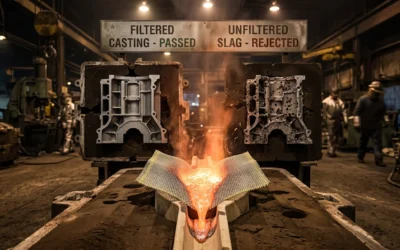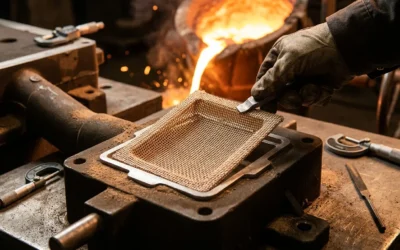
A single mesh screens mismatch can turn a flawless aluminum pour into a scrapped batch full of oxide inclusions and gas porosity. By the time you spot the defect, the damage is already done. That’s the hidden cost of getting Fiberglass filter mesh selection wrong. With casting temperatures often pushing past 700°C and molten metal flowing fast, the margin for error is razor-thin.
This guide breaks down how to select the right fiberglass filter mesh for aluminum casting, starting with temperature rating alignment—the factor most foundries overlook first. From there, we’ll work through mesh size trade-offs, material composition choices between raw silica glass and resin-coated variants, and the mechanical durability checks that separate a mesh that survives a full production run from one that fails mid-pour. By the end, you’ll have a practical decision framework plus the common selection mistakes that drive up rejection rates without anyone noticing why.
Confirming Casting Temperature Requirements and Matching Mesh Heat Ratings
Temperature is where mesh selection fails. Get the temperature wrong, and the mesh collapses in the melt. Mesh size, material composition, mechanical durability—none of it matters after that.
Know Your Actual Pour Temperature First
Pure aluminum melts at 660.32°C, but that number is almost useless for casting decisions. Foundries need superheat above the liquidus line to keep the metal flowing and allow proper degassing. That pushes real-world melting and holding temperatures to 700–760°C, with pour-end temperatures commonly landing at 720–790°C.
Aluminum alloys melt across a solidus-to-liquidus range:
- A356-type Al-Si alloys: roughly 577–615°C, with a freezing range around 38°C
- High-silicon alloys like A413: span 520–640°C
Because pour temperatures run well above liquidus for flow and gas-management reasons, the practical filtration window across most aluminum casting operations sits at 700–800°C, regardless of which alloy you’re running.
Match Mesh Heat Rating to That Window
Standard fiberglass filter mesh is built for this exact range.
- Working temperature: 700–800°C
- Softening point: 900°C
- Sustained exposure limit: usually under 20 minutes, some products rated at 10 minutes
The 100–200°C gap between working temperature and softening point is a built-in structural safety margin. But that margin doesn’t buy you time. It buys you temperature headroom for short-duration exposure, not extended soaking.
The heat-rating tiers:
- Standard fiberglass mesh is capped near 800°C, purpose-built for aluminum.
- High-silica fiberglass mesh is rated to 1000–1200°C, but that’s overkill for aluminum and better suited to steel.
- Metal mesh filters top out around 500°C, disqualifying them for most aluminum applications.
Confirm your alloy’s actual pour temperature and dwell time first, then match it against working temperature, softening point, and time rating. If your process runs above 800°C or holds molten metal in contact with the filter longer than 20 minutes, standard fiberglass will soften and collapse mid-run. You need a higher-temperature grade.
Mesh Size Selection and Filtration Precision Balance
Mesh size is a trade-off. Go too fine, and you choke flow. Go too coarse, and inclusions sail straight through. This balance determines your selection of fiberglass filter mesh for aluminum casting.
The Standard Sizing Bands
aluminum casting filtration runs on a handful of proven mesh sizes: 0.8×0.8mm, 1.0×1.0mm, 1.2×1.2mm, 1.5×1.5mm, 2.0×2.0mm, and 2.5×2.5mm. Suppliers across the industry treat this band as the default range for molten aluminum filtration, dross removal, and inclusion capture ahead of the mold.
For quick mesh-count conversion:
- 2.5×2.5mm ≈ 8 mesh
- 2.0×2.0mm ≈ 10 mesh
- 1.5×1.5mm ≈ 12 mesh
- 1.0×1.0mm ≈ 14 mesh
The Core Trade-Off: Precision vs. Flow
Smaller openings trap more inclusions but clog faster, raise pressure drop, and slow throughput. Larger openings do the opposite: faster flow, less clogging, weaker filtration. In continuous aluminum casting, this trade-off decides your entire mesh selection strategy.
- 0.8–1.0mm: high-precision tier, best when inclusion control matters more than throughput risk.
- 1.2–1.5mm: the balance zone, right for most standard aluminum filtration jobs.
- 2.0–2.5mm: high-throughput tier, suited to setups with pre-filtration already in place.
Match Mesh to Casting Line Type
- Continuous casting lines: start at 1.0–1.5mm to prioritize stable flow and avoid line-stopping clogs. If upstream melt is already clean, loosen to 2.0mm for better throughput.
- Furnace/melt fine filtration: run 0.8–1.2mm for stronger inclusion capture, but plan for stable filter area and better flow control to offset clogging risk.
- Ingot casting lines: 1.5–2.5mm is typical, since pour speed and output usually outweigh precision demands.
Match Mesh to Alloy Cleanliness Requirements
Aerospace-grade and high-purity aluminum alloys need 0.8–1.2mm: oxide films and non-metallic particles must be caught, even at the cost of flow speed. General construction and industrial aluminum can run 1.5–2.5mm, prioritizing output and clog resistance.
Two operational fixes worth remembering:
- Frequent clogging? Bump the mesh up one size, or add filter area.
- Inclusion defects persisting? Drop the mesh down one size, or add upstream purification.
Quick Selection Rule
Chasing precision, start at 1.0–1.2mm. Chasing balance, start at 1.5mm. Chasing throughput, start at 2.0–2.5mm.
Material Composition and Surface Treatment Selection (Silica Fiberglass/Resin Coating)
Not all fiberglass is created equal. Once you’ve locked in temperature rating and mesh size, the next decision is whether to use standard fiberglass or high-silica fiberglass, and whether that mesh carries a resin coating.
Standard vs. High-Silica Fiberglass
Standard fiberglass mesh for molten aluminum filtration softens around 900°C and carries a tensile strength rating above 6 kg/4 (manufacturer-reported). It works fine for short-duration, low-cost, high-volume aluminum casting, provided temperature, dwell time, and flux activity all stay moderate.
High-silica Fiberglass mesh runs 58–65% SiO2 content and can be engineered for heat ratings up to 1400–1600°C, though that’s overkill for aluminum and more relevant to steel. The real value in aluminum applications is chemical corrosion resistance. Molten aluminum is highly reactive. Contact with standard silicate-based fiberglass triggers interface reactions that produce alumina and magnesium-aluminum spinel (MgAl2O4), corroding the fiber surface, weakening strength, and clogging pores over time.
Resin Coating
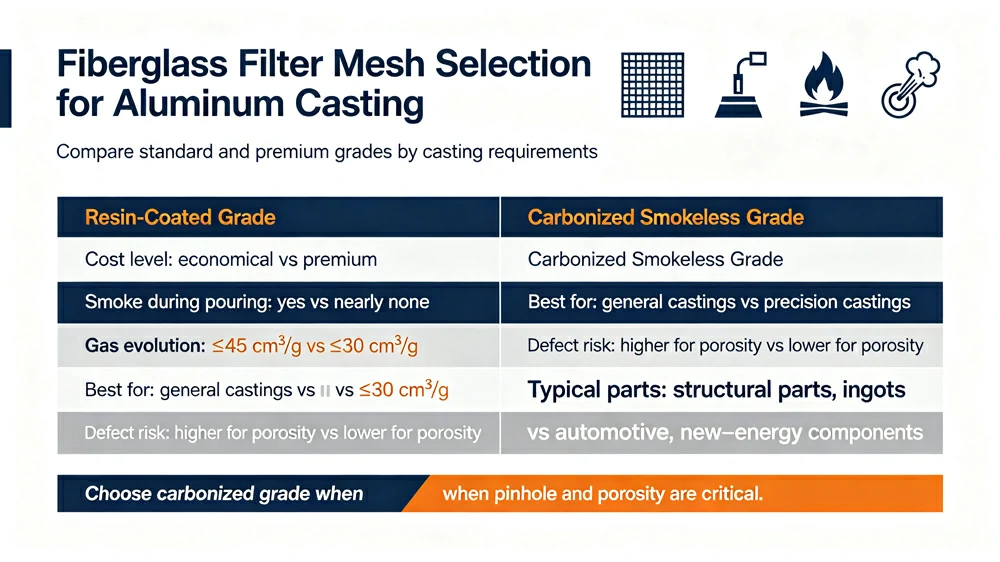
Resin or refractory coatings like phenolic resin and vermiculite don’t push the temperature ceiling higher. They add rigidity, enable shape retention, and convert flexible mesh into rigid sheets for easier handling. They improve resistance to erosion, fiber shedding, and cracking, increasing effective filtration area per pour without extending the standard 10-minute working window.
Cost and Application Fit
- Standard fiberglass: lowest cost, best for high-volume runs tolerant of minor surface defects.
- High-silica + coating: higher upfront cost, better ROI when scrap costs, flux activity, or inclusion rates run high.
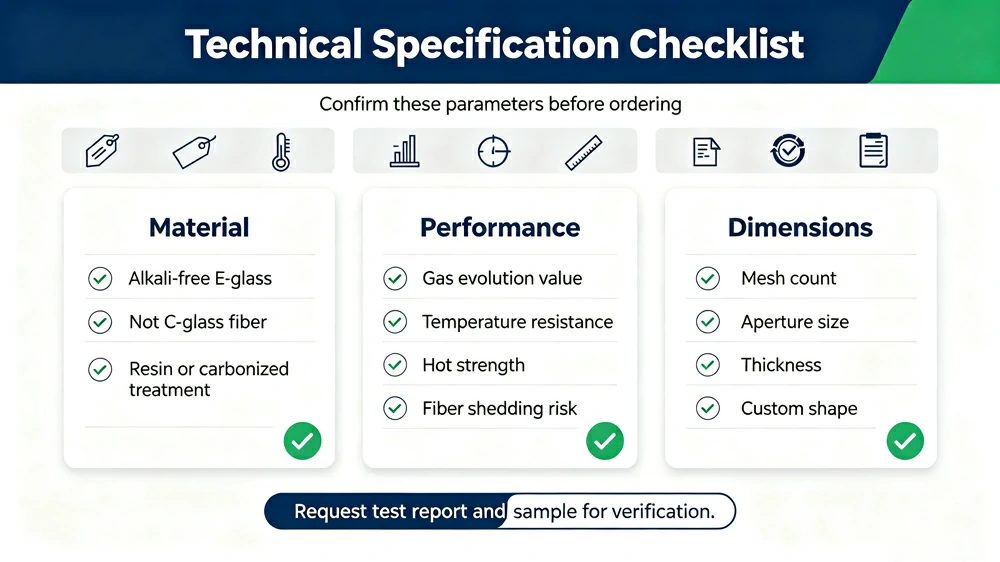
For purchasing, always request SiO2 content, softening temperature, coating type, and verified performance under actual aluminum wetting conditions.
Mechanical Strength and Stability Verification for Sustained Working Time
Six kilograms per four ends. That’s the tensile strength rating stamped on most aluminum filter mesh specs, and it decides whether your filter survives the pour or fails halfway through.
Reading the Strength-Temperature Relationship
Fiberglass filter mesh for aluminum casting is rated at 6 kg/4 ends, with a 700–800°C working range, a 900°C melting point, and a 10-minute sustained working time. Copper mesh carries the same 6 kg/4 ends rating. Iron filtration jumps to 8 kg/4 ends. Steel pushes to 16 kg/4 ends, but only for 5 minutes.
Higher pour temperatures demand more instantaneous strength but allow less sustained exposure. Steel needs the toughest mesh yet tolerates it for half the time aluminum does.
Matching Duration to Your Pour Cycle
If your pour or transfer window stays under 10 minutes, standard aluminum-grade mesh covers the full cycle. Push past that, and you’re gambling on rupture, perforation, or structural collapse, which leads straight to metal leakage, uncontrolled inclusions, and scrapped castings.
Verification checklist:
– Confirm 6 kg/4 ends minimum for aluminum
– Cap pour time at 10 minutes
– If time runs long, check mesh area, flow rate, and temperature before switching grades
Filter Mesh Shapes and Their Compatibility with Casting Equipment
Shape decides installation speed. Two mesh grades can share identical temperature ratings and mesh counts, yet one fits your equipment in seconds while the other stalls the line. That’s the physical-form problem most selection guides skip.
Roll-Cut Mesh for Flexible, Fast-Changeover Lines
With roll-cut fiberglass filter mesh, you trim it on-site, from 20×20mm up to 900×1000mm. It works with manual, semi-automatic, or fully automatic cutting equipment. No preheating needed. It drops straight into cold or warm molds, cutting setup time. It’s a single-pour consumable, best suited to multi-variety, small-batch production with frequent tooling changes.
Bag Filters for High-Volume, Distributed Flow
Bag-style mesh handles large-volume, distribution-heavy filtration of aluminum ingots, billets, and rectangular slabs. It’s the standard choice for continuous casting distribution boxes and pre-furnace flow-splitting systems. Some products rate up to 1000°C for aluminum service. Bags mount faster than sheets and reduce misalignment risk on fixed inlet/outlet interfaces.
Sheet and Custom Shapes for Precision Fit
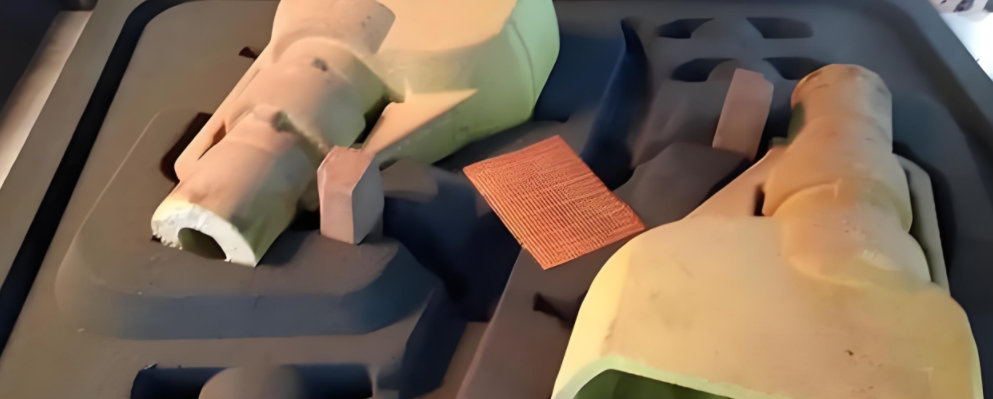
Sheet mesh suits Sand casting, gravity pouring, and low-pressure gate systems. Cut it square, round, or fan-shaped to match sprue cups and runners directly. One supplier recommends a filter area of 2–4 times the runway cross-section, based on 50–60% porosity and 60–80% filtration efficiency. Custom shapes fit low-pressure wheel and cylinder-head interfaces where bypass leakage isn’t tolerable.
Quick Matching Rule
- Sprue/runner filtration → sheet or roll-cut pieces
- Furnace mouth/pouring cup → round cup or preformed cap
- Continuous casting line → bag/box-style distribution structure
Selection Decision Process and Avoiding Common Pitfalls
Three foundries running identical alloys can land on three different mesh choices. The variable is the decision process.
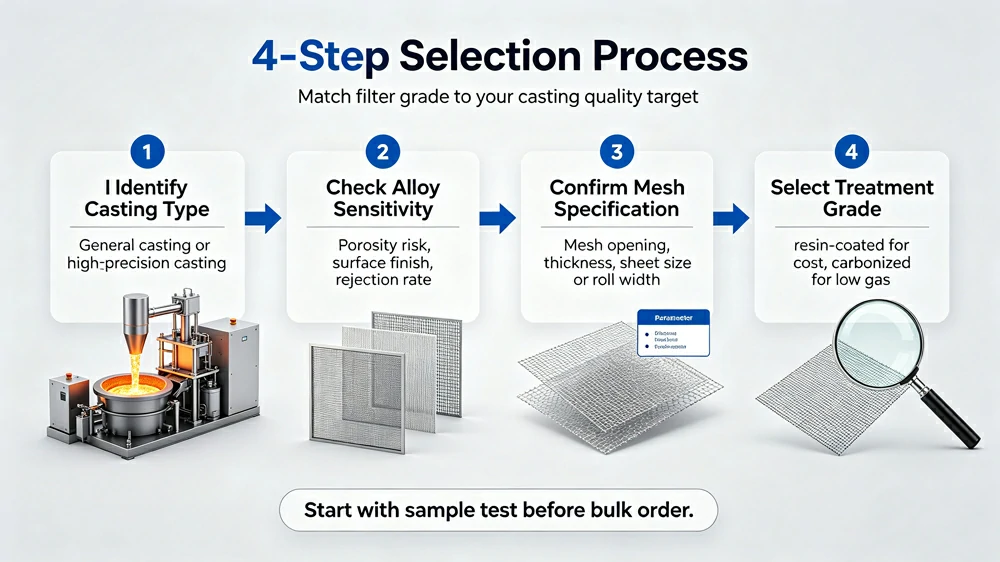
A tight workflow avoids most failures. Confirm pour temperature, lock mesh size to alloy cleanliness, verify tensile strength against dwell time, check physical fit against equipment, then trial-run before full production.
Skip steps, and hidden costs pile up fast. Clogged mesh causes 3–5 unplanned stops monthly, each costing $2,500–$8,000. Poor filtration on food-grade or precision alloys adds $5,000–$15,000 in scrap monthly.
Common mistakes include chasing low unit price while ignoring downtime, sizing mesh too fine for safety, matching material without checking real dwell time, and skipping sample trials before committing to a full production run.
Conclusion
Match the mesh to your actual pour temperature (not just the alloy’s melting point), balance mesh size against your inclusion removal targets without choking flow rate, and verify the filter’s mechanical strength holds up across your full casting cycle, not just the first pour. These three criteria are non-negotiable.
Skip any one of these, and you’re rolling the dice on porosity defects, filter blowouts mid-pour, or worse, contaminated castings that fail downstream. That’s an expensive lesson to learn on the shop floor.
Once you know what to check, selecting the right fiberglass filter mesh for aluminum casting is a systematic process. Pull your process data (temperature logs, alloy specs, current defect rates), match them against the criteria we covered, and you’ll narrow your options fast.
If you’re still unsure which mesh spec fits your setup, talk to a filtration specialist who can review your process parameters before you commit to a bulk order. The right mesh pays for itself in fewer rejects, while the wrong one costs you far more than the filter itself.