A single batch of contaminated molten aluminium can cost a foundry lakhs in scrapped castings. More often than not, the culprit is substandard filtration mesh—mesh that couldn’t survive the heat or missed the particulates it was supposed to catch.
If you’re sourcing glass fiber filter mesh for aluminium filtration in India, you’ve already seen the gap: suppliers who talk a big game versus those who actually deliver mesh that holds up at 700°C+ without degrading.
This guide gives you the real specs to demand—mesh count, thermal ratings, fiber composition—plus a shortlist of Indian suppliers worth vetting, a checklist to verify their claims, and an honest comparison against international alternatives. Your next procurement decision should rest on evidence, not a sales pitch.
The Core Role and Working Principle of Glass Fiber Filter Mesh in Aluminum Filtration
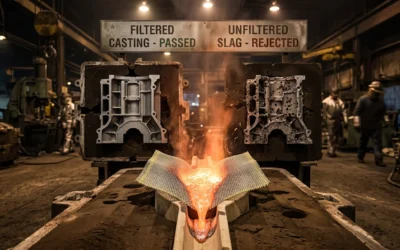
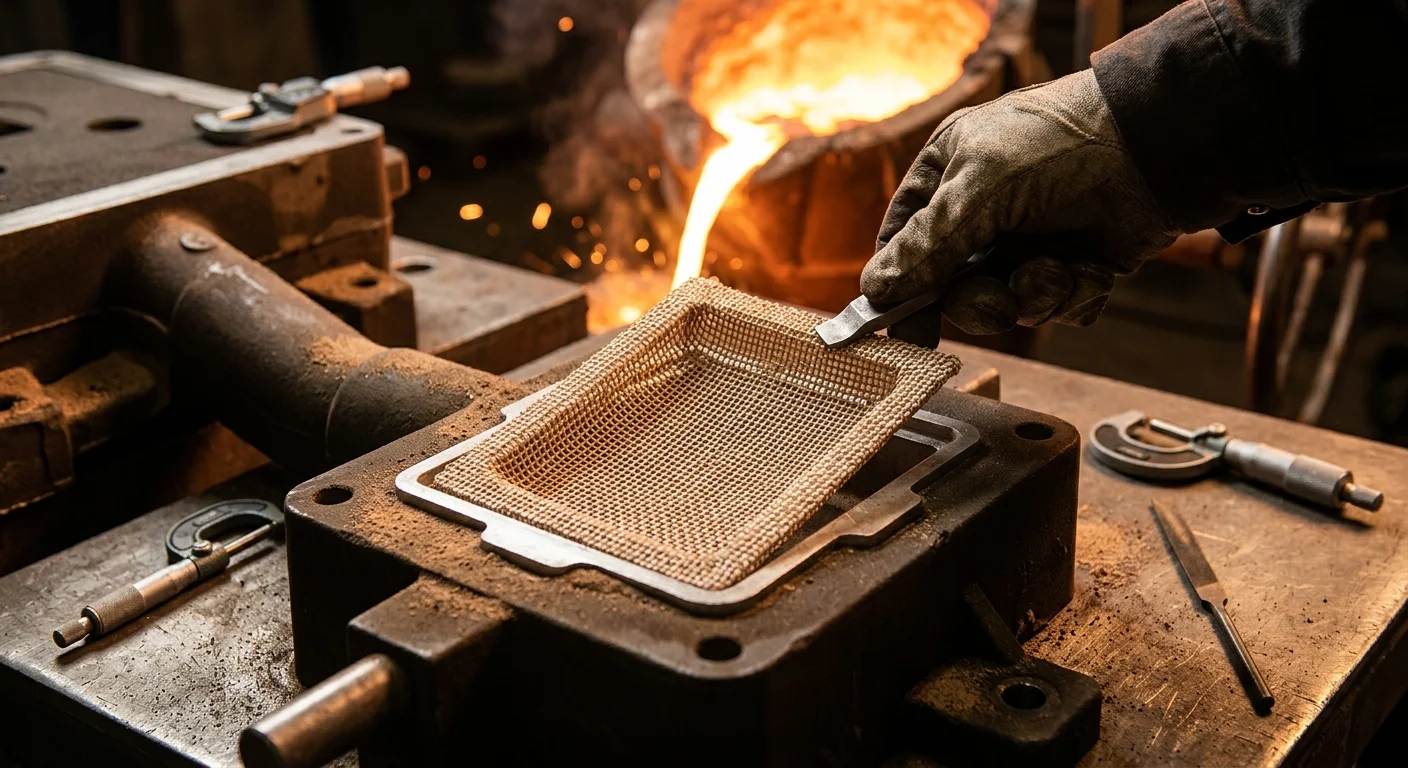
Inside a filter box during a pour, molten aluminium gets purified by the glass fiber filter mesh before it reaches the mould or die cavity. The mesh intercepts oxide inclusions, slag particles, and trapped gas bubbles while calming turbulent flow. Less turbulence means fewer defects. Fewer defects mean higher casting yield.
What the Material Is
The most reliable mesh in this category is woven from alkali-free E-glass fiber, a high-temperature, non-metallic filtration media built for non-ferrous Metal casting, including aluminium. Industry documentation describes its function in three words: filtration, turbulence reduction, and flow distribution improvement. Two structural factors decide whether a mesh performs or fails: mesh count (the opening size) and weave pattern. Mesh count alone determines the balance between filtration efficiency and cost. Smaller openings trap more, but they also increase flow resistance and price.
Plain Weave vs. Leno Weave
Not all weaves behave the same under molten aluminium.
Plain weave has a simple structure, regular pore geometry, and predictable flow resistance. It works best for standard filtration panels at lower cost and stable processing, suited to routine aluminium pouring operations.
Leno weave uses interlocked warp threads that lock the structure together. This prevents mesh deformation under heat and handling stress. It’s a better choice for higher flow volumes or more demanding installation conditions.
Practical rule: routine pours go plain weave. Complex or high-throughput setups go leno.
How Filtration Works
Glass microfibers work as a deep filtration system, not a simple mesh screen. The process goes like this:
-
Flow rectification: molten aluminium hits the mesh, spreads out, and loses velocity gradient. Less impact, less gas entrainment.
-
Mechanical interception: larger oxide films and slag get caught at the mesh surface.
-
Deep capture: smaller particles get absorbed and retained inside the fiber structure itself, not just blocked at the surface.
-
Reduced re-oxidation: calmer flow means less turbulent contact with air, which limits new oxide formation.
-
Better final quality: fewer gas holes, less slag inclusion, cleaner surface finish, stronger internal structure.
Where It Gets Used
This filtration step sits in the pouring line for aluminium ingots, bars, sheets, wheels, pistons, and automotive or motorcycle components. It’s positioned at the runner, filter box, or filter plate stage, right before molten aluminium enters the mould. Some foundries even recycle the used mesh along with scrap during remelting.
Quality glass fiber mesh barely affects the aluminium alloy’s chemical composition. For foundries running tight alloy specs, that’s not a minor detail. It’s often the deciding factor.
Key Technical Selection Criteria: Temperature, Mesh Count, and Material
Three numbers separate a mesh that survives a pour from one that fails mid-batch: temperature rating, mesh count, and fiber composition. Get any one wrong, and you’re back to scrapped castings.
Temperature Rating: Read the Fine Print
Most stainless steel mesh in industrial filtration tops out at ≤800°C—fine for general screening, useless for molten aluminium running at 700°C+. Push into 310S stainless steel (0Cr25Ni20) territory and you’re looking at ≤600°C-rated wire, typically 80–200 mesh at 0.5–2mm thickness, common in petrochemical setups. Neither matches what aluminium foundries actually need. If a supplier quotes 1200°C without showing test data, ask for it. There’s no universal published standard at that range—only engineering validation against your furnace’s actual thermal shock and oxidation conditions.
Mesh Count: Bigger Number, Smaller Hole
One mesh count equals openings per inch. Higher count, finer capture, lower flow. Roughly: 20 mesh ≈ 840–850 μm, 80–100 mesh ≈ 150–178 μm (the industrial sweet spot for protecting downstream equipment), 200 mesh ≈ 74–75 μm, and 300+ mesh for fine particulate control. A practical rule engineers use: pick mesh count at roughly 1/3 the target particle diameter. Chasing 100 μm inclusions means 300+ mesh minimum.
Material Grade: Where E-Glass Fits
Alkali-free E-glass doesn’t have one universal published spec sheet—vendors vary. What you should verify instead: heat tolerance, chemical stability, filament diameter (0.5–2.5mm), fabric weight (50–400 g/m²), and weave structure. For comparison, metal alternatives split by environment—304 for general use, 316L/2205 for corrosive/chlorine exposure, 310S for high-heat priority.
Open Area: The Hidden Variable
Mesh count alone doesn’t fix flow rate. Wire diameter and weave determine open area, and open area determines throughput. Approximate formula for plain weave: pore diameter (µm) ≈ (25,400 / mesh count) − wire diameter (µm). Two mesh sheets at identical count can flow completely differently.
A Reliable List of Local Indian Suppliers and How to Verify Their Credentials
A glossy company brochure means nothing. The question is whether the paperwork behind it checks out against government databases.
Six Documents That Actually Prove Legitimacy
Before you shortlist any glass fiber filter mesh supplier in India, run these checks:
-
GSTIN: Verify “Active” status on the GST Portal. Match company name, state, and registration address.
-
MCA/CIN: Pull the company’s registration number, incorporation date, and director details from MCA21. LLPs need Master Data too.
-
IEC: If they claim export capability, confirm a valid Import Export Code through DGFT’s “View Any IEC” tool.
-
Udyam/MSME: A genuine 19-digit Udyam number (format: UDYAM-XX-00-0000000) confirms local manufacturing status.
-
ISO/BIS certificates: Don’t trust screenshots. Cross-check the certificate holder’s name, factory address, and scope with the issuing body.
-
Third-party test reports: SGS, Bureau Veritas, or IIP reports carry weight. Internal QC sheets from the supplier don’t.
Gujarat Suppliers Worth a Closer Look
Leo Technical Textile, Unitech Glass Tech, and Supertech Fabrics come up often in sourcing conversations. What matters is whether factory address, years in operation, monthly capacity, and the six documents above align on record.
Aluminium-Specific vs. General Filtration Suppliers
Comparing Shri Premolite Industries against Urja Fabrics? Pull five data points from each: temperature range, mesh count range, fiber material, certification status, and most critically proven aluminium industry supply history. A supplier with documented aluminium casting clients and matching test reports usually beats one selling generic filtration media across ten unrelated industries.
The Verification Sequence That Works
Shortlist 5-10 candidates. Verify GSTIN, CIN, IEC, and Udyam against official records. Request factory address, capacity charts, samples, test reports, and client references. Visit the factory physically or via video call, checking raw material storage, machines, and batch logs. Place a small trial order before committing to volume.
How to Verify Supplier Reliability: A Practical Checklist
Paperwork gets you in the door. Performance data gets you a repeat order. Here’s what separates the two.
Ask These Before You Buy
Push every glass fiber filter mesh supplier for aluminium filtration to answer: does the mesh carry an explicit “molten aluminium” rating with material grade and temperature ceiling? No clear label, treat the sample as high-risk. Demand continuous heat-exposure test data—method, temperature curve, sample size, failure criteria—not just the phrase “heat resistant.” Ask for batch-to-batch consistency records: incoming inspection, outgoing QC, and CAPA documentation. One good sample proves nothing about the next 500 rolls.
Trial Batch Testing
Before scaling volume, run a small trial under identical conditions and track three hard numbers: slag buildup, mesh breakage rate, and service life. Log spec, mesh count, edge treatment, and batch number for every sample. Compare results across suppliers under the same temperature range and run time.
Background Verification
Search public reviews for recurring complaints—delivery delays, quality drift, poor after-sales support. Request named client references and confirm the relationships are real. Check trade show history: consistent participation and matching booth names signal genuine capacity.
Scoring Sheet for Your Team
-
Quality: defect rate, return rate, warranty claims, CAPA closure speed
-
Delivery: on-time rate, order completeness, response speed
-
Documentation: certifications, test reports, change records
-
Red flags: no actual-value reports, refusal of factory visits, unverifiable clients
Desk review works for low-risk, stable suppliers. Anything custom or unproven needs a factory visit.
Where India Stands Against China And Other International Suppliers
India’s PLI solar manufacturing data tells the story. Indosol Solar lists 65 Chinese suppliers out of 94 total, and Waaree Energies sources all 20 of its listed suppliers from China. Roughly 70% of India’s installed solar capacity runs on Chinese-made equipment. This is a manufacturing scale gap. China accounts for close to 35% of global manufacturing output; India is under 3%. For glass fiber filter mesh buyers, China wins on complex, high-temperature, high-volume parts, and India wins on flexibility.
Indian labor costs run roughly 70% cheaper than China on paper. Factor in productivity and supervision overhead, and India’s real labor cost climbs to 2-3x China’s effective rate. A lower unit price doesn’t always mean a lower total cost.
Quick Comparison Table
|
Factor |
Indian Suppliers |
China/International Suppliers |
|---|---|---|
|
MOQ |
Flexible, good for trial batches; higher per-unit cost at low volume |
Higher MOQ, lower per-unit cost at scale |
|
Lead time |
Fragmented capacity, variable delivery |
Mature supply chains, faster reorders |
|
Technical capability |
Better for custom, labor-intensive work |
Better for complex, high-heat, precision parts |
|
After-sales support |
Faster local response |
Slower cross-border communication |
|
Import duty |
None—transparent landed cost |
Duty, customs, forex add to landed cost |
Chinese suppliers worth benchmarking for high-temperature or piston-casting applications include Kingwell (1200°C-rated, piston-casting specific) and Baoding Ningxin (strong on customization and batch consistency). Neither publishes a full public price sheet, so request MOQ, sample-to-bulk pricing tiers, lead times, temperature/material specs, certifications (ISO 9001, IATF 16949), and duty-inclusive landed cost directly.
For small trial orders and fast after-sales support, go Indian. For high-temperature, precision, or bulk production runs, benchmark against Chinese suppliers before locking in price.
A Practical Buying Guide: From RFQ to Delivery
Getting a quote is easy. Getting the right quote is where most buyers stumble.
What Your RFQ Must Spell Out
A vague inquiry gets vague answers. Your RFQ should include material name and exact specification, quantity, delivery timeline, acceptance criteria, payment terms, quote deadline, pricing basis (tax-inclusive or not, per-unit or total), delivery location, and after-sales terms. For technical products like glass fiber filter mesh, ask suppliers to attach technical notes or a Q&A record too. Otherwise you’re comparing apples to oranges.
Documents Worth Fighting For
Push suppliers for temperature rating certificates, not verbal claims. If they can’t produce test conditions (duration, load, environment), the number is meaningless. Also demand mesh count test reports showing actual method, sample batch, measured count, and tolerance, not just “high mesh count.” Ask for material composition proof, especially for alkali-free claims. Get MSDS and composition analysis, not marketing pages. And require sample sign-off sheets with dimensional drawings and performance parameters before the first small batch ships.
Traps That Cost You Later
The lowest quote often hides shortcuts like cheaper raw material, compressed testing, and tighter timelines. Compare quotes only when scope, quantity, and delivery terms match exactly. Watch for mesh count exaggeration (demand retest on arrival), inflated temperature claims (no test conditions equals no credibility), and inconsistent pricing formats across suppliers. A real risk is that haggling through four or five rounds often pushes suppliers to quietly downgrade materials just to hold their price.
Four-Stage Buying Path
-
Small trial order: verify spec, temperature, mesh count, packaging, documentation.
-
Sample approval: lock version number, acceptance standard, deviation process.
-
Long-term agreement: after a few stable batches, sign annual terms covering price adjustment, delivery KPIs, and claims.
-
Review and rank: score every supplier post-delivery; build your own price and blacklist database for next time.
Conclusion
Picking the right glass fiber filter mesh directly impacts your aluminium melt quality, casting defects, and ultimately, your bottom line. Get the temperature rating, mesh count, and material grade wrong, and you’ll pay for it in scrap rates down the line.
If you’re looking for reliable glass fiber filter mesh for aluminium filtration in India, run potential suppliers through the verification checklist we covered: ask for test certificates, check their client references, and request a small trial batch before committing to bulk orders. Compare a couple of Indian manufacturers against international options on lead time and consistency, then base your decision on that data.
Shortlist two or three vetted suppliers this week, request samples, and test them on your actual production line.