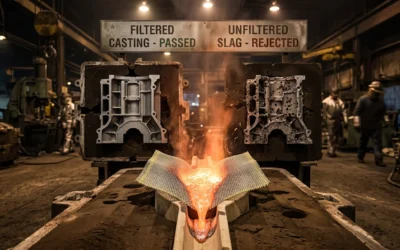
Pick the wrong filter and you’ll pay for it twice—once in scrap castings, once in wasted metal. Foundry engineers deal with that reality every time they spec a filtration system, and it’s why the Fiberglass mesh vs ceramic foam filter debate keeps coming up on shop floors. Both have their champions, both work great in the right application, and both will quietly sabotage your pour quality if you use them in the wrong scenario.
This is about matching filter architecture to your specific casting demands—alloy type, pour temperature, inclusion size, budget constraints. Get that match wrong, and even premium filter media won’t save you.
This guide breaks down where each filter type genuinely excels, what the cost-to-performance tradeoffs look like in practice, and how to build a selection framework you can apply to your next job—decision criteria that hold up on the shop floor, not generic advice.
Fiberglass Mesh Filter: Material Properties and Application Scenarios
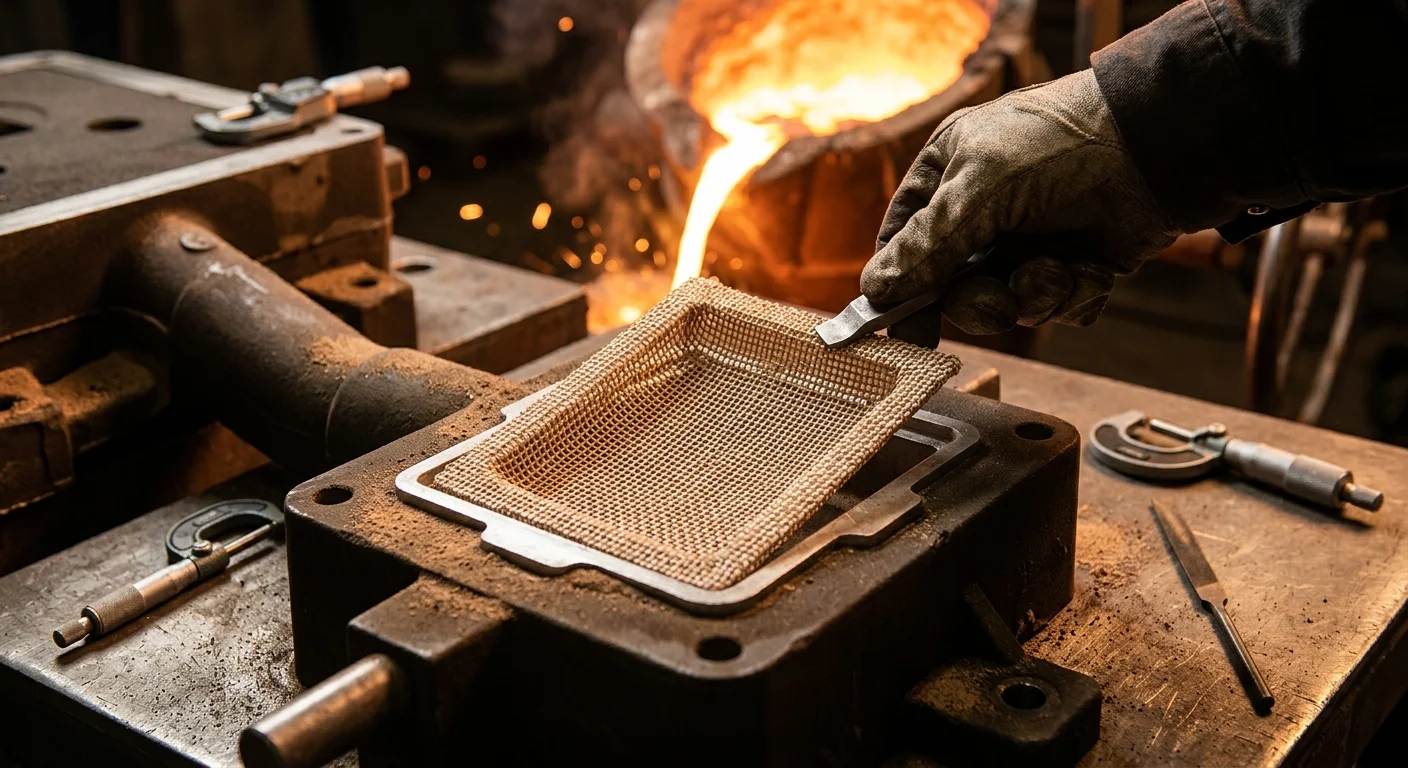
E-glass is the backbone of most Fiberglass mesh filters used in aluminum casting. Alkali-free E-glass fiber forms the mainstream structure you’ll find on shop floors worldwide. It’s chosen for a specific balance of cost, workability, and heat resistance within a defined window.

Material Specs That Matter
- Mesh grid size: typically 0.8×0.8 mm to 2.5×2.5 mm
- Thickness: 0.18–0.35 mm
- Working temperature: 700–800°C for standard applications (some products claim up to 900°C, but pushing that ceiling for extended periods is asking for trouble)
- Softening point: around 900°C—treat this as a hard limit
- Continuous duration at peak temp: 10–20 minutes at 700–800°C before performance degrades
- Gas evolution: roughly 30 cm³/g, which means you still need to manage surface contamination and gas pickup during the pour
That duration limit tells you everything about how this filter is meant to be used. It’s built for short-cycle filtration.
Where Fiberglass Mesh Actually Works
Continuous casting lines: aluminum ingots, bars, plates, and strips passing through launder systems, holding furnaces, and pre-pour delivery sections
Standard aluminum castings: wheels, pistons, engine blocks/heads, transmission housings, installed at the gating system, runner, or low-pressure casting channel
Precision and low-pressure casting: automotive and motorcycle wheels, aluminum pistons, where the goal is reducing turbulence and stabilizing metal flow
Why Foundries Keep Choosing It
Cost efficiency. For high-volume, single-use filtration, fiberglass mesh beats ceramic foam on price per pour.
Flow stabilization. It disperses the metal stream, cuts turbulence, and reduces oxide film formation during fill.
Basic impurity capture. Slag and larger oxide inclusions get caught, making it solid as a front-end or protective filter.
Where It Falls Short
Temperature ceiling sits well below Ceramic foam alternatives. Continuous high-temp exposure is capped at 10–20 minutes, not suitable for long soak times. And if your target is ultra-clean aluminum with tight inclusion control specs, fiberglass mesh alone won’t get you there. That’s ceramic foam territory.
Ceramic Foam Filter: Material Properties and Application Scenarios
High-purity aluminum oxide (Al2O3) changes the equation. That’s what Ceramic foam Filters are built on—a material that performs at a level fiberglass mesh never reaches.
Material Specs That Matter
- Porosity: ≥80%
- Bulk density: roughly 0.3–0.5 g/cm³
- Cold compressive strength: ≥0.8 MPa
- Continuous working temperature: up to 1100°C
- Thermal shock resistance: survives roughly 3 cycles of 1100°C-to-room-temperature swings
That temperature ceiling puts ceramic foam in a different durability category than fiberglass mesh. Some suppliers list 1100°C as the continuous service limit, not just a peak spike tolerance.

PPI Selection Logic (Pore Density Drives Everything)
PPI stands for pores per inch. Higher PPI filters finer, but resists flow more. Here’s how it breaks down:
10–20 PPI: high-volume, low-resistance jobs—think high-pressure die casting and larger, simpler castings
20–30 PPI: general aluminum alloy castings, gravity die casting, structural components—the balanced middle ground
30–40 PPI: precision castings, automotive structural parts, thin-wall components where surface quality matters
50–60 PPI: aerospace and ultra-high-purity electronic castings—maximum cleanliness, maximum resistance
Matching PPI to Alloy Type
- 1xxx pure aluminum: 30–50 PPI
- 3xxx (Al-Mn): 30–40 PPI
- 5xxx (Al-Mg): 20–30 PPI—magnesium oxidizes fast, so lower PPI avoids premature clogging
- 6xxx (Al-Mg-Si): 30–40 PPI
- 8xxx and high-purity grades: 40–60 PPI
The pattern is simple: tighter purity targets push PPI higher. But alloys prone to oxidation need lower PPI regardless of purity goals, or you’ll choke the flow before the pour finishes.
Industry Applications
Automotive structural components typically land in the 20–40 PPI range, balancing inclusion control with production speed. Aerospace parts push into 30–60 PPI territory, where inclusion and porosity tolerances are unforgiving.
The Tradeoff You Can’t Ignore
ceramic foam filters cost more than fiberglass mesh, full stop. Higher PPI means higher resistance—you need to match filter area, pour rate, and alloy fluidity precisely, or you’ll see pressure drop and clogging mid-pour.
Selection order matters here: alloy type first, then cleanliness target, then casting geometry, then pour flow rate—only then PPI.
Core Comparison: Material, Temperature, Cost, Filtration Efficiency
Numbers settle most filter arguments faster than opinions do. Line up material composition, temperature ceilings, price per unit, and capture rates side by side, and the fiberglass mesh vs ceramic foam filter question starts answering itself.
Material Composition Goes Deeper Than “Glass vs Ceramic”
Ceramic Foam filters aren’t one material—they’re a family. SiC, ZrO2, and Al2O3 each tolerate different heat ranges: roughly 1560°C, 1760°C, and 1250°C respectively. That’s why “ceramic foam” specs vary so widely between suppliers—they’re not always talking about the same base material.
Metal mesh filters top out around 500°C. That’s a different durability tier, better suited to lower-temp or non-molten-metal applications than aluminum casting floors. Coated fiberglass filters sit in the middle at roughly 800°C, priced below ceramic foam but above bare metal mesh.
The structural advantage ceramic foam holds is the open, interconnected pore network. It enables Deep bed filtration, catching inclusions throughout the filter body instead of just at the surface. Mesh and coated fiberglass rely more on surface screening.
Temperature Ceilings, Ranked
- Ceramic foam (ZrO2): up to 1760°C—covers the hottest molten metal scenarios
- Ceramic foam (SiC/Al2O3): 1250–1560°C range
- Coated fiberglass: ~800°C
- Metal mesh: ~500°C
Cost Per Unit
- Ceramic foam filters: $25–42 per piece
- Coated fiberglass: $11–21 per piece
- Metal mesh: $3–7 per piece
Cost ranking runs metal mesh < coated fiberglass < ceramic foam. Within ceramic foam itself, ZrO2 typically costs more than SiC or Al2O3—you’re paying for that higher temperature window.
Filtration Efficiency by Particle Size
Ceramic foam’s efficiency scales with inclusion size:
- <60 μm inclusions: 60–70%+ capture rate
- 70–79 μm: ~88%
- >80 μm: ~97%
Broader industry data puts overall ceramic foam efficiency between 30% and 90%, depending on melt cleanliness. Cleaner melts with larger particles push efficiency toward 85–90%. Dirtier feedstock can drag it down to 30–40%. Best-case scenarios reach the 95% range.
Comparison Table
| Dimension | Ceramic Foam | Metal Mesh | Coated Fiberglass |
|---|---|---|---|
| Base Material | SiC / ZrO2 / Al2O3 | Metal alloy | Fiberglass + coating |
| Temp Ceiling | 1250–1760°C | ~500°C | ~800°C |
| Unit Cost | $25–42 | $3–7 | $11–21 |
| Efficiency | Up to 95% | Coarser filtration | Moderate |
| Install Complexity | Medium–High | Low | Low–Medium |
Bottom line: high heat and high inclusion capture point toward ceramic foam. Budget-driven, coarse filtration favors metal mesh. Coated fiberglass splits the difference.
How to Match Your Filter to the Casting Job
Before you open a spec sheet, three questions decide most filter selections: what alloy you’re pouring, how clean the metal needs to be, and your pour temperature. Everything else—casting process, budget, how much room you have in the gating system—starts from those answers.
When Fiberglass Mesh Makes Sense
Fiberglass mesh is for standard aluminum castings when cleanliness needs are low to mid and cost matters. Think automotive brackets, housing components, general machined blanks, pump and valve bodies in common aluminum grades. Mesh does its job without spending extra. It runs in Sand casting, permanent mold, shell mold, die casting, and precision casting lines, as long as the pour temperature stays within its working range—roughly 850°C for standard fiberglass grades. Typical mesh products have openings around 1.5×1.5 mm, porosity near 50–60%, and thickness around 0.35 mm. It’s an economical, often single-use setup for smaller parts, not safety-critical structural pieces.
When Ceramic Foam Justifies the Cost
Ceramic foam takes over once the part carries structural or safety weight, or the alloy demands tighter inclusion control. Engine blocks, cylinder heads, brake discs and drums, pressure vessel components, pump housings, valve bodies, railway wheels and bogie parts, crusher jaw plates—these all rely on ceramic foam’s higher capture rate and ability to reduce turbulence. It also works beyond aluminum: copper alloys, gray iron, Ductile Iron, and steel systems all use it. SiC-type filters are commonly rated near 1530°C, and the broader ceramic foam family tolerates roughly 1400–1750°C.
What To Consider
- Process type: Sand, permanent mold, shell, die, precision, and continuous casting each affect filter size, how you install it, and the temperature requirements.
- Cleanliness tier: Low-to-mid priority favors mesh; strict targets for inclusions, porosity, or scrap rate point you toward ceramic foam.
- Flow and turbulence: High pour speeds with turbulence risk push you toward ceramic foam—it filters and calms the flow at the same time.
- Installation space: Tight budgets and simple assembly work better with mesh; setups that need a stable filtration area within the gating system work better with ceramic foam.
- Filter area sizing: Engineering practice recommends an effective filter area 2–5 times the narrowest runner cross-section. That benchmark prevents clogging and pressure drop no matter which filter type you pick.
Quick Rule Of Thumb
Use fiberglass mesh for routine aluminum parts with moderate cleanliness needs, tighter budgets, and lower pour temperatures where “good enough” really is good enough. Choose ceramic foam for structural or safety-critical parts, premium alloys, and any job where low inclusion count and consistent quality matter more than unit cost.
Practical Application Tips: Mixed Use and Common Pitfalls
Nobody said you have to pick one filter and stick with it. Combining coarse and fine filtration—catching slag first, controlling fine inclusions second—is standard practice on plenty of shop floors. The fiberglass mesh vs ceramic foam filter decision often resolves into “both, staged correctly” rather than “either/or.”
Layering PPI For Real Jobs
Ceramic foam PPI ranges cluster around 10, 20, 30, 40, and 50. Here’s how foundries stack them:
High-volume or large castings: run 10–20 PPI first to guarantee fill, then step up to 20–30 PPI downstream for inclusion control
General automotive aluminum parts: 20–30 PPI alone, balancing flow rate against filtration
Thin-wall or surface-critical parts: push to 30–40 PPI—finer oxide capture, but expect more flow resistance
Four Mistakes That Keep Showing Up
- “Higher PPI is always better.” Higher PPI raises resistance and clogs faster—especially with dirty melt or fast pour speeds. You get incomplete fill, interrupted casting.
- Chasing filtration precision while ignoring flow. PPI has to be evaluated alongside pour rate, filter size, casting geometry, and gate height. Bump PPI without checking those, and “cleaner metal” turns into “misrun.”
- Overspecifying standard parts. Most aluminum castings sit at 20–30 PPI. Jumping straight to 40–60 PPI on a non-critical part is money spent for marginal gain.
- Mismatched PPI causing scrap either direction. Too high, and you get head-pressure loss plus early clogging. Too low, and fine inclusions slip straight through—defeating the point of filtering at all.
What Different Foundries Run
Die casters lean toward mid-to-low PPI—20–30 range—because stable fill and cycle time matter more than squeezing out extra cleanliness.
Gravity casting shops work 20–40 PPI, tilting toward 30–40 for cosmetic, pressure-tight, or premium parts.
Low-pressure casters favor finer filtration since fill depends on steady pressure and sequential flow—30–40 PPI shows up often in cleanliness-critical zones, though excessive resistance still risks late-stage underfill.
A Selection Rule You Can Apply Today
Set flow requirements first, PPI second. High-volume pours: start at 10–20 PPI. General-purpose castings: start at 20–30 PPI. High-cleanliness or thin-wall parts: start at 30–40 PPI. Then validate on the floor—watch for stable fill, absence of misruns, inclusion counts within spec, and whether the filter clogs prematurely. Adjust from there.
Quick Reference
| PPI Range | Best Fit |
|---|---|
| 10–20 | High-flow, coarse filtration, dirty melt, large parts |
| 20–30 | Most aluminum castings—the default starting point |
| 30–40 | High cleanliness, thin-wall, surface-sensitive parts |
| 60–80 | Only for extreme-purity applications—high clog risk |
Conclusion
Match the filter to the job. Fiberglass mesh works well in lower-temperature, cost-sensitive runs where quick setup matters more than absolute purity. Ceramic foam handles high-integrity castings that can’t afford inclusions, especially in thermally demanding pours. Read your casting requirements, including alloy type, pour temperature, and quality tolerances, before locking in a choice. Some foundries blend both, using mesh as a pre-filter ahead of ceramic foam for maximum cleanup.
Pull your process data, talk to your filter supplier about your specific alloy and pour conditions, and run a small trial batch before committing to a full production switch. The right filter choice today saves you scrap, rework, and headaches tomorrow.