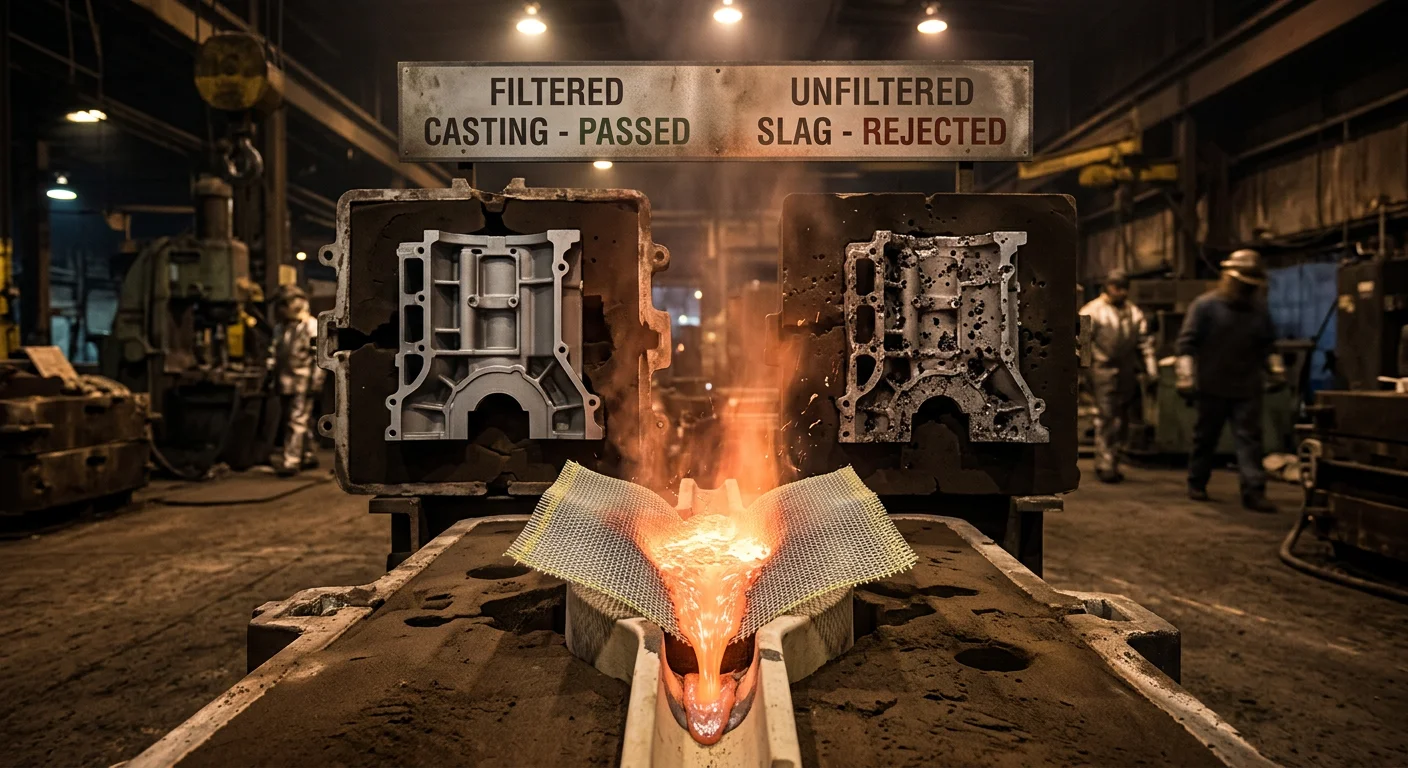
A single mislabeled roll of fiberglass mesh can turn a molten aluminum filtration or reinforcement job into a costly failure—and the culprit is almost always alkali content. When engineers compare E‑Glass vs C‑Glass fiberglass mesh, the differences look subtle on a spec sheet but become critical the moment either material meets aluminum at temperature. Medium‑alkali glass, often chosen because it’s cheaper or more available, breaks down chemically in ways that E‑Glass resists. The article walks through the chemistry of alkali-driven corrosion, compares E‑Glass and C‑Glass on the properties that matter in high-heat aluminum environments, and gives you a clear framework for choosing and sourcing the right mesh screens before your next production run.
E-Glass Fiberglass Mesh Core Characteristics: The Real Numbers Behind the Chemistry
Three numbers separate E-Glass from every alkali-heavy alternative on the market, and they’re worth memorizing before you sign a purchase order.
The Composition That Matters
A typical E-Glass formula runs SiO₂ at 52–56%, Al₂O₃ at 12–16%, CaO at 16–25%, B₂O₃ at 5–10%, and MgO at 0–5%. Industrial specs sometimes tighten that range to SiO₂ 53–55%, Al₂O₃ 14–15.5%, and combined CaO+MgO at 20–25%. The number buyers should actually chase is Na₂O/K₂O below 1%. That’s the whole story. Lower alkali content means slower ionic migration through the glass network, which translates directly into better alkali resistance, better moisture resistance, and tighter dimensional stability over time. It’s exactly why E-Glass dominates construction mesh, insulation reinforcement, and PCB substrates.
Thermal Limits You Can’t Ignore
E-Glass softens around 830–860°C, with a liquid/molten range stretching to roughly 1160–1196°C. Sounds like plenty of headroom, until you check the continuous-use ceiling, which sits at just 550°C. Engineers treat anything approaching 600°C as short-duration or restricted-exposure only.
Mechanical Profile for Spec Sheets
Tensile strength ranges from 3400 to 3700 MPa (commonly cited around 3445 MPa), elastic modulus is about 76 GPa, density is about 2.58 g/cm³, CTE is about 5 μm/m·°C, thermal conductivity is 0.85–1.0 W/m·K at 23°C, and elongation at break is 3.3–4.8%.
Mesh-Grade Data Worth Verifying
Areal density typically runs 60–260 g/m², with 110, 145, and 160–170 g/m² as common mid-range picks. Mesh openings land at 2.5×2.5 mm, 4×4 mm, or 5×5 mm, sometimes larger for exterior wall applications. A 230 g/m² construction-grade mesh should deliver initial warp/weft strength of ≥2600/2500 N/50mm, averaging ≥3100/3000 N/50mm, and after 28 days of alkali treatment, retain at least 50% of that strength. That retention threshold is the industry benchmark for anything calling itself high-performance E-Glass mesh.
C-Glass Medium-Alkali Glass Fiber Mesh: Properties and Common Misconceptions
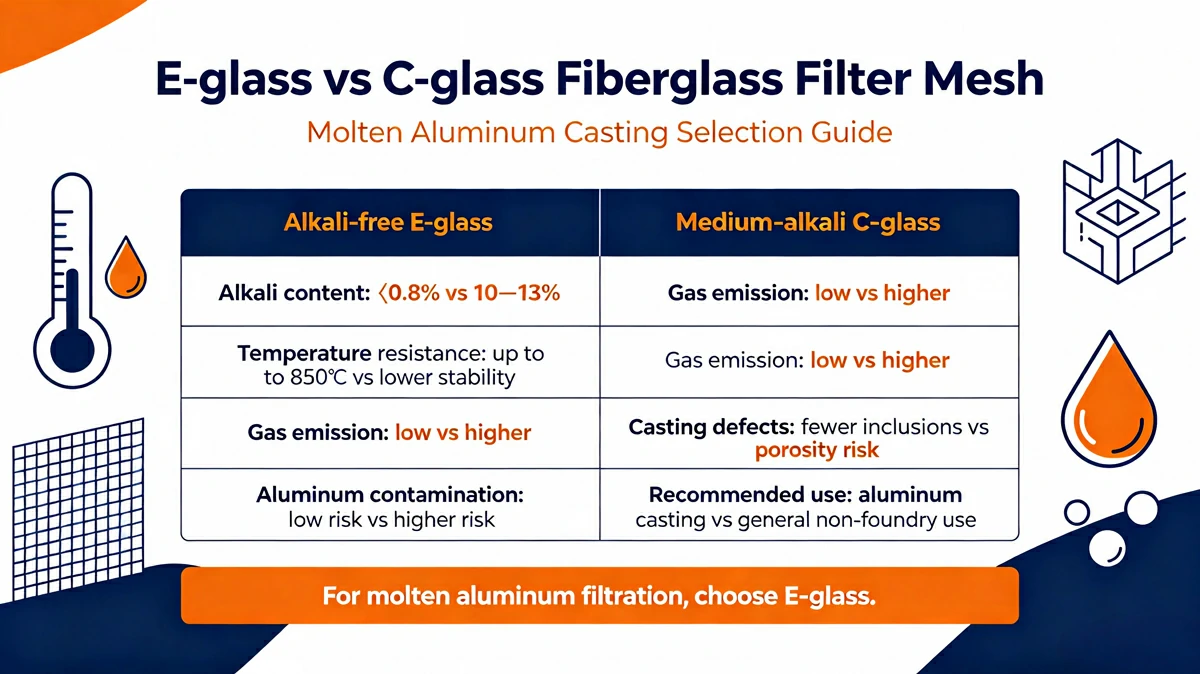
Strip away the marketing language and C-Glass comes down to one number: alkali metal oxide content at 11.5%–12.5%. Compare that to E-Glass, capped near 2 wt.%, and you see why the “medium-alkali” label exists. This is a different material philosophy.
What C-Glass Does Well
C-Glass earns its keep in acid resistance and chemical stability. Think acidic filtration cloth, acid-resistant mesh, coating substrates, wall reinforcement fabric—applications where electrical insulation doesn’t matter but chemical exposure does. E-Glass leans structural and electrical. Its acid resistance is documented as “relatively poor” in published specs. That’s the trade-off buyers need to internalize before they order a roll.
The Strength Gap, Quantified
E-Glass tensile strength runs around 3,445 MPa with a modulus near 76 GPa. C-Glass comes in lower—roughly 3,300 MPa tensile, 69 GPa modulus. That’s a 4.2% strength gap and a 9.2% modulus gap. Some datasets widen the range further: C-Glass at 2,400–3,500 MPa versus E-Glass at 3,100–3,800 MPa. The ranges overlap, but C-Glass consistently sits toward the lower bound. If a supplier tells you C-Glass is “only 10-20% weaker,” demand the test conditions—gauge length, resin content, yarn spec, ASTM C158-23 reference standard. Numbers from mismatched testing methods aren’t comparable.
The Myth That Costs Money
Projects go wrong when acid resistance gets confused with molten metal resistance. They’re not the same mechanism. Chemical corrosion resistance covers ambient and moderate-temperature exposure to acids, salts, solvents—glass fiber handles most of these well, with hydrofluoric acid as the notable exception. Molten metal contact involves extreme heat, wettability, oxidation-reduction reactions, and thermal shock. Different physics entirely. Higher alkali content also accelerates water erosion and microcracking over time, so “medium-alkali” is a targeted trade-off, not universal chemical armor. Acid fog, pickling lines, chemical filtration? C-Glass fits. Molten aluminum, furnace slag, casting contact? That calls for refractory-grade material, not C-Glass mesh mislabeled as a substitute.
The Chemical Mechanism Behind Molten Aluminum Attacking Fiberglass (Core Technical Support Section)
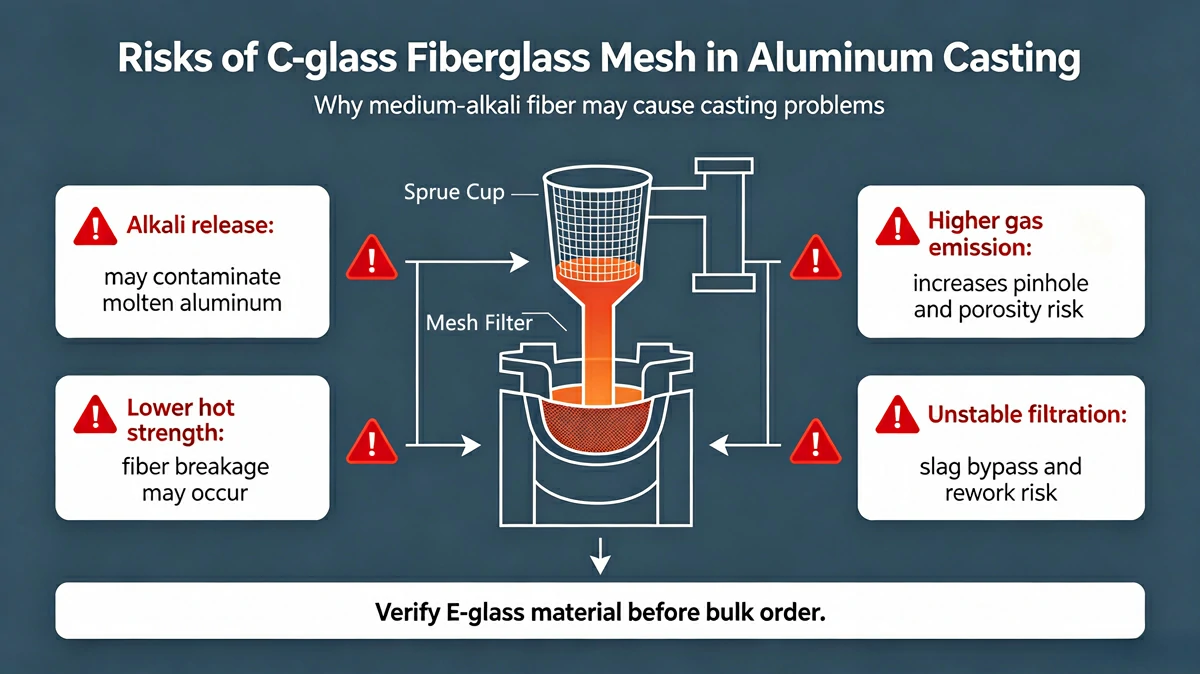
Chemistry, not marketing copy, decides whether a Fiberglass mesh survives contact with molten aluminum. The reaction is straightforward on paper: 4Al(l) + 3SiO₂(s) → 2Al₂O₃(s) + 3Si, sometimes written as 3SiO₂(s) + 4Al(l) → 2Al₂O₃(s) + 3Si. Molten aluminum acts as a powerful deoxidizer. It strips oxygen straight out of the SiO₂ network, leaving behind free silicon and a growing layer of α-Al₂O₃/γ-Al₂O₃ at the interface.
Aluminum first pulls oxygen from SiO₂, forming an Al₂O₃ skin at the boundary. From there, Al and Si ions diffuse across that reaction layer in opposite directions, and the reaction front keeps advancing as long as heat and contact persist. Molten aluminum/molten silica wetting tests confirm that the contact angle drops to roughly 90° between 800–1000°C, falling further as the reaction proceeds, driven by lower interfacial energy and shifting surface tension as Si dissolves into the melt.
At 700°C the reaction becomes measurable. Reaction-layer thickness grows following a square-root-of-time law, classic diffusion-controlled kinetics. Around 800°C erosion and penetration accelerate; one study on fiber preform infiltration recorded aluminum penetration rates near 3 mm/h at this threshold. Between 800 and 1000°C, wetting behavior shifts as the contact angle drops, with reaction byproducts changing surface chemistry.
What failure looks like
Glass fiber doesn’t dissolve evenly under molten aluminum. It fails through a chain reaction where an interfacial reaction layer forms, volume change triggers microcracking, and structural collapse follows. Post-reaction microstructure at room temperature shows Al₂O₃, free Si, and residual Al—sometimes with MgAl₂O₄ spinel when magnesium-bearing aluminum alloys are involved. That combination is brittle, non-uniform, and mechanically compromised on both sides of the interface.
Where alkali content fits into this mechanism
Na₂O and K₂O act as network modifiers. They cut Si–O–Si crosslinking density, loosen the glass network, and make ion exchange easier. A weaker, less polymerized network gives molten aluminum less resistance—oxygen extraction happens faster, and the reaction front pushes forward at a higher rate. Medium-alkali, soda-lime-silica-type glass already shows square-root reaction-layer growth starting around 700°C, meaning it enters diffusion-reaction coupled failure well before high-alkali-resistant alternatives.
Any silica-based fiberglass mesh with elevated Na₂O/K₂O reaches critical instability in the 700–800°C window. Surviving contact with molten aluminum requires cutting reactive SiO₂ content, increasing Al₂O₃ or mullite content, or applying isolation coatings—otherwise the chemistry above runs its course regardless of what the label says.
E-Glass vs C-Glass: Key Dimension Comparison Table
Numbers settle arguments faster than opinions. Here’s the side-by-side data engineers actually pull up when a purchase order is on the line.
| Dimension | E-Glass | C-Glass | Why It Matters |
|---|---|---|---|
| Density | 2.58–2.61 g/cm³ | ~2.49 g/cm³ | C-Glass is slightly lighter, but that difference rarely drives the choice |
| Temperature ceiling (commonly cited) | ~700°C | ~1000°C | The ceiling describes chemical stability, not survival in molten metal |
| Electrical insulation | Primary insulation material; low alkali content stabilizes dielectric performance | Not suitable for electrical insulation; high alkali content degrades it | For any insulation function, E-Glass is the default choice |
| Dielectric constant (22°C, 10 Hz) | 6.1–6.7 (verifiable range) | No stable published value; inferior in high-alkali systems | E-Glass provides tested, documented values; C-Glass doesn’t compete here |
| Acid immersion loss (sample data) | 39% strength loss | 25.8% strength loss | C-Glass performs better under acid exposure—this is its actual strength |
| RH 100%, 7-day strength loss (sample data) | 5% | 20% | E-Glass holds up better under humidity, another reason it dominates construction and structural use |
Application Priority
- E-Glass: electrical insulation, FRP reinforcement, general composites, insulation boards, cable and motor components
- C-Glass: acid-resistant linings, chemical corrosion layers, acid fog environments, non-insulation chemical-resistance scenarios
Selection logic follows from the table: pick E-Glass for insulation or structural loads, pick C-Glass for acid exposure, and never confuse either one’s “temperature rating” with molten aluminum survivability. Those are separate tests measuring separate failure modes.
The Right Material Choices for Molten Aluminum Applications
How much Al₂O₃ is in the material touching your melt? The higher the Al₂O₃-to-SiO₂ ratio, the better the resistance to molten aluminum attack. SiO₂ reacts with aluminum on contact and forms a corundum layer that accelerates degradation.
For Direct Contact with Molten Aluminum
For direct contact, skip glass fiber entirely. Silicon nitride (Si₃N₄), aluminum nitride (AlN), and boron nitride (BN) resist wetting and metal penetration far better than any silica-based option. A 4-ton vacuum induction furnace trial on aluminum-lithium alloys confirmed that alumina-silicon nitride composite refractories outperformed standard linings. High-purity alumina-magnesia and graphite-alumina composites also showed solid protective performance. Use these nitride-based composites for crucibles, ladles, tools, and any localized lining exposed to direct contact.
For Filtration Applications
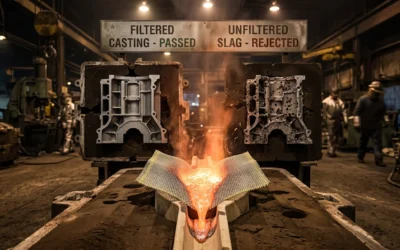
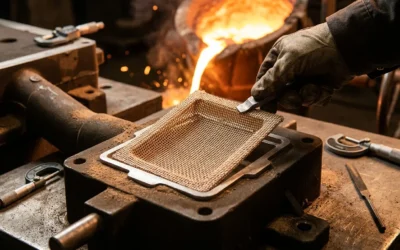
Filtration is a different exposure profile than direct contact, so high-silica E-Glass filter mesh remains the industry default. Published specs cluster around SiO₂ content of 58%, a working temperature of 700–800°C, and a softening point near 900°C. Mesh openings run 0.8×0.8mm to 2.5×2.5mm, with some products reaching 1.0×1.0mm. Areal density lands between 150–350 g/m², thickness between 0.18–0.35mm. Suppliers in the Hebei/North China cluster—Hebei Cangchen and Baoding Ningxin among them—standardize around these figures.
For Furnace Linings and Repair Zones
Prioritize high-Al₂O₃, low-SiO₂ systems, paired with non-wetting additives or densified surface coatings to slow reaction with the melt.
Purchasing Sequence
For direct melt contact, choose Si₃N₄/AlN/BN or Al₂O₃-nitride composites. For aluminum filtration, use high-silica/E-Glass mesh verified against 700–800°C service and 900°C softening point. For lining and insulation, go with high-Al₂O₃, low-SiO₂ refractory. For long service life and low contamination, select nitride composites or alumina-silicon nitride blends.
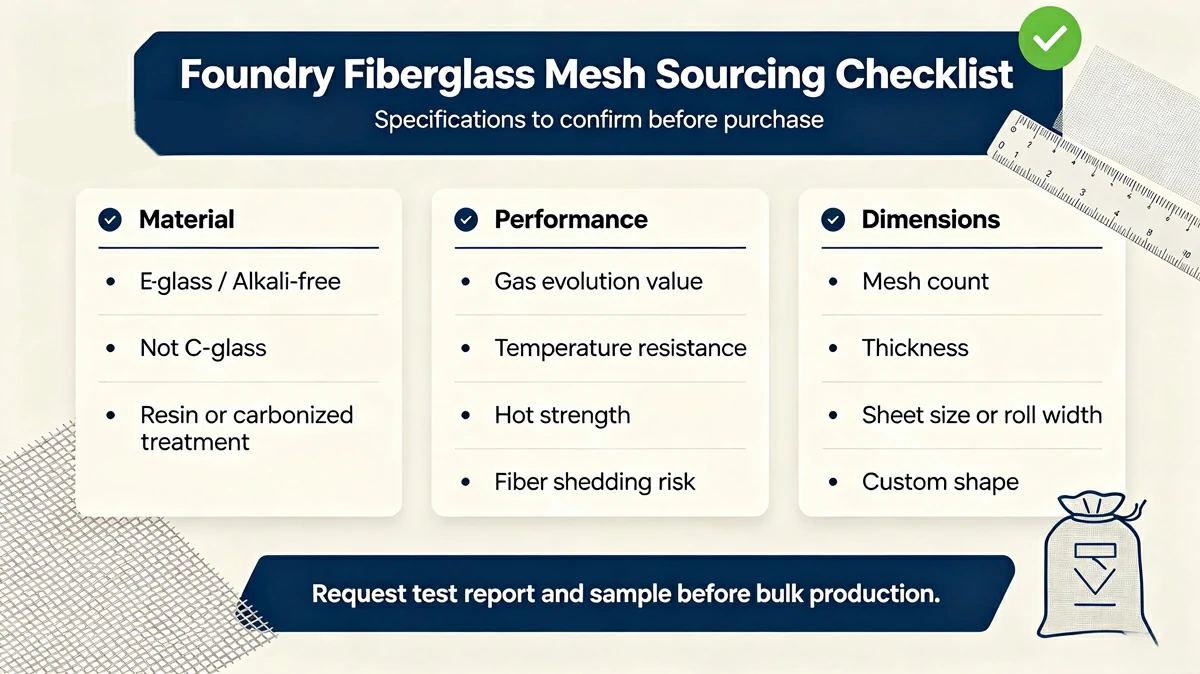
Procurement and Selection Decision Guide
Every failed fiberglass mesh order traces back to a decision made on paper, weeks before anyone opened the crate. The sequence below catches those mistakes before they cost you a production run.
Build the decision tree around exposure
Start with the application. Insulation reinforcement needs dielectric strength, CTI ratings, and low moisture absorption. Acid environments demand a documented chemical-resistance list plus mass-loss data at specific concentrations and temperatures. Molten metal contact needs long-term service temperature, thermal deformation point, and post-thermal-aging strength retention.
Lock boundary conditions before you request quotes
Nail down continuous operating temperature, peak temperature, and thermal cycle count. Define the chemical environment: acid or alkali type, concentration, soak time, splash exposure. Confirm mechanical load, abrasion, and dimensional tolerance. Check compliance needs: flame retardancy class, RoHS, REACH, food-contact status.
Demand apples-to-apples supplier comparisons
Quotes only mean something when everyone bids against the same baseline spec. Mixing E-Glass and C-Glass quotes without normalizing SiO₂ content, alkali percentage, and test standard (ASTM C158-23, for instance) invites bad comparisons. Score suppliers on technical fit, compliance, lead time, total cost of ownership, and risk in that order.
Common failure points to check before signing
- Vague material identity (“acid-resistant plastic” with no grade or temperature spec) invites underspecced substitutes
- Comparing insulation-grade materials on price alone while skipping CTI and dielectric strength
- Ignoring thermal aging data on high-heat parts, then discovering deformation after install
- No agreed COA items, sampling method, or test protocol at receiving
Supplier question checklist
Ask for the full grade name, standard number, and manufacturer identity. Get continuous-use temperature, peak temperature, and the acid/solvent resistance list in writing. Request test standards behind dielectric strength and CTI figures. Confirm MOQ, lead time, packaging, and whether COA/SDS ship with every batch. Push for same-condition project references and third-party test reports before committing volume.
Conclusion
The chemistry doesn’t lie: molten aluminum breaks down medium-alkali glass fast, and no amount of coating or wishful spec-sheet reading changes that fact. When you’re weighing E-Glass vs C-Glass fiberglass mesh filter for high-temperature aluminum applications, the decision is whether your reinforcement survives contact with the melt or dissolves into it. E-Glass has the low-alkali chemistry and thermal stability that molten aluminum demands; C-Glass wasn’t built for that.
If you’re sourcing mesh for foundry filtration, casting, or any aluminum-adjacent process, don’t gamble on alkali content buried in a datasheet. Ask your supplier for verified E-Glass composition, request corrosion test data, and treat material selection as a safety decision, not a procurement afterthought. Get the chemistry right, and yield, safety, and cost take care of themselves.