A Swedish Ductile Iron foundry and a Danish aluminum shop may both source molten metal filtration from the same European suppliers, but their specification sheets rarely match. Pore count, material chemistry, EN compliance documentation, and preferred filter geometry all change with the alloy mix, melt temperature, and the quality standards the procurement manager follows. For buyers, the gap between a generic ceramic foam filter (CFF) datasheet and what a Nordic foundry specifies can lead to rejected shipments or costly defect-reduction failures downstream.
This guide breaks down what Swedish and Danish buyers put in their technical data packages, from filter porosity ppi selection by alloy type to the supplier validation checks that separate a one-time vendor from a long-term gating system design partner. If you’re preparing a quote for the Nordic market, this is the specification logic you need to get right the first time.

Nordic Foundry Filtration Requirements: Core Buying Criteria
Pore count sits at the top of every Nordic specification sheet, shifting heavily by alloy. Swedish aluminum foundries use 20–40 PPI for standard work, then push to 30–60 PPI for critical structural components that demand clean metal. Tighter porosity captures more inclusions, but it raises pressure drop, clogging risks, and short pours. Danish shops running copper and copper alloys hold at 10–30 PPI, choosing flow stability at high temperatures over dense filtration.
Filter sizing also requires specific area ratios alongside PPI:
-
Gray cast iron: filter area at least 3x the gating system’s choke area
-
Aluminum and copper alloys: minimum 4x choke area
-
Ductile iron: minimum 5x choke area
Buyers running high-volume or dirtier iron melts lean toward 10–15 PPI with thicker filter bodies, giving the melt a longer depth-filtration path. Thin-wall castings and cleaner aluminum streams run in the other direction: 20–40 PPI with a thinner cross-section. Filter thickness across the Nordic market spans 10–50 mm, where thicker units capture more particulate in exchange for higher static head requirements.
Foundries match flow capacity directly against filter diameter. Published aluminum casting filter benchmarks show:
-
12″: 90–150 kg/min
-
15″: 140–290 kg/min
-
17″: 180–390 kg/min
-
20″: 270–510 kg/min
-
23″: 380–700 kg/min
-
26″: 450–950 kg/min
Thermal limits round out the specifications. Alumina Ceramic Foam filters (CFF) top out near 1100°C, which handles aluminum but fails in steel or nickel-based alloys. Those pours require zirconia filtration rated to 1760°C. To initiate flow in aluminum systems, operators need 50–120 mm of metallostatic head above the filter, though the exact height depends on porosity, wetting behavior, and melt cleanliness.
Filter Specification By Alloy: Swedish & Danish Standard Starting Points
Standards compliance comes before PPI selection. Swedish foundries work from SS-EN designations, while Danish buyers reference DS/EN. Both trace back to the same European framework, with EN 1561 governing grey cast iron across both markets. Danish delivery terms go further by specifying direct test methods for castings, which Swedish buyers often request as supporting documentation even when their own rules do not mandate it.
filter materials and PPI ranges vary by alloy:
|
Alloy |
Filter Material |
Starting PPI |
|---|---|---|
|
Grey cast iron |
SiC or alumina |
10–20 PPI |
|
Ductile iron |
SiC or alumina |
10–20 PPI |
|
Malleable iron |
Alumina or SiC |
10–20 PPI |
|
Aluminium alloys |
Alumina foam |
20–30 PPI |
|
Structural aluminium |
High-purity alumina |
30–40 PPI |
|
Copper alloys |
Alumina or zirconia |
20–30 PPI |
|
Carbon/low-alloy steel |
Zirconia or carbon-ceramic |
10–20 PPI |
|
Stainless/high-alloy steel |
Zirconia or high-temp alumina |
10–20 PPI |
Commercial grades run 10, 20, 30, 40, 50, and 60 PPI. When a Nordic buyer puts “30 PPI” on a spec sheet, they expect 28–32 pores per linear inch; “40 PPI” lands around 38–42. If a supplier cannot confirm that tolerance range on request, they rarely test their product batch to batch.
Filter sizing follows standard catalogue dimensions. Round filters run from Ø40 to Ø125 mm, square filters range from 40×40 to 150×150 mm, and a 10–22 mm thickness covers most orders. Open porosity sits at 80–90% for standard ceramic foam. A practical Nordic RFQ baseline is 50×50×15 mm, 30 PPI alumina for structural aluminium, and 75×75×20 mm, 10–20 PPI SiC or alumina for iron.
Ceramic Foam Filter (CFF) vs Extruded Ceramic Filter: Which Nordic Foundries Prefer

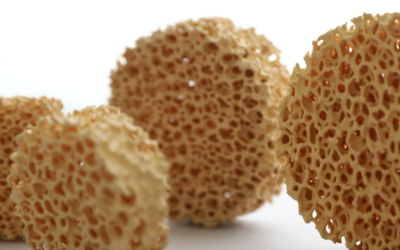
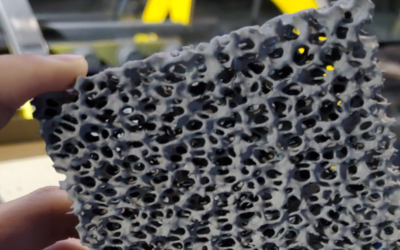
Internal geometry dictates how both filters behave. A ceramic foam filter (CFF) uses an interconnected, three-dimensional network of winding, near-dodecahedral pores. As molten metal moves through this maze, it repeatedly changes direction, trapping impurities deep inside the structure as well as on the surface. Extruded Ceramic filters take a different approach, using straight, parallel channels in a honeycomb grid engineered for uniform cell dimensions and minimal pressure drop. Without a tortuous path, filtration relies almost entirely on surface screening.
That structural difference directly affects the pour. Internal turbulence inside a CFF blocks inclusions and helps contain oxide films, but it increases pressure drop, particularly at higher PPI ratings or in dirty melt. Extruded filters maintain a smoother, more predictable flow with lower clogging risk, though they do less to dampen turbulence and capture fewer fine inclusions.
Nordic foundries split their choice by melt condition and alloy:
-
Dirty melt, high-volume iron, large castings (common across Sweden, Finland, and Norway for ductile iron and heavy sections): 10–15 PPI CFF provides coarse, high-throughput filtration with low clogging risk. When static head is limited or pour volume is extreme, low-pressure-drop extruded filters serve as the fallback.
-
General aluminium housings and structural parts: 15–20 PPI CFF balances flow rate against cleanliness.
-
High-end automotive aluminium, thin-wall parts, wheels: 20–30 PPI CFF is standard, with technical references linking 30 PPI to capturing inclusions down to roughly 50 µm. Moving to 40 PPI only makes sense when the melt is thoroughly degassed and refined, and the mold setup provides enough static head to prevent short pours.
Public procurement data rarely breaks down CFF versus extruded share by country. Even so, the application patterns are clear across the region: Nordic aluminium casting and high-cleanliness operations favor fine-pore CFF, while heavy iron casting and high-volume lines lean toward coarse CFF or low-pressure-drop extruded filters. On a standard coarse-foam setup, initial start-up head runs around 6 inches (152 mm), and running head loss can climb from about 1/8 inch to a full inch as filtered metal volume builds up.
EN/ISO Compliance & Quality Documentation: What Swedish And Danish Buyers Require
Paperwork kills more foundry deals than bad pour tests. A Swedish procurement manager will not sign off on a filter batch because the box says “ISO 9001 certified.” That certificate must come from an accredited body, and the scope has to cover the production facility making your Ceramic foam filter (CFF), not a trading company’s head office three countries away.
Documentation Swedish and Danish buyers expect on file:
-
Quality system procedures covering inspection, release, supplier management, and corrective action
-
Order review records showing specs, drawings, and inspection levels were confirmed before production
-
Full batch traceability linking raw material heat numbers, production line, operator, inspector, and finished lot number
-
Supplier control records, including raw material approval and incoming inspection
-
ISO 14001 or ISO 45001, often a scoring factor in public tenders even when not mandatory
ISO 9001 proves the management system works, but it does not prove your 30 PPI filter measures 30 PPI.
To verify that, buyers require batch-specific data: pore count, dimensional tolerances, material certificates (EN 10204 3.1, or 3.2 for high-risk orders), and mechanical test results with stated standards and sample direction. Stating “hardness passed” is not a deliverable; buyers require the Rockwell or Vickers method, load, and dwell time.
Certificate of Conformity (CoC) minimums on Nordic contracts:
-
Manufacturer name, production address, and order/drawing reference
-
Applicable standard and version: EN, ISO, or customer spec
-
Explicit conformity statement tied to that batch
-
Inspection date, release date, and authorized signature
Common contract language is blunt: “Every delivery batch must include a CoC. Without it, payment may be withheld.” Swedish public tenders go further, requiring documented deviation-handling procedures and supply-chain traceability, with audit rights reserved for the buyer.
Technical Data Package: Procurement Checklist for Casting Filter Specification Sheet
A spec sheet missing even one line item turns a two-week lead time into a six-week dispute. Nordic buyers build their technical data packages around seven categories, and suppliers who fail to answer every line get dropped from the bid list before pricing even comes up.
Filter material and temperature rating:
-
Alumina: max service temperature ~1,200°C
-
Silicon carbide: ~1,500°C
-
Diatomite: ~800°C
-
High-refractory grades: up to 1,700°C
PPI tolerance and pore data. Nominal PPI must hold within ±2 PPI across sampled zones (center, edge, and corner, checked separately). Open porosity runs 74–86% depending on rating, with finer filters trending lower. Reject batches showing blocked cells, cracked struts, or delamination. Request microscopic images when cell uniformity is critical.
Chemical composition and binder disclosure. Require a wt% breakdown of Al₂O₃, SiC, SiO₂, ZrO₂, Fe₂O₃, CaO, MgO, and Na₂O/K₂O, plus loss on ignition. For aluminum work, specify a phosphate-free or low-alkali binder to limit hydrogen pickup.
Mechanical and thermal shock data. Minimum compressive strength: 0.8–1.2 MPa standard, 1.5–2.5 MPa for heavy-duty or fine-PPI filters. SiC filters should survive six thermal cycles at 1,100°C without cracking.
Flow-capacity curves mapped to the exact PPI, dimensions, alloy, and pouring temperature rather than generic reference rates.
Dimensional tolerance: +0/−2 mm below 100 mm, +0/−3 mm at 100 mm and above.
Trial qualification: Run 10 pieces minimum for initial trials, followed by 20–30 pieces across three heats for production sign-off, evaluated directly on defect rate and total cost per accepted casting.
Supplier Evaluation Criteria: How Nordic Buyers Validate Ceramic Foam Filter Manufacturers
A sample that performs well on the first pour proves nothing. Nordic buyers know this, which is why they run factory-trial validation before granting long-term approval status to any ceramic foam filter (CFF) manufacturer.
The trial protocol holds everything constant except the filter. Alloy chemistry, melt temperature, pouring method, filter area, and casting geometry stay fixed while the candidate filter runs against the incumbent or an unfiltered baseline. Buyers track five measurements across at least three production trials:
-
Inclusion-related defect rate: radiographic or metallographic counts, reported by casting family instead of blended averages
-
Filter blockage: usable pouring time before flow restriction, premature blockage percentage, and fracture or shedding incidents
-
Metal loss and yield: recoverable versus unrecoverable residue trapped above the filter
-
Pouring performance: flow rate, pressure drop, and metal-head height before and after filtration
-
Scrap and rework rate: total defects, including leak-test failures and filter-induced inclusions
Approval hinges on total cost per accepted casting. Buyers calculate the full impact, folding in trapped metal, scrap, downtime, and filter changes. A cheaper filter that clogs early or sheds particles loses on this scorecard every time.
For safety-critical parts, validation expands to tensile testing, fatigue life (S–N curves), and leak testing via pressure-decay or helium methods. Sintering strength matters here as well, because a weak structure sheds ceramic into the melt. Nordic buyers grant long-term approval only after repeated heats demonstrate stable defect and fatigue performance.
Filter Capacity & Flow Rate: Calculating Requirements for Specific Casting Applications
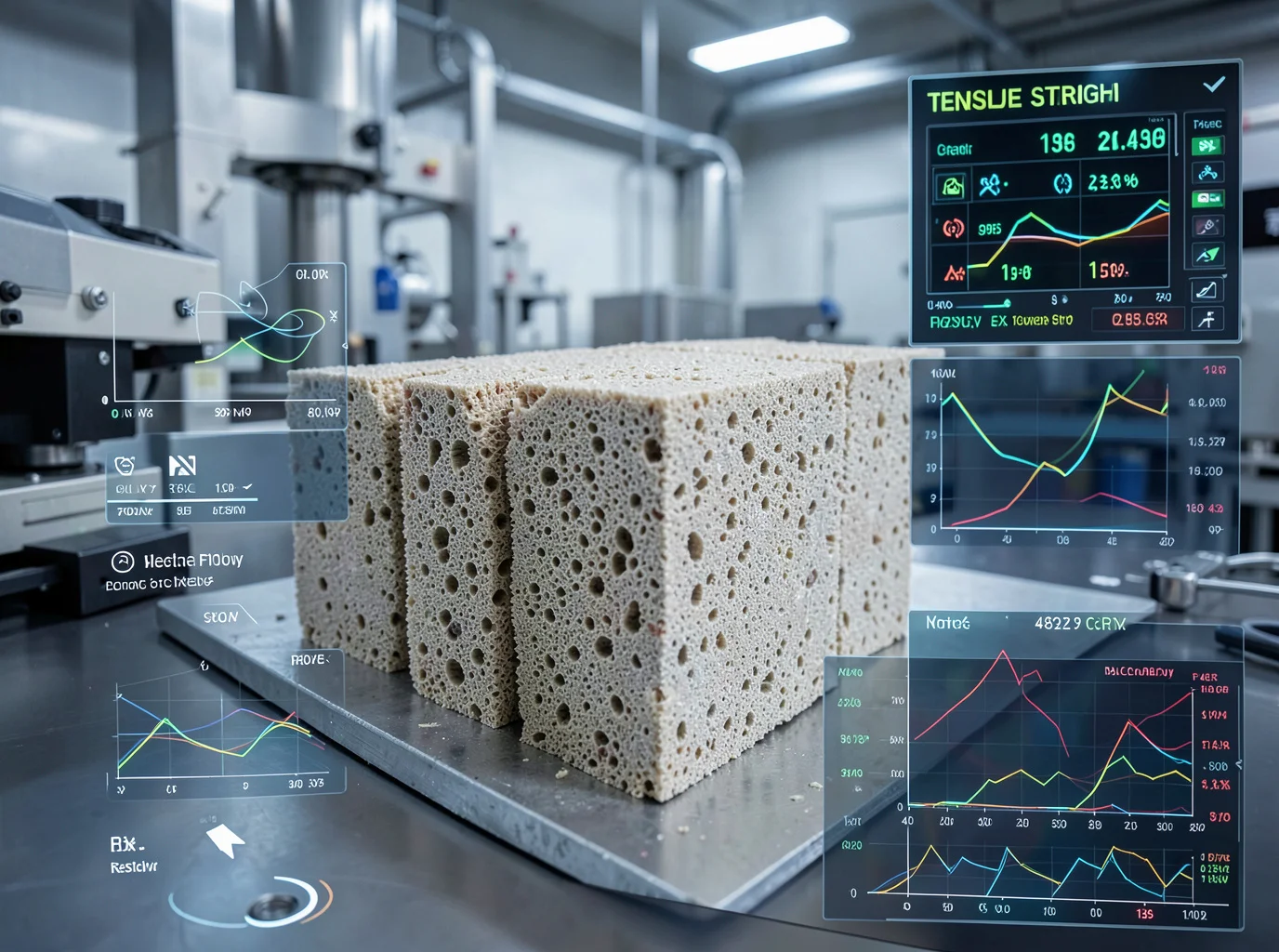
A 40 × 40 × 15 mm filter provides an effective area of 16 cm², but that number means little without knowing the alloy. Gray Iron pushes about 64 kg through that filter, while ductile iron caps out near 32 kg. Flow rates split the same way: roughly 4 kg/s for gray iron and 3 kg/s for ductile iron.
Standard capacity factors (R) for preliminary sizing:
-
Gray and malleable iron: 2.0–4.0 kg/cm²
-
Ductile or compacted-graphite iron: 1.0–2.0 kg/cm²
-
Alloyed or in-mold-treated ductile iron: 0.5–1.0 kg/cm²
The working formula is Af = M / R, where Af is required filter area in cm², M is total pour mass in kg, and R is the capacity factor. Run the lower end of the range whenever metal cleanliness or pouring temperature control is uncertain.
Quick lookup for common pours:
|
Metal load |
Gray iron (4 kg/cm²) |
Ductile iron (2 kg/cm²) |
Practical selection |
|---|---|---|---|
|
50 kg |
12.5 cm² |
25 cm² |
1× 40×40 mm GI; 1× 50×50 mm DI |
|
64 kg |
16 cm² |
32 cm² |
1× 40×40 mm GI; 2× 40×40 mm DI |
|
100 kg |
25 cm² |
50 cm² |
1× 50×50 mm GI; 2× 50×50 mm DI |
For flow-driven sizing, calculate Q = M / tf, then determine filter count using N = max(M/Cf, Q/qf). A 96 kg ductile iron pour targeting 12 seconds demands Q = 8 kg/s, which requires 3 × 40×40×15 mm filters for 48 cm² total area and ~9 kg/s combined flow.
Check your sizing against real shop conditions. Keep static head below 300 mm, maintain a filter-to-choke ratio above 2:1 for gray iron and 3:1 for ductile iron, and add 20–30% filter area if trial pours run borderline.
Conclusion
Specifying metal casting filters for Nordic foundries comes down to three decisions: matching filter porosity and pore structure to your alloy and pouring conditions, confirming EN/ISO documentation before signing the PO, and sizing filter capacity against actual flow rates rather than assumptions carried over from an earlier job. Get these right, and inclusion-related rejections drop. Miss them, and you spend time reworking castings instead of shipping them.
Swedish and Danish buyers who treat filter selection as an engineering specification report fewer defects and smoother quality audits. A ceramic foam filter (CFF) selected properly on day one saves far more than its unit cost.
If you are building out your next casting filter specification sheet, you do not have to start from scratch. Reach out to FoundryMax‘s technical team for alloy-specific recommendations, current EN/ISO compliance documentation, and flow-rate calculations matched to your Gating System and the standards Nordic foundries already run on.