
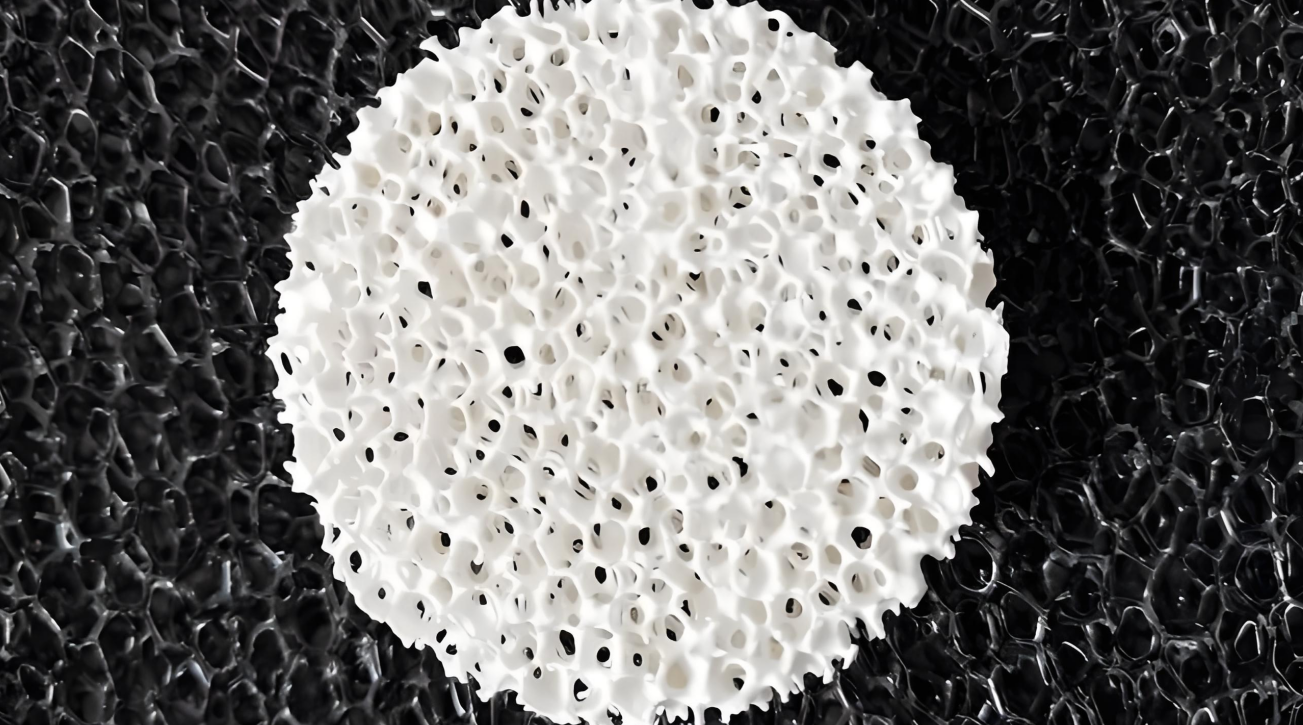
Choosing the wrong ceramic foam filter hurts more than just part quality. It drains your yield, pushes up your scrap rate, and leaves your team chasing defects that didn’t need to happen.
For foundry operators comparing alumina vs Silicon carbide filters for aluminum casting, there’s no single right answer. Both materials work — but they work in different ways. Temperature ranges, alloy chemistry, and production demands all shift the outcome.
This comparison cuts through the technical details. You get a clear, practical look at where each filter performs well, where it falls short, and how to match the right material to your casting conditions.
What Are Ceramic Foam Filters in Aluminum Casting?
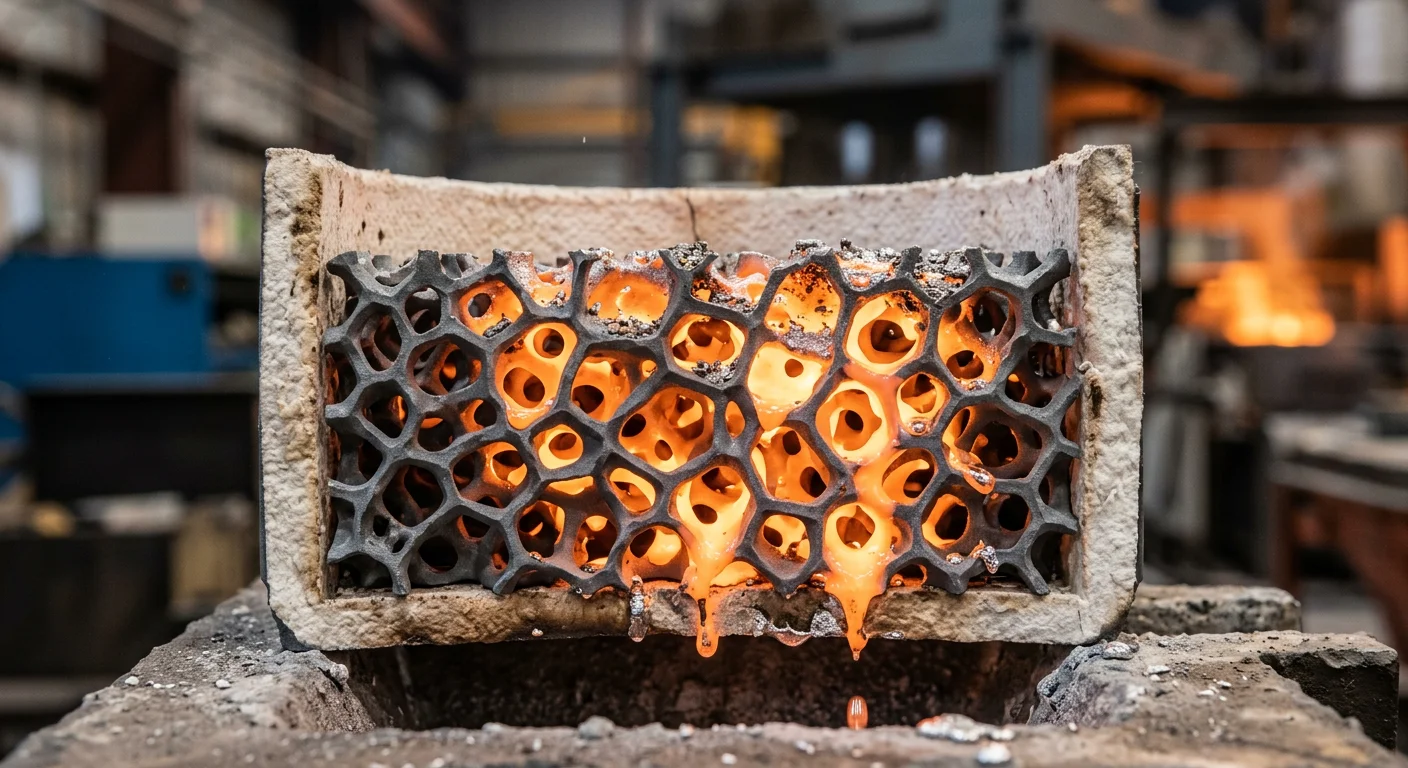
A Ceramic foam filter works like a three-dimensional sponge — but made from refractory material. It handles molten aluminum at temperatures up to 800°C.
The internal structure is an open-cell network of connected pores and struts. Molten metal flows through, and impurities get trapped along the way. Oxides, dross, sand particles, refractory debris — they snag on the ceramic surfaces or get pulled in through adsorption. Clean metal passes through. The contaminants stay behind.
Filtration at this stage handles three jobs at once:
-
Inclusion capture — catches oxide films and micron-sized particles that flat screens miss entirely
-
Slag reduction — intercepts by-products before they reach the mold cavity
-
Flow conditioning — stabilizes the metal stream, kills turbulence, and stops fresh oxides from forming mid-pour
PPI rating controls the tradeoff between flow rate and filtration precision. Filters range from 10 to 60 pores per inch. Lower PPI (10–30) moves metal faster — a good fit for large castings. Higher PPI (40–60) catches finer inclusions down to 20 microns, but slows the pour rate. Manufacturers like FoundryMax and Pyrotek report that well-matched alumina filters hit 99%+ removal of inclusions above 20μm.
The two main materials are alumina (Al₂O₃) and silicon carbide (SiC). Both handle thermal shock well. Both resist corrosion in molten aluminum. But their behavior under pressure is where the real difference shows — and that’s what makes this comparison worth a closer look.
Silicon Carbide (SiC) Filters: Properties, Strengths & Limitations
Silicon carbide doesn’t compromise. It ranks among the hardest engineering materials on the planet — Mohs 13, sitting just behind diamond and boron carbide. That hardness drives everything about how SiC filters perform inside a foundry.
The material is dense at 3.21 g/cm³. Flexural strength reaches 490–600 MPa. Compressive strength goes up to 3,900 MPa. In a multi-shift operation with continuous pours, those numbers matter. Filters don’t deform. They don’t creep. They hold their shape under load, shift after shift.
Thermal conductivity is where SiC stands apart from alumina. At 120–180 W/m·K, SiC moves heat fast — the filter primes quickly once molten aluminum hits it. Less hesitation at the pour. Faster wetting. That high conductivity also keeps the metal stream temperature stable through the filter body. This cuts the risk of early solidification blocking the pore network mid-cast.
What SiC Filters Do Well
Inclusion capture is reliable and consistent. SiC doesn’t wet against molten aluminum, so pore surfaces don’t bond with metal. Inclusions snag. Clean metal passes through. The filter resists clogging in ways that denser-pored alumina ceramic filters often can’t match.
Chemical stability holds across the full working range. SiC is pH 0–14 compatible, resistant to acids, alkalis, and molten salts up to 800°C. At standard aluminum casting temperatures below 1,000°C, the silicon-carbon bond stays intact. No silicon bleeds into the melt. No contamination.
Thermal shock resistance is built into the microstructure:
– Low thermal expansion coefficient
– High fracture toughness at 6.8 MPa·m⁰·⁵
The filter handles rapid temperature cycling up to 400°C delta without cracking or breaking down.
Where SiC Falls Short
Brittleness is real — and it’s the main practical limit. High hardness and fracture resistance are not the same thing under sudden impact. A sharp thermal spike — not a slow cycle, but an instant shock — can crack a sic ceramic filter that would have survived a slower temperature rise.
Cost is another factor. Manufacturing sic filters is not simple: – Sintering requires temperatures up to 2,300°C – Non-standard shapes are hard to machine – Raw material inputs are expensive
For high-volume commodity casting, you need clear data — yield improvement or scrap reduction numbers — to justify that price gap.
SiC also doesn’t suit environments with large abrasive particles in the metal stream. The same brittleness that limits impact resistance also makes it vulnerable under sustained particle wear.
Alumina (Al₂O₃) Filters: Properties, Strengths & Limitations
Alumina is the default choice in most aluminum foundries — and there are real reasons it got there.
Al₂O₃ filters run up to 1,200°C in filter-grade use. High-purity 99.8% material stays stable all the way to 1,800°C. For standard aluminum casting temperatures, that’s a wide safety margin. The filter isn’t fighting the environment. It sits well inside its comfort zone.
Mechanical specs back this up. Compressive strength falls between 2,070–3,180 MPa, depending on purity grade. Vickers hardness runs 13.8–17.6 GPa. Those are strong numbers. They hold up under sustained pour loads and everyday handling stress.

Where Alumina Filters Deliver
Silicon contamination is zero. For aerospace and high-purity aluminum work, that’s the key fact. Al₂O₃ carries no silicon in its makeup. SiC filters bring a documented Si pickup risk of 0.01–0.1%. For 99.9%+ primary aluminum or Si-restricted alloys, that number rules SiC out. Alumina ceramic cuts that risk completely.
Chemical resistance is broad. Solubility stays below 0.0001 g/100 mL water. The ceramic filter holds up against acids, alkalis, sulfides, and chlorides across the full working temperature range. The surface stays inert through the entire cast cycle.
Cost and availability also favor alumina. Manufacturing is simpler than SiC ceramic. Raw material costs are lower. For high-volume operations running on tight margins, that price gap adds up fast.
Where Alumina Falls Short
Thermal conductivity is the weak spot: 25.1–35.6 W/m·K at room temperature. Compare that to SiC’s 120–180 W/m·K — alumina runs much lower. The filter primes slower. Heat dissipation lags behind.
So you’ll need to adjust your process. Extend pre-wet time by 20–30%, or drop pour rate by 10–15%. This helps prevent dry spots and channeling through the pore network.
Brittleness is a real concern. Thermal shock resistance tops out at a ΔT of 200–250°C — a narrower range than SiC. Flexural strength sits at 310–400 MPa. Under sudden mechanical impact or sharp temperature spikes, alumina cracks rather than flexes. In high-vibration foundry settings, single-run use is the safer call.
Head-to-Head Comparison: SiC Ceramic vs Alumina Ceramic Filter Across Key Decision Factors
Six numbers settle most of the argument between these two materials. Put them side by side, and the tradeoffs become clear fast.
|
Property |
SiC |
Alumina |
|---|---|---|
|
Compressive Strength (MPa) |
2,780–3,900 |
1,920–2,750 |
|
Thermal Conductivity (W/m·K) |
120–180 |
30 |
|
Max Operating Temp (°C) |
1,600 |
1,650 (degrades above 1,200) |
|
Thermal Shock Resistance (°C) |
~400 |
170–300 |
|
Mohs Hardness |
9–9.5 |
9 |
|
Service Life vs. Baseline |
2–3x alumina |
Baseline |
The numbers don’t tell you which filter to buy. They tell you which environment each filter was built for.
Strength and Wear: SiC Pulls Ahead Under Load
SiC’s compressive strength tops out at 3,900 MPa. Alumina maxes out at 2,750 MPa. That’s a real gap. Under heavy pour loads across multiple shifts, you’ll see the difference in how each filter holds its shape over time. Alumina compresses. SiC doesn’t.
Wear resistance follows the same pattern. In high-velocity, particle-heavy metal streams, SiC erodes far less than alumina. In fluidized-bed and aggressive-flow setups, that’s not a small edge. It’s the reason the filter makes it through the run intact.
Thermal Performance: Two Different Strategies
SiC runs hot and fast. Thermal conductivity sits between 120–180 W/m·K. The filter heats up fast, holds temperature through its body, and takes thermal shock up to 400°C delta without cracking. Rapid heating, rapid cooling, repeat — that’s where SiC earns its higher price.
Alumina runs cool and stable. Conductivity sits around 30 W/m·K. It heats up slower, sheds heat at a steadier pace, and thermal shock tolerance tops out at 170–300°C. It suits slower pours and controlled temperature environments. Push past that range and cracking becomes a real risk on the floor.
Alumina’s rated max temperature is 1,650°C — higher on paper. But it loses strength above 1,200°C. SiC holds 94% of its strength after exposure to 1,900°C in argon. For aluminum casting temperatures, both pass the test — but SiC passes with a wider safety margin.
Chemical Resistance: Context Determines the Winner
Both materials handle strong acids without issue. The difference shows up in harder conditions.
-
Strong alkalis at high temperature — SiC holds. Alumina weakens.
-
HF acid exposure — SiC excellent. Alumina good, not exceptional.
-
Molten metal contact — SiC excellent. Alumina rated fair.
-
Oxidizing and reducing environments — SiC records material loss 10–15x lower than alumina over the same exposure cycles.
For standard aluminum casting chemistry, alumina holds up fine. Move into aggressive flux treatments, high-alkali conditions, or reactive alloy streams, and SiC’s chemical toughness becomes the deciding factor.
Cost and Lifecycle: The Calculation Most Teams Get Wrong
Alumina costs less upfront. That’s real, and it matters in high-volume commodity casting where margins are tight.
But the lifecycle numbers tell a different story. SiC filters last 2–3x longer than alumina in high-wear applications. SiC production also uses 15–20% less water than alumina processing — a factor that’s getting harder to overlook as environmental compliance rules tighten.
The practical split looks like this:
– Alumina wins in mild-acid, lower-stress applications where the cost saving is clear and the operating window stays controlled
– SiC wins in rapid-cycling kilns, high-load multi-shift operations, and aggressive chemical environments where alumina can’t keep up
Running alumina in conditions that call for SiC doesn’t save money. It speeds up replacement cycles, raises scrap exposure, and pushes the cost burden downstream — where it’s harder to track and harder to fix.
SiC Filters: Best Applications & Casting Conditions
SiC filters aren’t the right fit for every operation — but in the right conditions, they’re the clear choice.
Volume is the clearest signal. High-output foundries on multi-shift schedules push filters through sustained mechanical and thermal stress. Alumina wasn’t built for that load. SiC is. It handles process variation, runs long without breaking down, and holds its structure through rapid temperature swings that would crack alumina mid-cycle.
Applications Where SiC Earns Its Price
SiC shines in Aluminum Alloy casting, automotive components, and aerospace structural parts. For those jobs, 30–40 PPI is the standard starting spec. That range gives you enough inclusion control to catch oxide films and fine particles — without cutting your pour rate on heavier sections.
Past aluminum, SiC works with copper alloys and cast iron at temperatures up to 1,500°C. It also covers steel and superalloy work where melting points push past 2,700°C. Alumina tops out well before those numbers. SiC doesn’t.
PPI selection by application:
|
PPI Range |
Best Fit |
|---|---|
|
10–20 |
Large castings, high flow, primary aluminum |
|
20–30 |
Standard aluminum alloy casting |
|
30–40 |
Automotive and aerospace, tighter inclusion control |
|
40–60 |
Precision aluminum components |
Two Problems SiC Fixes
Filter cracking is the first one. SiC’s higher strength and thermal shock resistance go after the root cause — not the symptom. Switching to SiC is the mechanical fix your team needs.
Inclusion defects and rising scrap are the second. The numbers make the case. SiC’s wetting behavior primes faster and captures more inclusions than alumina. Documented defect reduction hits up to 85% in matched comparisons. That’s hard to ignore.
One Condition Where SiC Falls Short
Strict zero-silicon primary aluminum is the exception. SiC stays stable at normal casting temperatures — but 99.9%+ purity specs with hard silicon limits change the equation. Alumina is the safe pick there, and the right one. For every other aluminum alloy application, SiC is the default — and it earns that position.
Alumina Filters: Ideal Applications & Casting Conditions
Alumina filters work best in a specific lane. Stay inside it, and they perform well.
The core case comes down to purity. For high-purity primary aluminum (99.9%+ ingots) and specialty alloys with hard silicon limits, the choice is clear. SiC filters carry a documented Si pickup risk. Even at 0.01–0.1%, that’s enough to fail purity-critical specs. Alumina carries zero silicon. That chemical inertness is why aerospace and medical Investment casting operations use it — not cost, not convenience. Purity.
Temperature is the second factor. Alumina handles aluminum casting temperatures without strain. Aluminum melts at 660–700°C. Alumina’s working ceiling sits at 1,200°C before strength begins to degrade. That’s a wide safety buffer. For moderate-to-high temperature processes inside that window, the filter runs well below its limits.
Where Alumina Fits
-
Single-shift or lower-volume production — multi-shift durability isn’t a concern here. Alumina’s lower unit cost gives you real margin with no real trade-off.
-
Complex or precision molds — place the filter closer to the casting. This improves flow smoothness and cuts down on non-fills in tight cavities.
-
Laminar flow priority — alumina’s slower thermal conductivity is an advantage here. It conditions metal flow for directionally solidified castings, where a steady pour cuts inclusion formation.
-
Controlled alloy chemistry — Si thresholds are fixed and non-negotiable. Alumina is the safe call.
Managing Alumina’s Limitations in Practice
Slow priming catches teams off guard most often. Preheat to 800–1,000°C over a 30–60 minute ramp before the pour. This wets the full filter body and prevents dry spots that cause channeling.
Keep thermal gradients below 200°C per minute. Past that threshold, cracking risk climbs fast. In stable, lower-volume settings — one shift per day, steady pour temperatures — alumina delivers 70–90% inclusion removal without problems.
Match PPI to your target contaminants. For aluminum inclusions, the 10–50 PPI range covers most needs. Check silicon compatibility with your specific alloy before starting a run.
How To Select The Right Filter: A Practical Decision Guide For Foundry Operators
Three questions determine the right filter for your operation. Answer them in order, and the choice becomes clear.
Step 1: What Does Your Alloy Demand?
Purity requirements set the baseline PPI:
-
Aerospace aluminum — 40–50 PPI. You’re chasing inclusions below 50μm. Slower flow is the trade-off. Accept it.
-
Automotive and general non-ferrous — 20–30 PPI. Good throughput, mid-range inclusion removal. This covers most operations.
-
Cast iron, copper alloys, high-volume steel — 10–20 PPI. Maximum flow. Large inclusions are the main target here.
Step 2: What Are Your Temperature and Volume Conditions?
-
Below 1,250°C with moderate shift volume: alumina or silicon carbide both work fine
-
High-volume multi-shift: put the filter farther from the mold. Cup filter placement manages the flow rate well.
-
Lower-volume precision work: move the filter closer to the casting. You get laminar flow and a cleaner fill.
Step 3: What’s Your Cost Tolerance?
fiberglass mesh works well for budget runs across iron, steel, aluminum, and copper. Custom ceramic foam — alumina or SiC — is the premium option. Before you bulk order either, request free test samples. CoorsTek, SEFU, and Carpenter Brothers all provide them. Run 3–5 filter sizes. Track inclusion count, flow rate, and scrap percentage. Let the data guide the final call.
Red Flags You’ve Picked the Wrong Filter
|
Symptom |
Cause |
|---|---|
|
Filter cracking |
Material can’t handle thermal shock |
|
Inclusions passing through |
PPI too coarse for the job |
|
Slow priming or clogging |
PPI too fine, or filter undersized |
|
Rising scrap rate |
Turbulent flow — splashing, air entrainment |
|
Overflow or non-fills |
Filter positioned too far from mold |
These aren’t random quality problems. Each one is a clear signal pointing to a specific selection error. The good news — every one of them is fixable before your next pour.
Conclusion
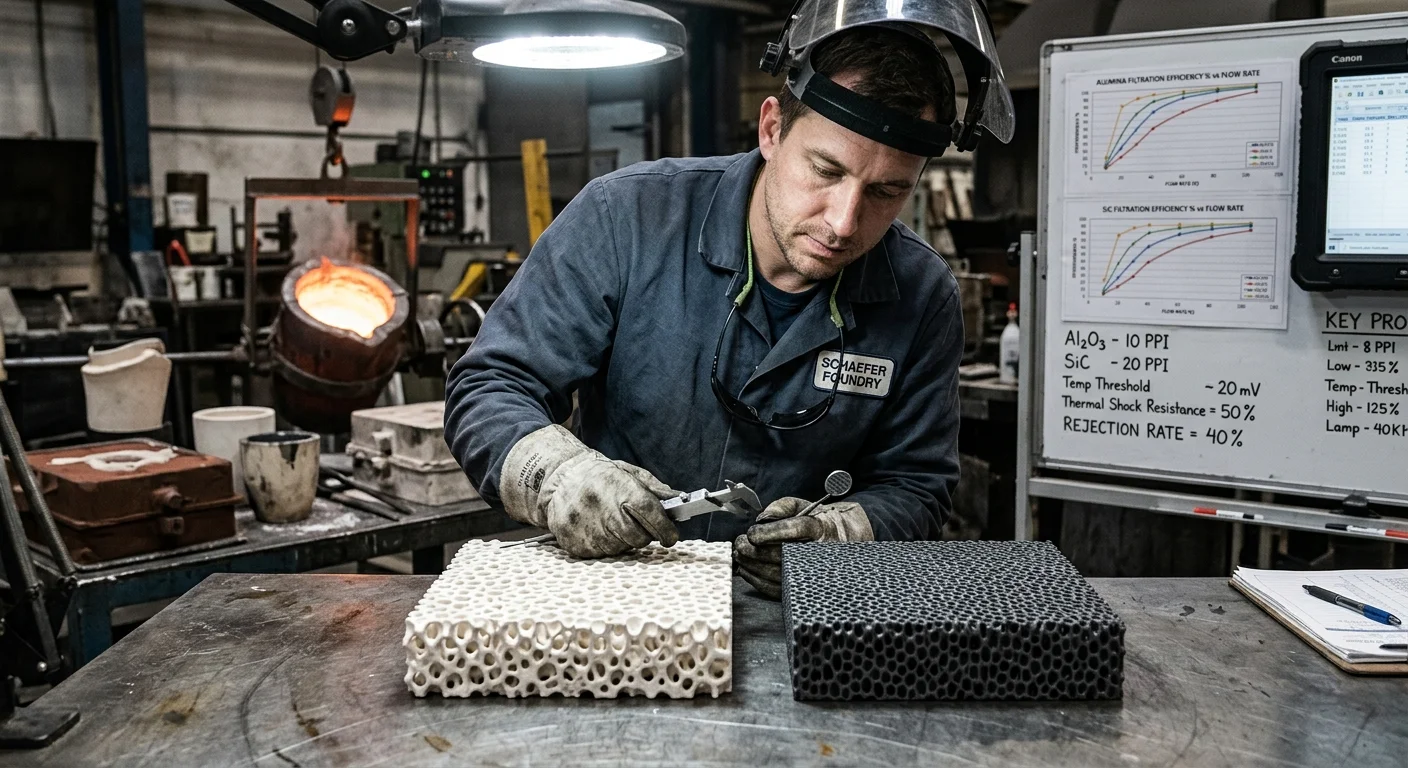
Picking between alumina and silicon carbide filters isn’t guesswork. It’s an engineering call — and it directly affects your scrap rate, metal cleanliness, and bottom line.
Here’s where each filter wins:
-
SiC performs better in high-temperature, high-flow environments. Thermal shock resistance is a hard requirement there — and SiC delivers it.
-
Alumina is the stronger choice when chemical compatibility with aluminum alloys and cost matter most.
No single filter is the best option across the board. The right one depends on your casting conditions — full stop.
So don’t just go with habit or pick the cheaper option. Check your pour temperatures, alloy chemistry, and defect history first. Then choose the filter that fits your process — not the other way around.
The foundries producing the cleanest castings aren’t running the most expensive filters. They’re running the right ones.
That’s the standard worth chasing.