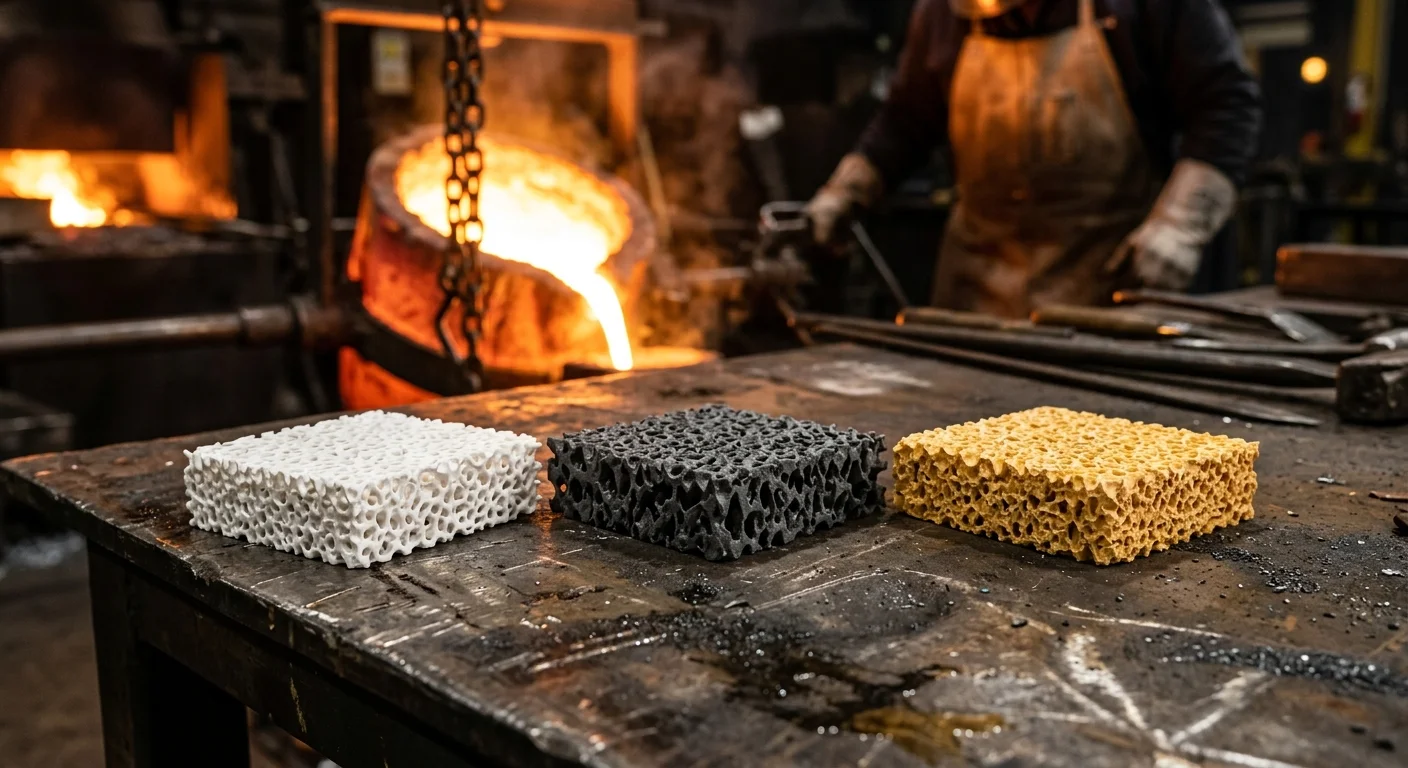
Pouring molten metal through a foam filter sounds like simple physics. It isn’t.
Compare automotive vs. aerospace foundry requirements and the gap becomes clear fast. “Good enough” works in one world. “Zero defects” is the only standard in the other. Foam filter performance sits right at the center of that divide.
Automotive foundries push for throughput and cost control. Aerospace foundries answer to zero-defect mandates and strict traceability rules. Same filters — completely different expectations.
The specs split across four key areas:
- Pore geometry — tolerances tighten as application risk rises
- Thermal thresholds — aerospace alloys often run hotter and less forgiving
- Qualification protocols — aerospace demands documented, repeatable proof
- Supplier tiers — aerospace supply chains require certified, auditable sources
A foundry that thinks it can cross industries and one that does are separated by this knowledge. Know where the requirements split, and you can plan a real path forward.
Automotive Foundry Profile: Volume, Cost, and Quality Priorities
The numbers behind automotive casting are big. The global automotive casting market stands at $89 billion in 2025 — and it’s on track to hit $150 billion by 2034, growing at 7% per year. That kind of growth doesn’t happen without pressure. It happens because of it.
Scale drives everything here. Asia-Pacific alone holds over 45% of global casting volume. A single engine block program can run 100,000+ units per year — and no one bats an eye. At that output, high-pressure die casting becomes the clear economic winner. Cross 1,000 units, and the tooling cost starts paying back fast. A typical aluminum transmission housing at 100k annual volume costs 60–80% less per piece than a CNC-machined billet equivalent. The mold spreads its cost across hundreds of thousands of shots. The math is simple.
Cost pressure shapes every decision downstream — including filter selection.
Labor, raw materials, and energy — these are the three variables that keep automotive foundry managers up at night. Suppliers get ranked on price first, then technical capability, then quality, then lead time. That order matters.
Quality systems run on IATF 16949. SPC controls critical process parameters — melt temperature, pour temperature, cycle time — with CMK/Cpk targets set at ≥1.33 for standard dimensions. Safety-critical features push that target to ≥1.67. Defect control uses real-time X-ray, spectrometer checks, and full batch traceability. The goal is simple: catch problems in-process, never at the customer.
Foam filters in automotive foundries get judged by this same standard — cost efficiency at volume, reliable scrap reduction, and measurable elongation gains. Performance has to scale. So does the price justification.
Aerospace Foundry Profile: Safety-Critical, Traceability, and Zero-Defect Mandate
One failed casting in an automotive line triggers a scrap report. One failed casting in an aerospace application triggers a full investigation — and a grounding.
That difference shapes everything about how aerospace foundries operate.
The governing standard is AS9100D. It covers ground that IATF 16949 never touches. Section 8.1.3 requires systematic product safety planning: identify safety-critical characteristics, run failure consequence analysis, and control failure records. No matching requirement exists in the automotive framework. Automotive OEMs have to build those controls themselves.
The qualification bar is much higher across every dimension:
- Defect tolerance — aerospace critical zones demand pore defects <0.5–1.0 mm diameter, with linear defects capped at <3–5 mm. Many critical cross-sections require zero detectable defects — full stop.
- Hydrogen content — aerospace aluminum castings target ≤0.10 ml/100g, with advanced engine components pushing 0.05–0.08 ml/100g. Automotive aluminum accepts 0.15–0.20 ml/100g.
- Inspection coverage — 100% NDT (RT/UT/PT) with image and waveform records archived 10–40 years per serial number. Automotive uses statistical batch sampling.
Traceability: Every Serial Number, Every Step
Aerospace traceability isn’t a quality checkbox. It’s a chain — and every link must hold.
A single casting must trace back through six distinct layers: raw material mill certificates, melt/heat IDs with refining parameters, pour records with operator signatures, heat treatment load IDs, NDT report numbers, and final delivery documentation. Miss one layer, and the part can’t be certified.
The capability that matters most? Containment speed. One flight-critical casting fails. The foundry must find every part from the same melt batch, same mold cavity, and same operator shift — then pull them before they reach an aircraft. That’s the real test of any traceability system.
Foam filter suppliers don’t get a pass here either. Under AS5553 counterfeit parts controls, every ceramic foam filter entering an aerospace melt stream must come from an Approved Supplier List. It must carry full batch and composition certification — Al₂O₃ grade, PPI rating, sintering lot number. It must also maintain an internal traceability chain from raw powder through final firing. A filter without that documentation doesn’t belong in the pour.
The aerospace foundry reality is this: Cpk ≥1.67 plus 100% screening on safety-critical features, serial-level genealogy on every casting, and records kept — across many military and engine programs — for 30 years or more.
Cost is secondary. Proof is the product.
Side-by-Side Requirements Comparison: Where the Two Industries Diverge
The distance between automotive and aerospace foundry requirements isn’t measured in specifications. It’s measured in consequences.
Break the numbers down and four fault lines show up: inspection intensity, scrap tolerance, documentation depth, and supplier qualification. Each one tells the same story in a different way.
Inspection: Statistical Sampling vs. Every Single Part
Automotive foundries work with batch-level AQL sampling. A typical safety-critical component runs an AQL of 0.25%–0.65%. On a batch of 2,000 parts, that means inspecting around 80–200 pieces. Rejects stay within the acceptance number, and the batch ships. Some defects slip through. That’s a known, accepted cost.
Aerospace doesn’t accept that math. Flight-critical castings require serial-number-level tracking plus 100% inspection and release certification — every single part, every single time. Inspection and certification activities alone eat up 10–30%+ of total part manufacturing cost. The target failure rate isn’t a percentage. Engineers design toward 10⁻⁶ to 10⁻⁹ — and they get there through layered controls and redundancy, not sampling luck.
Scrap Tolerance: Cost Variable vs. Near-Zero
Automotive treats scrap as an optimization parameter. A 1–3% scrap rate in stable mass production is normal. New tooling ramp-up can hit 5–10% without raising alarms — as long as it trends down. The math works at 100,000 units per year.
Aerospace critical components target <0.5% scrap. Internal goals often push <0.1% on high-value parts. One process variation that kicks out dozens of rejected castings can trigger hundreds of thousands of dollars in losses. Plus, you’re looking at a process re-verification cycle measured in months, not days.
Documentation: Batch Records vs. Lifetime Files
The gap here is structural, not just procedural.
Automotive supply chains keep batch-level records — material lot numbers, production batches, inspection results — held for 5–15 years. Traceability means answering: which batch, which customers, which raw materials.
Aerospace keeps serial-number-level records across every manufacturing stage, every process parameter, every inspection result, and every installation. Records for structural components and engine critical parts stay on file for 30 years or the full service life — and that’s the floor, not the ceiling. Auditors don’t ask about batches. They pull a specific serial number and expect a complete life history, reconstructed on demand.
Supplier Qualification: Months vs. Years
Qualifying as an automotive foam filter supplier means clearing ISO/IATF 16949 certification, OEM second-party audit, and PPAP approval. Timeline: 3–12 months. Cost: manageable.
Aerospace qualification adds Nadcap certification for special processes, AS9100D compliance, OEM-specific approvals, and in some cases civil aviation production authorization. The process isn’t just longer — it’s a different category entirely. These aren’t checkboxes. They’re proof-of-capability gates that regulators and OEMs can audit at any point in the supply relationship.
The automotive vs. aerospace foundry comparison comes down to one question: what does failure cost? In automotive, failure costs money and triggers a corrective action. In aerospace, it grounds aircraft and opens investigations. Foam filter performance standards — PPI ratings, Al₂O₃ purity, traceability documentation — are set to match that exact risk gap.
Foam Filter Pore Size and Filtration Efficiency: Automotive vs. Aerospace Specifications
PPI rating is where the split between these two industries gets real — measurable, purchasable, and impossible to ignore.
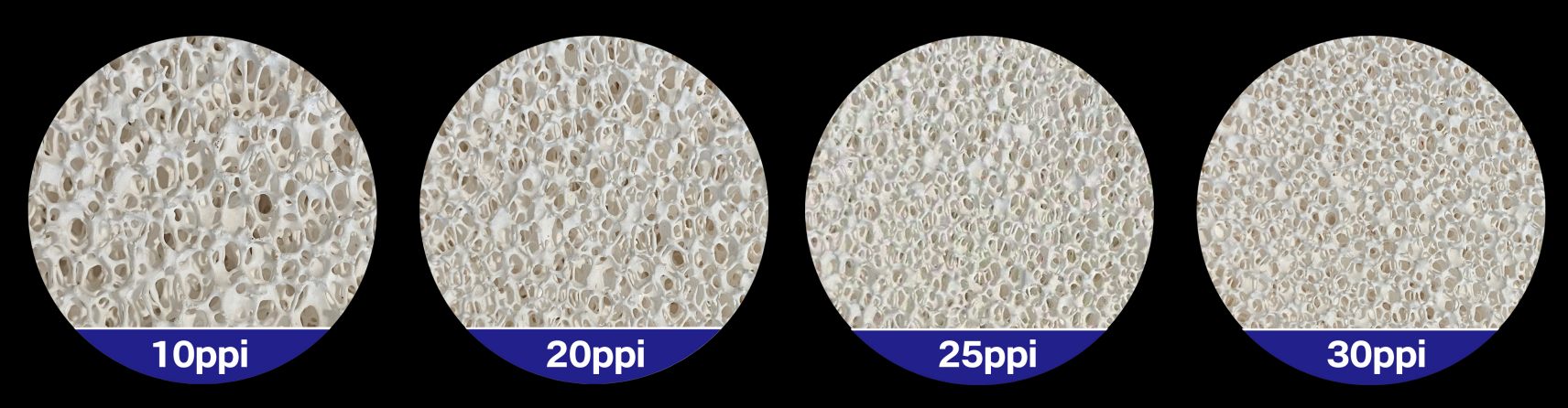
Automotive aluminum casting centers on 20–30 PPI. At 20 PPI, you balance flow rate, cost, and solid inclusion capture for general structural components. At 30 PPI, you push cleanliness further without cutting into your fill window. That range covers the vast majority of automotive aluminum work.
Aerospace shifts the target altogether. Structural aerospace castings call for 30–40 PPI as standard. Safety-critical parts — load-bearing airframe sections and engine housings — go up to 50 PPI. At that rating, pore diameter tightens to 0.30–0.45 mm. Filtration efficiency reaches the 88–95% range. That’s the confirmed, working benchmark for aerospace-grade cleanliness.
The selection logic follows a clear progression:
| PPI Range | Primary Application |
|---|---|
| 10–15 PPI | Flow-priority, low cleanliness demand |
| 20 PPI | General industrial / standard automotive |
| 30 PPI | Higher-cleanliness automotive aluminum |
| 30–40 PPI | Aerospace structural castings |
| 50 PPI | Safety-critical aerospace components |
Finer pores aren’t free. Higher PPI means smaller channels, stronger particle retention, and higher flow resistance. That tradeoff forces a real choice: accept slower pour rates, increase filter face area, or do both.
Aerospace foundries now handle this tension with multi-stage filter configurations. A 45/20 PPI dual-layer setup runs coarse capture first, then finer filtration second. You get high cleanliness without the worst flow penalties of a single 50 PPI layer. Two- and three-stage combinations are standard practice — not experimental fixes.
For procurement and process engineering, the decision matrix is clear:
- Automotive: Prioritize 20–30 PPI, filter face area, flow resistance, and unit cost
- Aerospace: Prioritize 30–50 PPI, pore size uniformity, batch-to-batch consistency, and melt cleanliness verification via LiMCA, PoDFA, or K-Mold testing
One more factor that never shows up in spec sheets but drives real-world performance: pore uniformity. Closed pores block metal flow. Non-uniform cell distribution creates preferred flow channels and breaks the entire filtration logic. Aerospace acceptance criteria treat uniform cell distribution as a hard requirement — not a preference. Automotive programs run the same check, but attach less weight to minor variation.
The number on the filter label is just the starting point. What it delivers in practice depends on how well that pore structure holds across every unit in the batch.
Thermal and Mechanical Performance Requirements for Foam Filters by Application
Temperature range tells you everything about material choice. Ceramic foam Filters work from room temperature up to 1,600°C. The alloy you’re pouring decides which filter material belongs in your gating system.
The breakdown is simple:
- Aluminum alloys (automotive, aerospace structural): pour temperatures of 650–750°C → Al₂O₃ filters handle this range with no issues
- Steel and superalloys (aerospace engine components): pour temperatures above 1,500°C → SiC or ZrO₂/composite ceramics are required
- Titanium and high-temperature alloys (aerospace critical): thermal loads of 1,400–1,650°C require higher-refractoriness ZrO₂ or SiC systems — standard alumina will not hold up
One key rule that most spec sheets skip: keep at least a 50°C safety margin between the filter’s maximum use temperature and your actual pour temperature. Push past that margin and you risk material softening, partial dissolution, or decomposition. Contamination feeds straight into the casting.
Thermal Shock Resistance: Where Automotive and Aerospace Part Ways
Thermal shock resistance is the property that splits acceptable from dangerous. A filter that cracks mid-pour does not just stop filtering — ceramic fragments enter the melt stream. Industry guidance is clear: that result is worse than using no filter at all.
The gap between material systems is real and measurable:
| Material | Thermal Shock Cycles | Typical Application |
|---|---|---|
| Al₂O₃ | 3–6 cycles | Automotive aluminum casting |
| SiC | 5–10+ cycles | Aerospace / high thermal load |
Al₂O₃ filters benchmark at ~5 thermal shock cycles (800°C → room temperature). That works for automotive aluminum casting — single-pour, controlled preheat, limited thermal cycling.
Aerospace qualification asks for more. Higher pour temperatures, tighter process checks, and zero tolerance for ceramic spalling push programs to require traceable thermal cycle test data — not just supplier spec sheets. A fragment in a flight-critical casting triggers a full melt-batch containment event. “Probably won’t crack” is not a good enough answer.
Compressive Strength and Structural Integrity Under Ferrostatic Pressure
A foam filter in active use is not passive. It holds back a continuous metal column, and ferrostatic pressure builds fast.
The published floor for Alumina foam filters is ≥1.0 MPa compressive strength at room temperature. That number matters less than what happens at actual casting temperature. Casting failures do not come from cold crushing. They come from thermal softening combined with ferrostatic pressure combined with thermal shock — all three hitting at once.
Aerospace programs push structural integrity requirements well past single-value strength specs. You need batch-to-batch consistency, defect rate minimums, and higher-refractoriness filter media. The acceptance rule is straightforward: any batch with potential spalling risk gets pulled from the critical-part pour chain. No exceptions.
Four criteria drive filter acceptance across both industries:
- Thermal shock cycle count — verified against your application temperature delta
- Compressive strength — room temperature floor of ≥1.0 MPa confirmed
- Preheat protocol — filter must reach near-process temperature before metal contact
- Pore structure integrity — no blocked pores, no transport damage, no edge chipping
Automotive programs treat these as quality checkpoints. Aerospace programs treat them as go/no-go gates.

Qualification, Testing Protocols, and Supplier Certification: A Two-Tier Reality
Certification in automotive is a process. Certification in aerospace is proof of survival.
Foam filter supplier qualification falls into two distinct categories. The gap between them isn’t about paperwork volume. It’s about what happens when the system fails.
Automotive: PPAP and Process Capability
Automotive foam filter suppliers qualify through PPAP — Production Part Approval Process. Level 3 or higher is standard. The document package covers design FMEA, process FMEA, control plans, full dimensional results, and a signed Part Submission Warrant.
The process capability targets are fixed and non-negotiable:
- Cpk ≥1.33 for standard critical-to-quality dimensions — filtration efficiency, pressure drop, leakage rate
- Cpk ≥1.67 for safety-critical features
- Initial process studies need a minimum of 25 consecutive parts to confirm stability before submission
The timeline from design freeze to PPAP approval runs 6–9 months under normal conditions. Safety-critical components stretch to 12 months. After approval, ongoing production runs under SPC monitoring — Xbar-R or Xbar-S charts — with control limits set at 2σ and action limits at 3σ.
Aerospace: FAI, DVT, and the Nadcap Layer
Aerospace qualification starts where PPAP ends — and keeps going.
First Article Inspection (AS9102) demands 100% characteristic measurement on the first production unit. Every dimension. Every material record. Every process parameter. Serial number, batch number, routing card, equipment ID — all documented and traceable.
Design Verification Testing adds structural and environmental proof:
- Filter burst pressure tested at 4–6× working pressure, held for a defined duration with zero failure
- Pressure pulse fatigue runs 10⁴–10⁶ cycles within the specified pressure range — no leaks, no cracks
- Temperature range validation covers −55°C to +125°C, confirmed under actual fluid conditions using aviation fuels like Jet A/JP-8 or hydraulic fluids like Skydrol
Environmental screening goes further. Tests include random vibration across 20–2,000 Hz at 7–10g RMS, thermal cycling for 10–20 cycles, and salt spray exposure at 5% NaCl for 48–96 hours.
The Nadcap Question: Required or Not?
Ceramic foam filters used as consumable melt filtration media don’t always need Nadcap certification on their own. Many OEMs treat them as controlled consumables. They require an approved supplier audit, material composition data, pore structure documentation, and thermal shock performance records instead.
The rules change once the filter supplier also performs heat treatment, brazing, or surface treatment on metallic components in the same supply chain. Those specific processes must come from a Nadcap-certified source. The certification number, scope, and audit status must all appear in the batch documentation chain.
Batch Certification Documents: The Aerospace Standard Package
Every aerospace foam filter shipment needs a full batch documentation package. The minimum includes:
- Certificate of Conformance — supplier details, PO number, part number, revision, batch number, declared compliance standard, authorized quality representative signature
- Material report — alloy grade, heat treatment condition, chemical composition results vs. specification limits, mechanical properties
- Performance verification — flow-pressure drop curves across the temperature range, filtration efficiency data, compliance to the relevant standard (ISO 16889 or equivalent)
Any Nadcap-certified processes in the manufacturing chain must be referenced in the CofC. That means the specific certifying facility and certificate number — both listed.
The two-tier reality: automotive qualification proves you can hold a process. Aerospace qualification proves the process holds under every condition that matters — documented, traceable, and ready for an auditor who may show up years later asking for the original records.
Cost and Supply Chain Impact: Filter Procurement in Automotive vs. Aerospace
The price tag on a foam filter tells you almost nothing. What you’re paying for is the system behind it.
In automotive, that system is lean. The part itself accounts for ≥85% of total delivered cost. Transportation, inventory, and quality loss absorb the remaining 15% — and procurement teams work hard to compress even that. High-volume orders, multi-source competition, and synchronized delivery windows push lead times to 2–6 weeks. The whole operation runs on predictability and scale.
Aerospace procurement runs on a different foundation. Certification, documentation, traceability, and compliance don’t disappear into overhead — they land on each individual unit. Certification and compliance costs alone can represent 10–30% of the per-filter price. In automotive, that same category stays below 5%.
The price premium reflects real structural costs:
- Pore tolerance tightening from ±5–10 μm (automotive) to ±1–2 μm (aerospace critical) adds 20–40% to per-unit inspection and machining costs
- Material upgrades from standard engineering-grade to aerospace-rated, high-temperature, corrosion-resistant ceramics push material costs 30–100% higher
- Low-volume production removes the one tool automotive uses to make unit economics work — spreading fixed costs across massive quantities
The qualification timeline piles on top of all this. Getting a new aerospace foam filter supplier approved takes 18–36 months — compared to 6–12 months in automotive. The investment during that window is real: testing, quality system audits, regulatory submissions, documentation packages. For smaller suppliers, that upfront spend can equal 10–20% of annual revenue. None of it comes back unless the unit price holds.
Supply Chain Structure: Two Different Risk Profiles
Automotive supply chains are built for replenishment speed. Low safety stock, frequent deliveries, dual-source requirements on critical parts. The system assumes you can call an alternate supplier if one goes down.
Aerospace supply chains are built to survive scarcity. Lead times on certified parts stretch to 12–20 weeks. Material substitutions can trigger a ≥12–24 month re-certification cycle. So OEMs and MRO operators carry 6–12 months of safety stock on critical filters. That’s not inefficiency. That’s the cost of operating in a space where a supply disruption doesn’t just slow a line down — it can ground a fleet.
Single-source dependency makes this worse. A critical filter with one approved supplier means any capacity interruption becomes an immediate operational problem. Supplier diversification is the clear answer. But qualifying each new source means running the full 18–36 month approval process again. Most aerospace OEMs weigh that cost hard before committing.
The result is a procurement environment built around long-term contracts, risk-sharing partnerships, and capacity lock-ins — tools automotive buyers seldom need. Higher unit prices come with the deal. So does a lower chance of a line-stopping shortage.
The gap between automotive and aerospace filter procurement isn’t a pricing quirk. It’s the supply chain charging what the risk profile demands — no more, no less.
Practical Transition Guide: What Automotive Foundries Must Change to Meet Aerospace Standards
Switching from IATF 16949 to AS9100D isn’t a certificate swap. It’s a full rebuild of how you prove process control.
Five systems need to change — not improve, change: process traceability, risk management, first-article release, configuration control, and supply chain oversight. All five must reach a level that holds up in an aerospace audit. The certification model shows how serious this is. AS9100D runs Stage 1 document review followed by Stage 2 on-site assessment. Every site gets audited. Every calendar year during transition gets covered.
Filtration Process: From Shop Habit to Controlled, Traceable Operation
Most automotive foundries have their largest gap here. It’s not a technical gap. It’s a documentation gap.
Automotive process records capture parameters. Aerospace traceability captures who, what, which batch, and who released it. That difference cuts straight through your filtration operation.
Every filter used in an aerospace pour needs a formal controlled procedure. That procedure must cover:
- Filter grade, material, and geometry
- Installation position, orientation, and shelf life
- Preheat SOP — temperature window, soak time, over/under temperature response
- Replacement interval
- Batch/heat/order number linkage
- Nonconformance handling and release authorization
Auditors won’t ask whether you used a filter. They’ll ask whether that specific filter batch ties to that casting serial number. They’ll expect a paper trail that proves it.
Filter Reselection: Work Backward From Aerospace Inclusion Limits
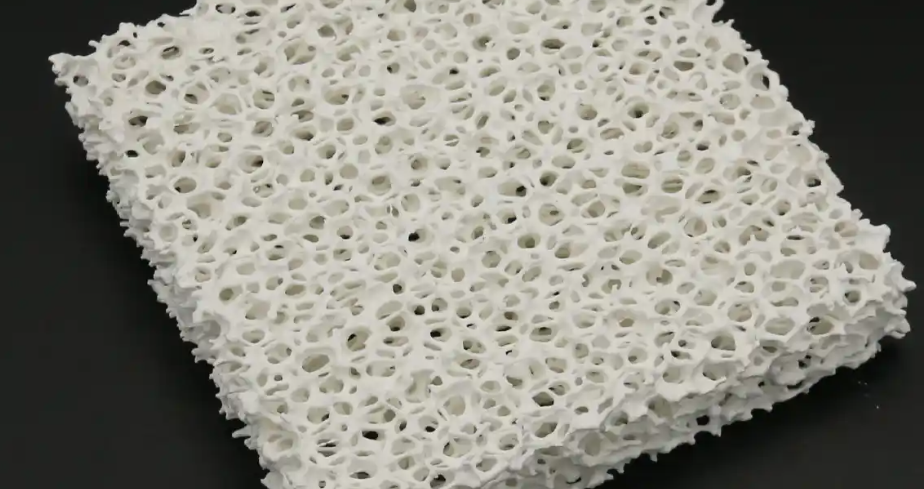
Don’t start with the filter catalog. Start with your aerospace customer’s inclusion tolerance and critical cross-section requirements. Then select PPI grade. Then verify pressure drop and fill stability. Then confirm with sample castings, metallographic sectioning, and NDT results.
The upgrade path runs one direction: cleanliness first, cost second. That means finer filtration grades, tighter batch-to-batch consistency, and stricter incoming material controls.
The key engineering test is straightforward. After the filter change, check three things:
- Do inclusion counts drop in critical zones?
- Does internal density improve?
- Does fill behavior stay stable?
Aerospace customers want those results confirmed with approved test castings — not estimated from datasheets.
Supplier Re-Qualification: Automotive Approvals Won’t Transfer
A supplier who ships volume with batch delivery confirmation is not aerospace-ready. The evidence chain is different in kind, not just in depth.
Re-evaluate every current foam filter supplier across six areas:
- Material traceability — raw materials, binders, coatings, sintering lots, all linked
- Certificate of Conformance — issued per shipment batch, matched one-to-one with delivery
- Consistency data — porosity, dimensional tolerance, compressive strength, thermal performance, batch variation
- Change notification — formulation, process, line, or subcontractor changes flagged before implementation
- Audit access — customer audits, process audits, second-party reviews accepted without restriction
- Special process control — Nadcap or equivalent where the manufacturing chain requires it
The minimum acceptable documentation package includes: quality records from the past 12 months, batch traceability examples, material certificates, process capability data, and a documented nonconformance handling procedure. A supplier who can provide bulk shipment confirmation only falls short. Aerospace needs single batch, single material source, single process chain — traceable end to end.
Personnel: From Trained to Certified
Aerospace operator qualification follows authorization logic, not onboarding logic. “Completed training” isn’t the standard. Certified, with defined scope and scheduled recertification, is.
For filtration-related roles, certification must cover at minimum:
- Filter preheat and installation
- Batch traceability documentation
- Deviation reporting
- First-heat confirmation
- Critical parameter anomaly identification
Training records must capture name, employee ID, date, theory and practical assessment results, authorized scope, and renewal interval.
The preheat SOP needs full re-validation from scratch — don’t carry it over from the automotive process. Confirm the temperature window, the method for verifying temperature attainment, soak duration, and the response for out-of-spec conditions. Then document the impact on internal casting defect rates. That last step is what aerospace auditors look for.
The Practical Transition Checklist
Six actions that move the needle:
- Build a filtration-specific traceability log — filter batch number, preheat record, heat number, operator, and inspection result all connected in one record
- Run a three-layer supplier audit — material certificates, batch consistency data, change control process
- Re-run process qualification trials — filter grade, preheat conditions, fill results, internal defect rate
- Lock critical procedures into version-controlled documents — close the gap between what the shop floor does and what the quality system says
- Prepare an audit-ready package for aerospace customers — process flow, control plan, FMEA, work instructions, batch traceability samples, CofC samples, training matrix
- Flag AS13100 requirements early — mandatory from January 2023 for engine supply chains, with no third-party certification path; process evidence carries more weight than any certificate
The foundries that complete this transition don’t treat it as a compliance exercise. They treat it as a process rebuild — and they track every step of it.
Conclusion
The gap between automotive and aerospace foundry requirements isn’t just wide — it’s structural. Automotive demands speed, repeatability, and cost discipline. Aerospace demands traceability, zero-defect certainty, and documentation that clears regulatory scrutiny. Foam filters serve both worlds, but the specifications, qualifications, and supply chain expectations are a different breed entirely.
Bridging that gap is achievable. But it’s only possible for foundries that treat the transition as a full systems overhaul — not a product swap.
This automotive vs. aerospace foundry requirements comparison should give you a clearer picture of where your operation stands. The next move is a straight gap audit against aerospace-grade foam filter performance standards. Start with two checkpoints: pore specification tolerances and supplier certification requirements. Those two alone will show you exactly how far you have to go.
The foundries that win aerospace contracts don’t get lucky. They get deliberate.